The Catalog That Lived on the Kitchen Drawer Shelf
The new one arrived in the mailbox folded inside a piece of kraft paper, and within twenty-four hours the old one was already being disassembled.
Not thrown out. Disassembled. There's a difference, and most households understood it without anyone saying so.
The Sears catalog, the Montgomery Ward, the J.C. Penney -- whichever one your family ran on -- came twice a year, fall-winter and spring-summer, and the arrival of the new edition did not retire the old one. It demoted it. The old catalog moved from the coffee table to the kitchen drawer, or to the shelf in the basement, or to the magazine rack beside the toilet where serious work got done. It became raw material. It became the thing you cut from, wrote on, tore pages out of without guilt, because its season as a shopping document was finished and its second life could begin.
This was ordinary household behavior for several decades, and it is worth accounting for exactly what happened to those books once they stopped being catalogs.
The children's department relocated to the bedroom floor
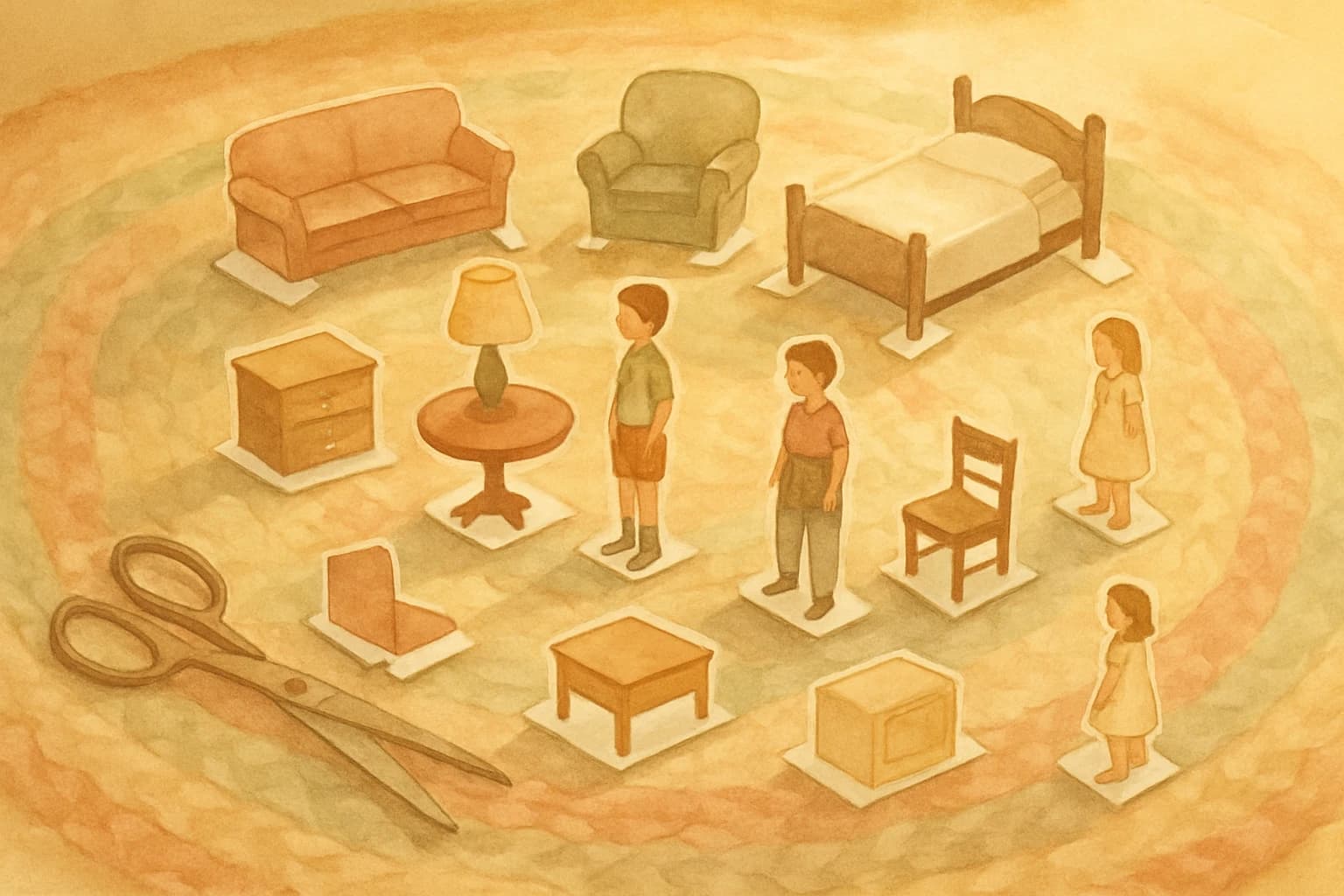
The first pages to go were the toy section, usually, and they went to the children of the house. A kid with scissors, a piece of cardboard, and three or four catalog pages could build a functional play world: paper furniture, paper families, paper vehicles. You cut out the people and bent the tabs back so they stood up. You cut out the rooms -- the catalog, helpfully, showed furniture arranged in actual rooms -- and arranged them into a floor plan on your rug.
This was not a craft project your mother set up. It was something you figured out yourself on a Thursday afternoon in November when there was nothing else to do and it was raining. The catalog provided the materials and the imagination filled the rest.
The furniture pages also went to the kids, often, because a bedroom set photographed in the catalog looked very much like a dollhouse room if you cut it right. Girls used them for exactly this. Some of the most elaborate paper dollhouses that ever existed were built on cardboard boxes from the post office with catalog pages glued to the interiors.
The clothing section went to school
Teachers, especially in the years before the photocopier was common in every school, appreciated what a catalog page could do. A clothing section had hundreds of illustrated figures -- men, women, children -- that could be used for math worksheets, for cutting practice, for identifying colors or letters or sizes. Some teachers requested that parents send old catalogs in with their children after the new one arrived. Others simply got them because parents knew they were useful.
A kindergarten teacher in a small town might receive fifteen or twenty catalogs in October, just after the fall editions went out. She stacked them in the supply closet and rationed them through the year.
The pages also showed up in home economics classes, where they were used to track prices, compare advertised claims, and practice the household math of budgeting on a real-world document. The catalog was a kind of controlled economy in miniature, and it taught arithmetic alongside advertising literacy in ways that were not deliberate but were real.
The whole book sometimes went to the outhouse
Plenty of rural households through the 1950s and into the 1960s maintained an outhouse or a cabin that was not on a septic system, and the final destination of a retired Sears catalog in these households required no explanation. This is not a polite subject but it is an accurate one. The catalog was designed to be used in this way, informally, and its paper stock accommodated it better than most alternatives. Nobody brought this up at dinner, but everyone knew.
Wrapping paper, packing material, paper for the fire
A catalog had around six hundred pages in a good year, and six hundred pages of newsprint-weight stock kept a fire going on the first cold morning of October, when the furnace hadn't been lit yet and someone needed to knock the chill out of the kitchen. You didn't burn it all at once. You folded a few pages tight, used them as kindling, and fed the rest in slowly.
It also wrapped things. Flat items going into a box for shipping, breakables padded inside a mailed package, school books that needed paper covers: the catalog gave you a continuous supply of large, flat paper that cost nothing because it had already served its primary purpose.
This instinct -- to find the second use before you admitted a thing was finished -- ran through household management in ways that have mostly disappeared. The catalog was an example of it, but not the only one. Bread bags became sandwich bags. Worn sheets became rags. Worn rags became stuffing for draft blockers at the base of the door. Nothing left the house until it had been thoroughly used up.
What shouldn't come back, and what is plainly better now
The catalog was not only a source of raw material. It was also the primary way that rural and small-town Americans accessed commercial goods for most of the twentieth century, and the access it provided was, by any honest measure, limited and slow.
You ordered in November and hoped for December. The sizes ran in standardized columns that did not account for the actual variation of human bodies. The colors in the photograph did not reliably match the colors of the item that arrived. Returns required you to fill out a form, package everything back up, and carry it to the post office yourself, and the process took weeks in each direction.
The internet has made this better in ways that are not sentimental and should not be pretended otherwise. Same-day delivery is a real improvement. The ability to see an item in a dozen colors and read a hundred reviews from people whose bodies match yours is a real improvement. The frictionless return is a real improvement.
What the catalog had that the algorithm does not is a more limited kind of selection that turned out to have some value nobody recognized until it was gone. You saw what the catalog showed you. The catalog had made choices on your behalf about what was worth including, and those choices were made by human buyers who had professional reasons to curate. You did not spend three hours comparing forty-seven similar items. You compared the three the catalog thought merited comparison.
This is not a reason to want the catalog back. It is a reason to notice that choice, past a certain volume, becomes its own kind of work.
The last catalog and what happened to it
Most families do not know when their last catalog was. There was no moment of recognition. The mailings thinned, then stopped, and nobody quite marked the occasion because by then the catalog had already been replaced by something faster. The final one went through the same cycle as the rest -- coffee table to kitchen drawer to cutting project to kindling or outhouse or recycling bin -- and then there wasn't another one, and no one said anything.
What's missing is not the catalog. The catalog's job has been done better by something else. What's missing is the household practice of understanding an object's second and third life, of not considering a thing finished just because its first purpose was complete. The catalog was useful when it was a shopping document and useful again when it was paper and useful one more time when it was fuel. The family that understood this about catalogs understood it about other things too.
A child who spent a November afternoon cutting paper furniture out of an old Sears book was not learning to shop. She was learning that materials have more in them than their original purpose, and that a thing demoted is not yet a thing discarded. It's a modest lesson, but it had a lot of repetitions.
Did your family save the old catalog for something specific? What did you use those pages for? Tell us in the comments -- we'd love to hear.
Get a new story every Sunday morning.
One email a week. No spam. Unsubscribe anytime.