14 Objects That Lived in a Bicycle Basket Before the Morning Got Away
The bicycle basket was the original go-bag.
Most kids didn't pack it the night before. You packed it in the morning, fast, while the cereal was still in the bowl, because the door was already open and somebody outside was circling the driveway on their Schwinn waiting for you. The basket wasn't organized. It wasn't meant to be. It was a wire or wicker rectangle bolted to the handlebars, and you loaded it the way you loaded a pocket -- by instinct, by habit, by whatever seemed necessary for a day whose shape you hadn't yet figured out.
What went in depended on the kid and the summer and the neighborhood. But certain things showed up everywhere, in baskets from Maine to California, year after year, because certain things were always needed when you had no plan and all day.
Here are fourteen of them.
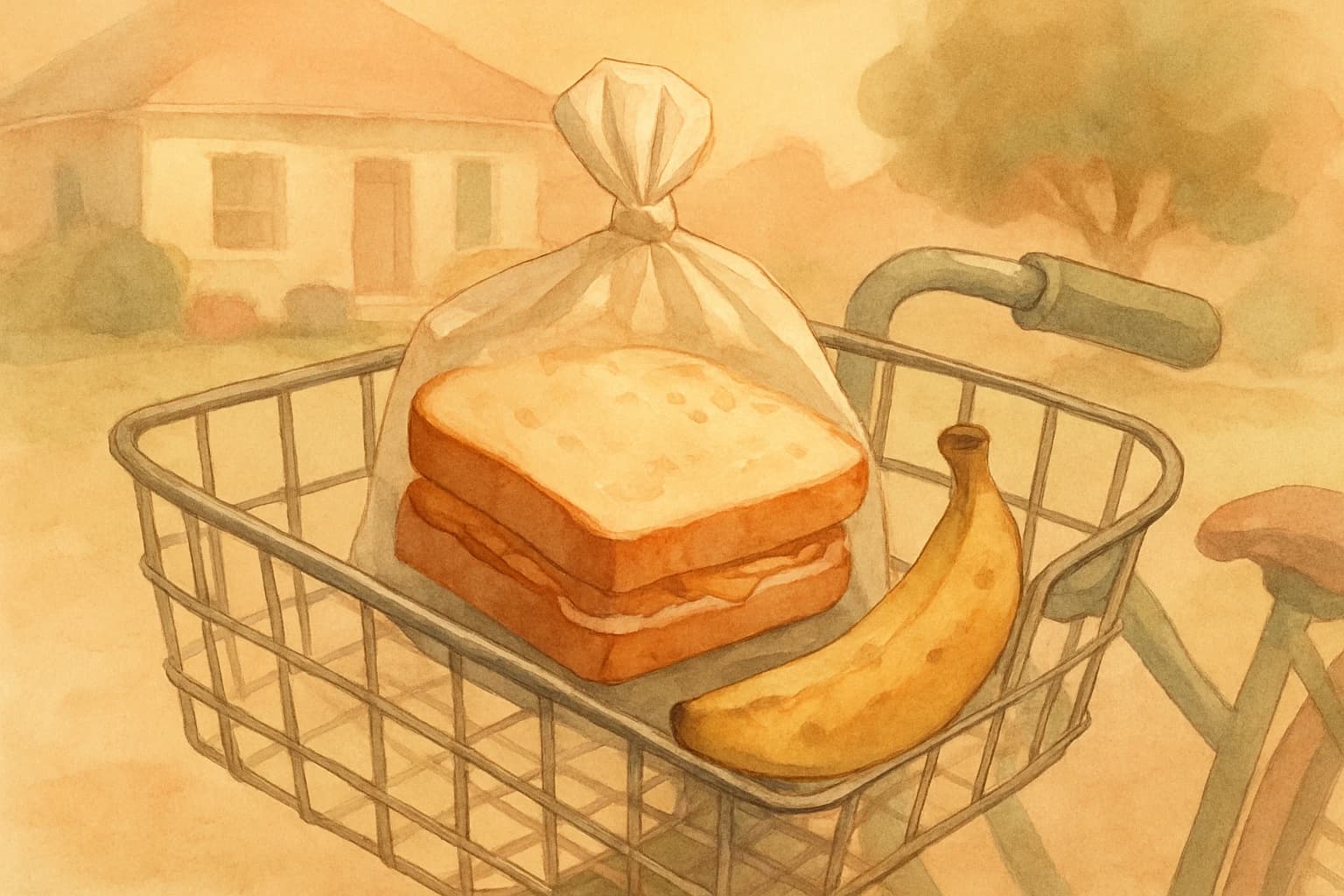
1. A peanut butter sandwich in a bread bag
Not a sandwich bag. A bread bag, twisted shut at the top or folded under the sandwich like a present. The sandwich was almost always made in under two minutes, on white bread, with whatever was in the jar -- creamy if you were lucky, the stiff end of the chunky if you weren't. It would be warm by ten o'clock and slightly flat by noon, and you would eat it anyway because there was nothing else and you were far from home.
Some kids added a banana. The banana went in separately, loose in the basket, and it was almost always bruised by the time you got where you were going.
2. A church key or bottle opener
If your family drank soda from glass bottles, which many still did in the early 1970s, you needed an opener. Kids kept one in the basket the same way their fathers kept one in a kitchen drawer -- not thinking about it, just knowing it was there when the Nehi was warm and you were sitting on a curb behind the convenience store trying to celebrate nothing in particular.
3. A library book, due on Thursday
It went in the basket because you were going to the library anyway, or because you were returning it on the way to somewhere else, or because you genuinely planned to read in the park and then ended up playing ditch all afternoon and brought it home unread. The library book in the basket was often more intention than fact. But it went in.
4. A transistor radio
Small enough to fit in a shirt pocket, but kids carried it in the basket to protect it. The station was already set. You didn't change it much once you found the one that played what you wanted. The tinny little speaker made everything sound like it was coming from the next room through a wall, and that was fine. It was better than nothing, and nothing was the alternative.
The radio had batteries that died without warning, always in the middle of something good, and you didn't have replacements. That was the whole economy of the transistor radio in a basket -- it worked until it didn't, and then you rode the rest of the way in quiet.
5. A nickel for the phone
Not a dime. A nickel, when a local call still cost a nickel. Later, a dime. The coin went in the basket as emergency infrastructure -- if you got hurt, if you got separated, if your bike threw a chain four miles from home and you needed to call somebody to come get you.
Most days it came home unspent. Some days it didn't. Either way, the nickel in the basket was the original version of the safety plan, and your mother felt better knowing it was there.
6. A stick of gum, sometimes a whole pack
Juicy Fruit or Doublemint, usually. The stick went soft by midday in the heat, which actually made it better -- easier to fold and chew. A whole pack in the basket was a form of social currency. Offering a stick was how you joined a group of kids you half-knew at the municipal pool or the vacant lot. Nobody refused gum.
7. A folded piece of paper with a route or address
Handwritten by a parent, or by you. The address of a friend's grandmother's house in a neighborhood you'd never been to. Directions to the new subdivision where somebody said there was a creek worth finding. The cross streets where the older kids met on Friday mornings in summer.
You couldn't call ahead. You couldn't look it up. The paper in the basket was your navigation, and if it blew out somewhere on Ridge Road you were figuring the rest out by memory.
8. A baseball card or two
Not the whole collection. Never the whole collection. Two or three cards, usually duplicates or ones you were willing to trade, carried in the basket for the same reason you carry change -- because there might be an opportunity and you wanted to be ready for it. A good trade could happen anywhere. Behind the dugout at the Little League field. On somebody's porch. At the end of a driveway where a kid you barely knew was also sitting around with nothing going on.
9. A pocketknife
Your father's spare, or a Christmas gift from a grandfather who assumed you were ready. Most kids were given vague instruction on what not to do with it and then left to figure out the rest. The knife went in the basket because it might be needed to cut a fishing line, whittle a point on a stick, dig something out of a tire, or open a package. It was also carried because carrying it felt like the right kind of serious. The basket was where it traveled. The pocket was where it lived once you were old enough to know how to keep it from showing.
10. A fishing hook and some line, wrapped around a stick
Not a whole pole. Kids who fished on a bike improvised. The hook and a few feet of monofilament wrapped around a trimmed stick was enough for an afternoon at a farm pond if somebody knew whose land it was on and the farmer generally looked the other way. You'd cut a pole when you got there. The bait was worms from someone's garden, dug up on the way.
This worked. Not always, not well, but well enough. The fish were small and almost always released because nobody wanted to clean them.
11. A dime-store notebook
The ones with the cardboard cover in red or blue, sometimes with a marbled pattern, 30 pages of wide-ruled paper for about 15 cents. Some kids genuinely used these -- writing down scores, keeping a log of addresses, drawing maps of territories. Others just carried the notebook because it seemed like the kind of thing a person ought to have. It got rained on eventually. The cover warped. The notes inside were usually lost before they were useful.
12. A swim towel
Rolled tight or folded into a rough square and wedged into the basket corner. If there was any reasonable chance the day ended at the pool or a creek, you brought the towel. If there was no chance at all, you sometimes brought it anyway, because you had learned that a day without a plan sometimes ended wet, and riding home soaking through your cutoffs on a bike for two miles was miserable in a specific way you only had to experience once to remember.
13. Something to trade
It might be a duplicate comic book, a marble you didn't care about, a toy out of a cereal box, a set of jacks missing two pieces. The item varied. The instinct didn't. Kids operated in a barter economy that ran parallel to the coin economy, and the basket held inventory.
14. Nothing else. The rest you found when you got there.
The basket wasn't big. That was the constraint. You made choices, fast, on a morning when the day outside was pulling you toward the door faster than you could think. You took what seemed necessary and left what didn't. Whatever you forgot, you did without.
That discipline -- choosing fast, making do, improvising when the dime was already spent and the battery was dead and the sandwich was gone -- was the whole education of a summer morning in 1972. It wasn't taught. It was just what happened when you ran out the door before anyone could tell you to slow down.
One thing that's actually better now
Kids on bikes today often have a phone in the basket or a jersey pocket. The phone is heavier than a transistor radio and more fragile, and it does eliminate the nickel-for-the-phone problem entirely. A kid who goes down with a thrown chain four miles from home can now call for pickup in thirty seconds rather than walking to a gas station and hoping someone will let them use the pay phone.
This is straightforwardly better. Pretending otherwise would be sentimental in a direction that doesn't serve anyone.
The rest of it -- the unplanned day, the wire basket, the baseball card as social currency, the towel just in case -- that part isn't better or worse now. It's mostly just gone, replaced by days that are scheduled and supervised in ways that don't leave room for a basket packed in under two minutes before the morning got away.
What did you carry in your basket? Was there something you brought every single day, no matter what? We want to hear your version in the comments.
Get a new story every Sunday morning.
One email a week. No spam. Unsubscribe anytime.