14 Things Quietly Waiting in the Attic That Prove Families Never Really Let Go
The attic is the one room in the house nobody lies to.
Every other room gets curated. The living room has the furniture you chose on purpose. The bedroom has the photographs you decided to keep. The kitchen has the gadgets you use. But the attic has what you couldn't throw away and couldn't explain, and the difference between those two categories is where a family's real history lives.
What follows is not a list of antiques or collectibles. It's a list of things that ended up in attics because the people who put them there weren't finished yet -- with the object, with the person it came from, or with the version of themselves that had needed it.
1. The Suitcase That Made Two Trips
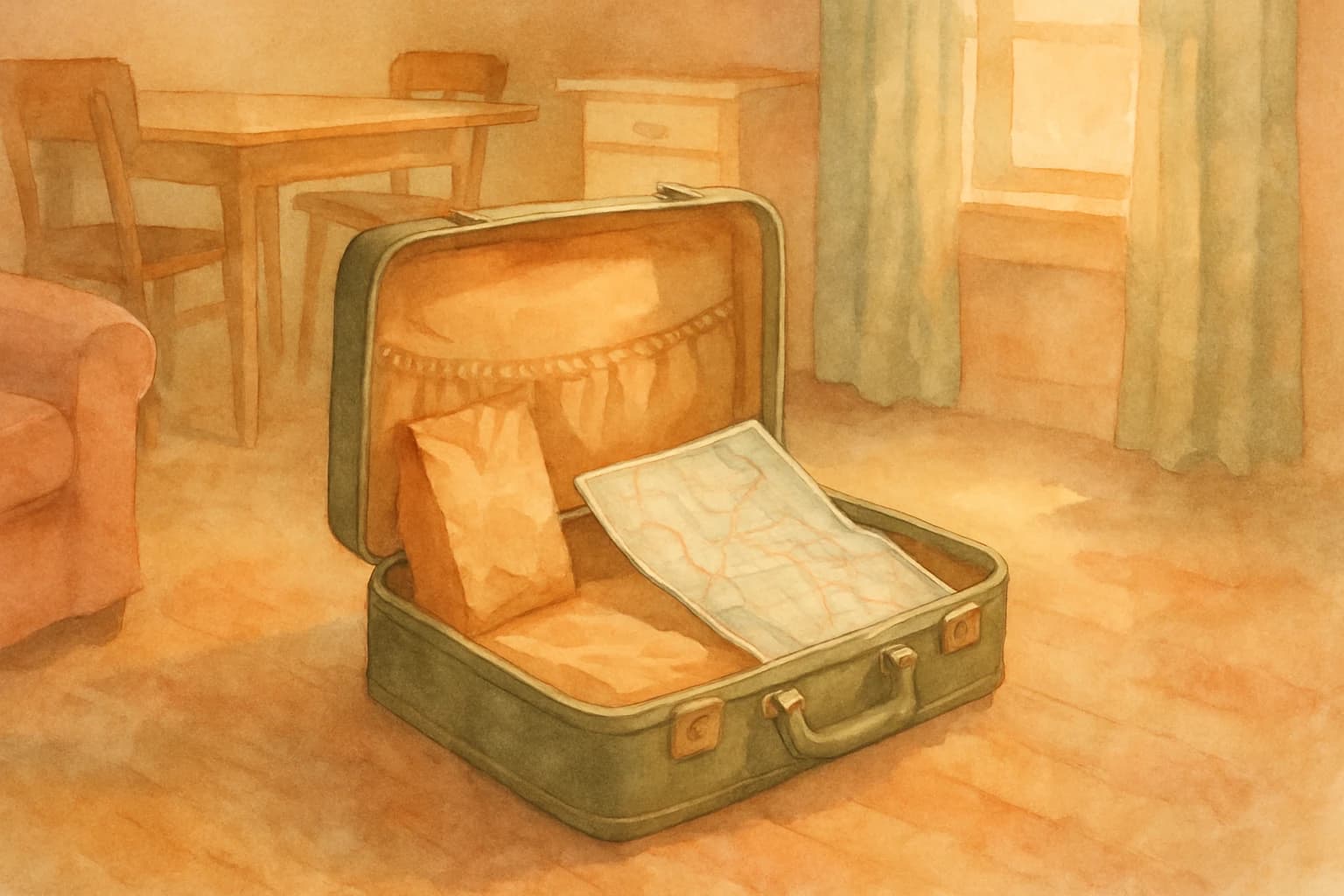
Not the rolling luggage from a decade ago. The older one, the hard-sided Samsonite in olive green or burnt orange, with the combination lock that nobody remembers. It survived because someone kept it. Not because it's useful -- airlines charge to check bags that heavy empty -- but because it went somewhere once, or came from somewhere, and the family never fully untethered from that trip.
Open one of these and you sometimes still find something inside. A hotel key. A folded tourist map of a city the traveler is not certain they'll ever see again. A paper bag from a restaurant that no longer exists.
2. The Report Cards
Rubber-banded, in a manila folder, or stuffed loose into a shoebox. Your grandmother's or your mother's or your own. The grades are not why they're saved. Nobody is keeping a C-minus in fourth-grade spelling for sentimental reasons.
What's saved is the handwriting in the teacher's comment box. Talks too much. Good imagination. Has trouble sitting still. The parent who kept these wasn't archiving academic performance. They were archiving the moment someone outside the family looked at their child and put words to what they saw.
3. The Wedding Dress in the Garment Bag
It won't fit anymore. The woman who wore it has known this for twenty years. The dress is not preserved because she plans to wear it again, and in most families, the daughter made clear she had her own preferences. The garment bag hangs anyway.
Some things are kept because throwing them away feels like a statement nobody is ready to make.
4. The Reel-to-Reel Tape Recorder
Or the 8mm film projector. Or both. Still in the original box, or in a case lined with foam that has gone brittle at the edges.
The machine itself is not the point. The point is that somewhere in the attic, near the machine, are the reels or cartridges it plays -- footage of a backyard birthday party in 1967, or a Christmas morning that everyone who was awake for it is now dead or eighty. The machine is in the attic because throwing it away would feel like destroying the evidence. Never mind that the family no longer owns anything that can display what the evidence shows.
This is one of the genuinely urgent items in any attic. The footage is degrading. It will be gone before the machine is.
5. The Collection That Got Serious and Then Stopped
Stamps, coins, baseball cards, milk glass, Depression glass, first editions. Somebody got into it somewhere around 1971, bought a few reference books, attended two shows, and assembled a collection that represented real time and real money and real enthusiasm. Then they stopped, without explanation, the way most collections stop.
The collection is in the attic because nobody can agree it's worthless and nobody can agree it's valuable. It occupies a middle category that makes decision-making impossible, so it waits.
6. The Letters, Tied with Kitchen Twine
Not ribbon. Kitchen twine, because that's what was on the counter when someone needed to bundle them. The letters in most attics are love letters, but not exclusively. Equally common: correspondence between two women friends, written over decades, describing children and moves and illnesses and ordinary days with a plainness that would embarrass both of them if they knew anyone was reading.
These are the documents that tell you who your grandmother actually was, as opposed to who she presented herself as. They are also the documents most families have no idea exist until the house is cleaned out. Finding them feels like an intrusion. Keeping them feels necessary. Destroying them feels like erasing something that has no other copy anywhere on earth.
7. The Tools from a Man Who Knew What He Was Doing
A wooden-handled draw knife. A hand drill with a brace. A set of chisels in a leather roll, each one sharpened and wrapped. These belonged to someone who understood what they were for, and that person is gone, and the person who inherited them does not entirely know what they are for, but can feel, holding them, that they were used by someone who did.
A good tool outlasts the knowledge required to use it. The attic is full of this problem.
8. The Baby Book That Runs Out of Entries Around Month Seven
The first page is filled in with care. Birth weight. Time. The name of the doctor. The first few weeks are documented: first bath, first smile. Then the entries thin. By month four, they're intermittent. By month seven, there are blank pages for the rest of the year.
This is not neglect. It's what happens when the baby becomes a child and the child requires too much attention to be simultaneously documented. Every parent who kept a baby book and trailed off recognizes this page, and most of them feel some version of guilt about it that is not warranted. The book is in the attic because it is unfinished and also irreplaceable.
9. The Bowling Ball
In its bag, the shoes rolled inside it to save space. This was someone's thing for a while. They were in a league. They had a handicap they tracked. They bowled with the same people every Tuesday for years, and then the league dissolved or they moved or they had a knee done, and the ball went to the attic.
The bowling ball is one of the few items in the attic with no sentimental ambiguity. It is just extremely heavy and impossible to throw away without feeling absurd.
10. The Flag, Folded into a Triangle
Presented at a graveside by someone in uniform, white-gloved, with the precise folds the ceremony requires. It's been in the attic not because it's forgotten but because nobody can agree on where it belongs in the living space of the house. Too significant for a shelf. Too present for a closet. The attic is the temporary arrangement that became permanent.
Families keep these for decades in their triangular cases, moving them from house to house, attic to attic, without being able to name exactly what they're waiting for.
11. The Box of Christmas Ornaments Nobody Uses Anymore
The family has a newer tree with a color scheme now, or the grandchildren have their own trees, or the ornaments are simply too old and fragile to risk. But they are not thrown away, because each one was purchased for a particular year, or made by a particular child, or survived from a time when the family had less money and the ornaments were handled carefully.
The aluminum icicles are still in the original box. The hook is still bent on the glass ball with the faded silver leaf. Nothing about this box is valuable in any commercial sense, and everything about it is impossible to let go of.
12. The Unfinished Project
The half-refinished chair. The quilt that is five blocks short of done. The model train layout on a piece of plywood, tracks down but no terrain, the locomotive still in its box. These represent a version of the person who started them that the person never quite became.
Keeping an unfinished project in the attic is a way of not deciding. Not deciding that you'll never finish it, but also not deciding that you will. The attic is patient with this.
13. The Yearbook from the School That Closed
The building is a condo now, or a community center, or a parking lot. The school is gone in the way institutions go -- not burned, not bombed, just gradually discontinued. The yearbook is the only evidence that a particular group of people occupied a particular building for a particular year, and that something happened there that was worth recording.
It's signed on the inside back cover by people the owner has not spoken to in forty years. Some of them are gone. The owner does not always know which ones.
14. The Child's Artwork, Rolled in a Cardboard Tube
The good stuff was hung on the refrigerator at the time. The rest went in a tube, which went in the attic. There are dozens of drawings in there: horses from a phase that lasted two years, abstract crayon pieces that might be landscapes or might be nothing, a careful pencil portrait of the family dog that is actually quite good and that the child who drew it has no memory of making.
The parent who saved these was saving evidence. Proof that the person who now lives across the country and has their own children was once small enough to need a step stool to reach the kitchen counter, and spent a Saturday afternoon in January drawing a dog.
What Belongs in the Attic and What Doesn't
There are things in attics that deserve to come down and be dealt with. The degrading film reels belong with a preservation service, now, before another decade passes. The letters belong with someone who can read them and understand what they're reading. The flag deserves a frame and a wall.
The attic as permanent storage is not always the respectful choice. Some of what waits up there is waiting to be rescued, not waiting to be kept in the dark.
But the attic as a concept -- as a place where families hold the things they're not finished with -- is not a failure of decisiveness. It's an honest acknowledgment that the past isn't done being processed. That the bowling ball and the report cards and the folded flag are still doing something for the people who kept them, even if what they're doing can't easily be named.
Most families will clean out the attic eventually, when they have to. Until then, the things up there are doing their quiet work.
What's in your attic that you can't bring yourself to part with? Is there something up there you've been meaning to deal with for years? Share your memory in the comments below.
Get a new story every Sunday morning.
One email a week. No spam. Unsubscribe anytime.
If this brought back a memory, you might also like
11 Unpacked Things That Lived in the Family Car Back Seat
A half-finished coloring book records the boredom of long trips, while a single dime waits under the floor mat, lost and found by turns.