11 Unpacked Things That Lived in the Family Car Back Seat
The back seat of the American family car was not a storage space. Nobody put it there. Nobody planned it. But by the time the car was two years old, the back seat had developed a complete ecosystem of its own, as specific to the family as a fingerprint.
This is a list of what accumulated there, across roughly thirty years of American car culture, starting in the late fifties and running through the mid-eighties. Not the things people packed. The things that just arrived.
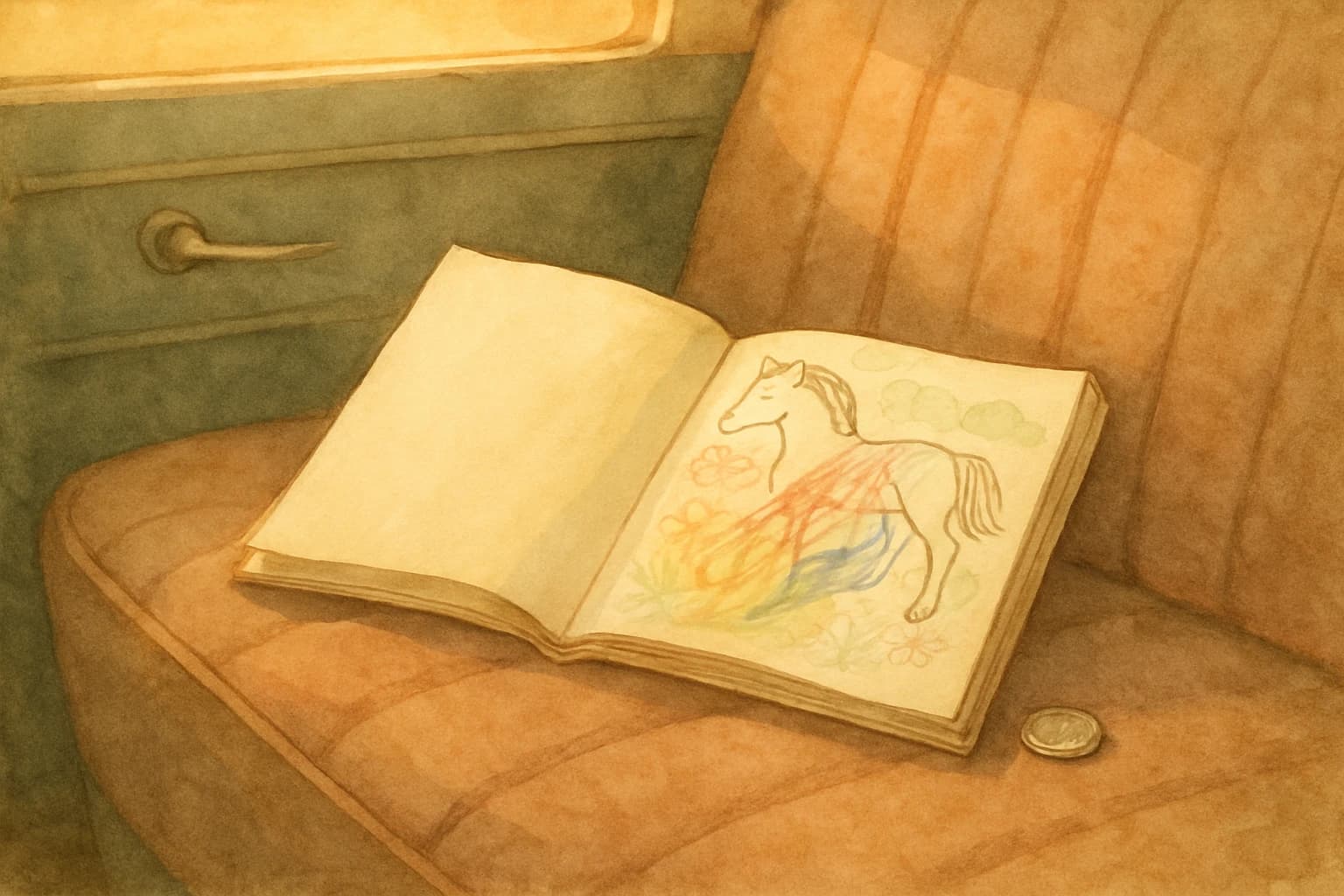
1. A Coloring Book, Half-Finished
Not brought deliberately on any particular trip. It materialized over a period of months, migrating from the house to the car and back to the car, accumulating crayon wax along its spine. The pages in the front half were colored with some care. The pages in the middle were colored fast, outside the lines, with whatever crayon was nearby. The pages in the back were blank, and they'd stay that way.
The coloring book in the back seat was a specific kind of artifact -- a record of how bored the kids were and how long the trip was on the day each page got colored. You could read it like a log.
2. A Dime Under the Floor Mat
Not two dimes. Not a quarter. One dime, specifically, because dimes roll differently than quarters and end up under mats rather than in seat crevices. Found during the biannual car cleaning, usually by a child who immediately tried to keep it, and usually lost that argument.
3. A Library Book
The library book had a due date. The due date had passed. The book was now generating a fine of two cents per day somewhere around week three. Nobody had noticed because it was in the car.
When it finally surfaced, during a search for something else, the question of how it got there was never satisfyingly answered. The kids said they didn't put it there. The parents didn't put it there. It was there. The fine was paid and nobody talked about it again.
4. A Wrapped Hard Candy, Slightly Lint-Covered
From a bank or a doctor's office or a restaurant front desk. Stuffed in a pocket after the visit, migrated to the back seat over successive trips. Still wrapped. Still technically edible. Consumed without ceremony when the trip was long enough and the hunger was real enough. Nobody remembered the candy being there until they needed it, and then there it was, exactly once.
5. A Gas Station Map, Wrong State
The glove box was full. The overflow went to the back seat. A Texaco map of Missouri in the back seat of a car that only drove through the Mid-Atlantic states, because your father had gotten turned around once in 1971 and grabbed whatever was at the counter and never threw it away.
The maps were folded wrong, re-folded badly, folded again. A gas station map that had been refolded four times no longer opened correctly. It accordioned. You had to hold it in the air and squint.
Nobody navigated with the back-seat map. It was there for the same reason most things in the back seat were there: inertia.
6. A Single Sneaker
The partner to this sneaker was not in the car. It was at home, or at school, or simply gone. The single sneaker in the back seat had been there long enough that it no longer provoked urgent questions. At some point the family had accepted that this was a one-sneaker situation and moved on.
Sneakers came off in the back seat because kids took their shoes off in the car, always, starting approximately ninety seconds after departure. The single sneaker in the back seat is the archaeological record of this habit.
7. A Sucker Stick
Not the sucker. The stick. The paper stick, slightly chewed at the tip, left in the cup holder or on the seat or on the floor, depending on the age of the child. The sucker itself had been consumed. The stick had survived because it was too small to notice until you found it in your hand after grabbing something else.
It joined other small artifacts of completed consumption: the popsicle stick, the straw, the gum wrapper folded into a tight rectangle by a bored nine-year-old on the interstate.
8. A Lone Crayola, Wrapper Peeling
Not a full box. One crayon, separated from its family by unknown events, rolling around loose on the floor mat. Usually a mid-spectrum color -- burnt sienna or cornflower blue or raw umber -- never the primaries, which were used first and used completely.
In summer, the crayon melted slightly against the rear window shelf or the floor mat, leaving a ghost of pigment. The car, on a hot August day, smelled faintly of warm wax, and this is one of the smells some people carry for sixty years without being able to name where it came from.
9. A Church Bulletin
Sunday morning, the whole family in good clothes, the bulletin tucked into the back of a pew, taken out and brought to the car and left on the back seat when everything moved on to lunch or to the rest of Sunday afternoon. The bulletin listed names: the sick, the recently passed, the missionaries. It listed announcements for Wednesday night and next Sunday and the covered dish supper in the fellowship hall.
By Thursday it was still there. By the following Sunday there were two.
10. A McDonald's Bag, Empty
Not a messy one. Not a bag with debris. An empty bag, folded more or less flat, left behind after the meal because the nearest trash was the gas station and the gas station was already behind them.
The empty bag sat on the back seat floor or the rear deck and contributed nothing. The family had driven through because they were somewhere between here and there, and the bag was the physical remainder of the stop. It had no smell after a day. It had no weight. It was a rectangular ghost of a meal that had already been forgotten.
11. A Paperback Somebody Started and Left
Dog-eared at a chapter that never got finished. A western, sometimes. A grocery-store thriller. One of the Reader's Digest condensed books, which were not technically paperbacks but behaved like them in back seats. Whoever had started it had gotten interested and then gotten distracted and then put it face-down and then it had slid under the seat and then been retrieved and placed on the back seat where it lived for the rest of the summer.
The back-seat paperback was a family artifact in its own right. Sometimes the kids read it. Sometimes the adults read it on a subsequent trip. Sometimes it made it back into the house and onto a shelf. Mostly it didn't.
What doesn't belong on this list, and what's actually better now
Car seats with proper harness systems. Those belong on the list of things that were missing, not present. Kids bounced around the back seat in the 1960s and 1970s with nothing holding them. Some sat in the rear window well. Some sat in the front seat. Infants rode in their mothers' arms on the highway at seventy miles an hour.
The back-seat ecosystem of accumulated junk was possible partly because the back seat was an undifferentiated space with no particular structure. That structure has improved in ways that matter. Tether anchors, LATCH systems, head restraints, side-impact protection -- these are not nostalgia items. They are advances. The loose, wandering, artifact-accumulating back seat was also a loosely supervised, inadequately restrained space for children, and nobody should want that part back.
What you can want back is the texture of a long family car trip in the days before screens, when the only entertainment was the window, the road game, and whatever had accumulated back there over the previous months. The sucker stick and the melted crayon and the peeling library book were the props of a particular kind of boredom, and that boredom produced things -- conversations, observations, games invented on the spot -- that didn't need an app.
What was in the back seat of your family's car? Is there something on this list you'd forgotten until just now? We want to hear your version in the comments.
Get a new story every Sunday morning.
One email a week. No spam. Unsubscribe anytime.