9 Smells That Filled the American Classroom Before the First Bell
You were in the building before the bell, and the school had its own weather.
Not the weather outside, where the September air was still warm and the October air had that first edge to it. The weather inside. The classroom held the night's worth of closed windows and radiator heat and chalk dust and whatever forty children had tracked in over the course of a week, and it hit you the moment you came through the main doors. Some mornings you could tell what kind of day it was going to be from the air alone, before a teacher had said a word.
The smells of the American classroom before the school day started were not glamorous. They were not designed. They accumulated. Here are nine of them.
1. Chalk dust
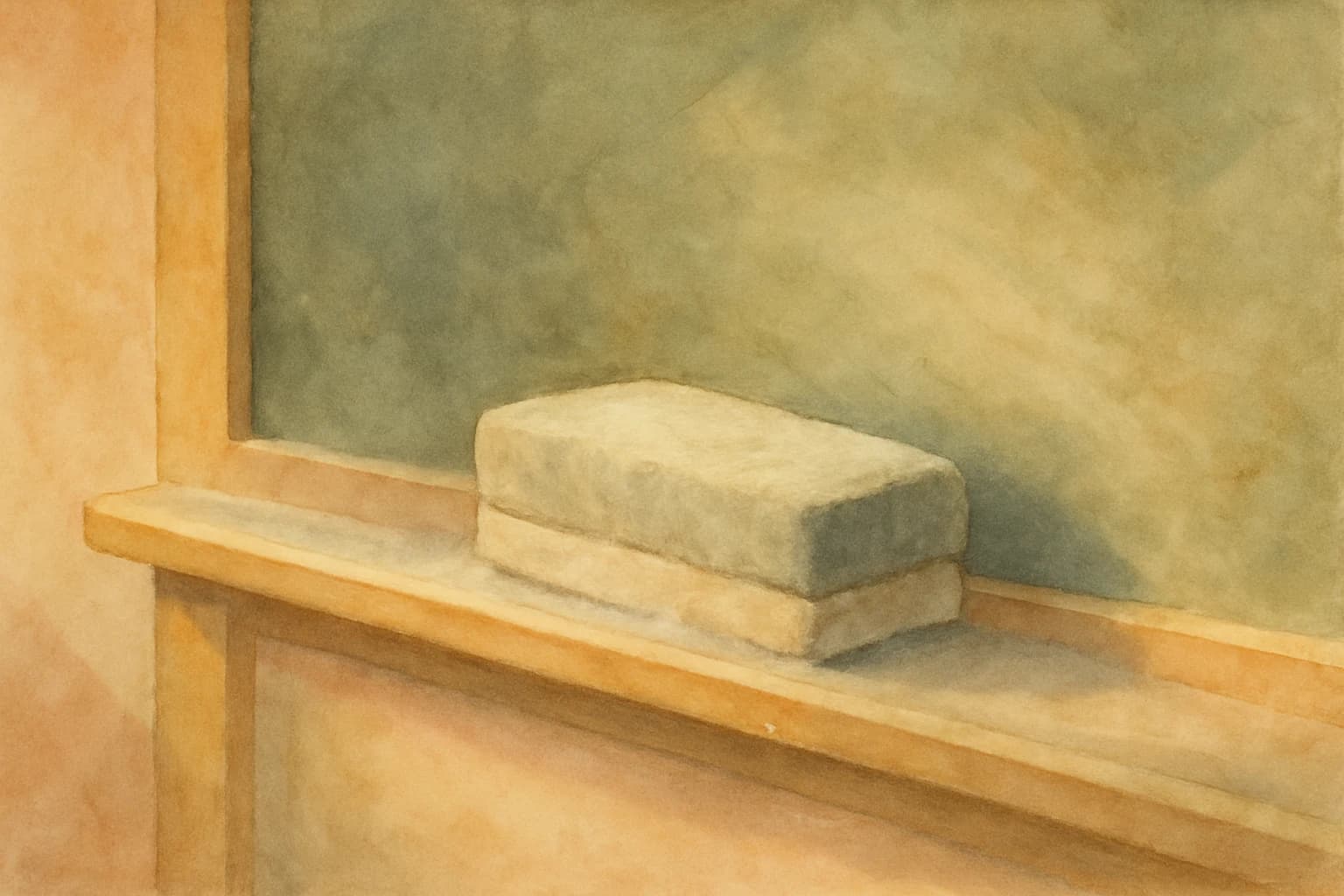
The chalkboard had been there since before your teacher was born, and the dust from it had settled into the chalk tray and into the eraser felt and into the air of the room at a level too low to see but constant enough that you breathed it every day for twelve years. First thing in the morning, before the windows were cranked open or the radiator had done its work, the chalk smell was cleanest. It was dry and mineral and faintly white, if a smell can be a color.
Teachers banged the erasers against the outside brick wall at the end of the day. You could see the pale clouds from across the street. But the chalk never fully left. It lived in the room the way old wood lives in a house -- as a permanent presence underneath everything else.
2. The radiator, dry and hot
Cast iron, bolted to the wall under the windows, painted over so many times that the surface had rounded edges where the paint had built up for decades. When the heat came on in October, the radiator burned off whatever had accumulated on it over the summer, and the smell was hard to name. Metallic. Faintly dusty. Vaguely animal, sometimes, if something had died behind the wall near the pipes.
By November you had stopped noticing it. By February it was the smell of being warm.
3. Wet wool
The coat hooks were in the cloakroom or along the back wall, and on rainy mornings or snowy ones, every coat was wet. Wool held water longer than anything. It dried slowly in the radiator heat, steaming quietly, filling the room with that particular smell that is not unpleasant exactly but is insistently present.
Add rubber boots, which stood in pairs below the coats and smelled of themselves, and wet mittens laid flat on the radiator to dry, and the back half of a classroom on a November morning had its own climate.
4. Mimeograph fluid
The teacher came in carrying a stack of worksheets, and if she had been to the mimeograph machine that morning, the copies were still damp. She put them on your desk face-down, and when you flipped the sheet over, the purple ink hadn't entirely dried and the chemical smell came up sharp and sweet, somewhere between rubbing alcohol and something you couldn't name.
Every child in America held that warm paper close to their face at some point. Nobody told you to. Nobody told you not to. The smell had a pull to it that was almost involuntary.
The mimeograph machine itself -- a hand-cranked drum that pressed the master against each sheet -- is gone now, replaced by photocopiers that produce odorless copies. The photocopies are sharper, more legible, and completely without that particular morning signal. You don't miss the machine. You miss the smell in the way you miss anything that disappeared before you knew to pay attention to it.
5. Pencil shavings
The pencil sharpener was mounted on the wall near the door, a cylinder of metal and gears, and you could hear it from across the room when someone turned the handle. The shavings collected in a clear plastic reservoir at the bottom, spiraling strips of cedar and graphite that were the exact smell of the beginning of the school year.
A new pencil through a fresh sharpener gave you cedar. An old pencil gave you something more muted, more eraser-adjacent. By October the reservoir needed emptying and the smell had concentrated into something richer and darker. The teacher emptied it into the trash can by the door, which temporarily became the loudest-smelling object in the room.
6. Someone's lunch
The lunch boxes were at the back of the room or inside desks, and even closed, certain lunches announced themselves. A hard-boiled egg was impossible to contain. Tuna on white bread in wax paper. Bologna warmed to room temperature by eight in the morning. Peanut butter, which was gentler, sweeter, and essentially harmless to everyone.
The school cafeteria smell is a separate subject. This is specifically the before-the-bell smell of lunches sitting quietly in metal boxes, leaking into the room, being judged.
7. Floor wax and whatever came in on your shoes
The floors were linoleum or hardwood, depending on when the building had been built, and the custodian waxed them over the weekend so Monday mornings had the cleanest floors and the sharpest wax smell of the week. The wax smelled institutional in a way that is hard to describe: flat, chemical, cold. It existed in the same family of smells as hospitals and public swimming pools, but not quite either one.
By Friday, the wax smell was mostly gone, replaced by everything the week had tracked in. Playground dirt. Fall leaves crushed to dust. The particular mud that lived outside the side door where kids came in from recess.
8. The paste jar
A wide-mouth jar, usually half-open, usually with a wooden applicator stick protruding from the lid. Elmer's glue came later, and the squeeze bottle later still. Before those, there was paste, which was white and thick and smelled faintly sweet in a way that was clearly not food but suggested food.
Children ate it. Not secretly. Openly, at the table, with the same face they made at lunch. The teacher noticed and said something general to the class without singling anyone out, and then the children ate less paste while she was watching and about the same amount when she turned back to the board.
9. The room itself, after the summer
September was different from every other month because the room had been sealed since June. The windows had been locked, the shades pulled, and whatever had been left behind -- the maps rolled up on their hooks, the encyclopedias on the shelf, the smell of the wooden desks themselves -- had been sitting together for two and a half months.
The first day of school had a specific smell underneath the chalk and the new notebooks and the pencils. It was old wood and closed air and paper that had been sitting in place long enough to become part of the room. It smelled like the past in a way that only old buildings manage, which is to say it smelled like nothing you could buy or replicate, only like time and a particular kind of institution that used to define the American fall.
What shouldn't come back
The chalk dust was a minor respiratory event that lasted twelve years per child, and some children were allergic to it in ways that nobody was tracking very carefully. The paste was not food. The mimeograph fluid was a solvent being huffed by entire classrooms of ten-year-olds, voluntarily, because it smelled good. The wet wool and inadequate ventilation in old buildings were, in retrospect, suboptimal for learning.
The schools that replaced those rooms are, in their physical operation, significantly better. The HVAC works. The air circulates. The classrooms don't smell like themselves. This is progress.
But progress, here as elsewhere, removed something without quite replacing it. The new classroom is clean. The old classroom had a presence. Those are not the same thing, and the generation that spent its school years in the rooms with the chalk trays and the cast-iron radiators and the paste jars is not wrong to remember the difference.
What do you remember about the smell of your classroom before the day started? Was there a smell that hit you the moment you walked into the building? We'd love to hear about yours in the comments.
Get a new story every Sunday morning.
One email a week. No spam. Unsubscribe anytime.
If this brought back a memory, you might also like
The August Aisle Where Summer Turned in Your Chest
The sharp chemical note of fresh erasers and the flat wood smell of unsharpened pencils told you summer was over before you even reached the checkout.