12 Friday Night Suppers That Emerged From the Bottom of the Refrigerator
Friday supper had no agenda.
Monday was meatloaf because Monday was meatloaf. Wednesday was something from the slow cooker. Sunday was whatever the roast had been, reassembled. But Friday was different. Friday was the end of the week and the bottom of the refrigerator and whatever your mother felt like doing, which often meant she didn't feel like doing much. The result was a category of meal that existed nowhere in any cookbook: the Friday night supper that nobody planned and everybody ate.
These were not bad meals. Some of them were better than the planned ones, because they were assembled with a kind of improvisation that couldn't be faked. Here are twelve of them.
1. Soup from what was left
Not a recipe. A reckoning. Whatever vegetables had gone soft, whatever broth was in a can in the back of the cabinet, whatever the week had left behind -- it all went into the pot around five o'clock, and by six it was soup. Some weeks it was good. Some weeks it was just hot and filling.
The bread alongside it was whatever bread was in the house, toasted if it was going stale, plain if it wasn't.
2. Grilled cheese and tomato soup from a can
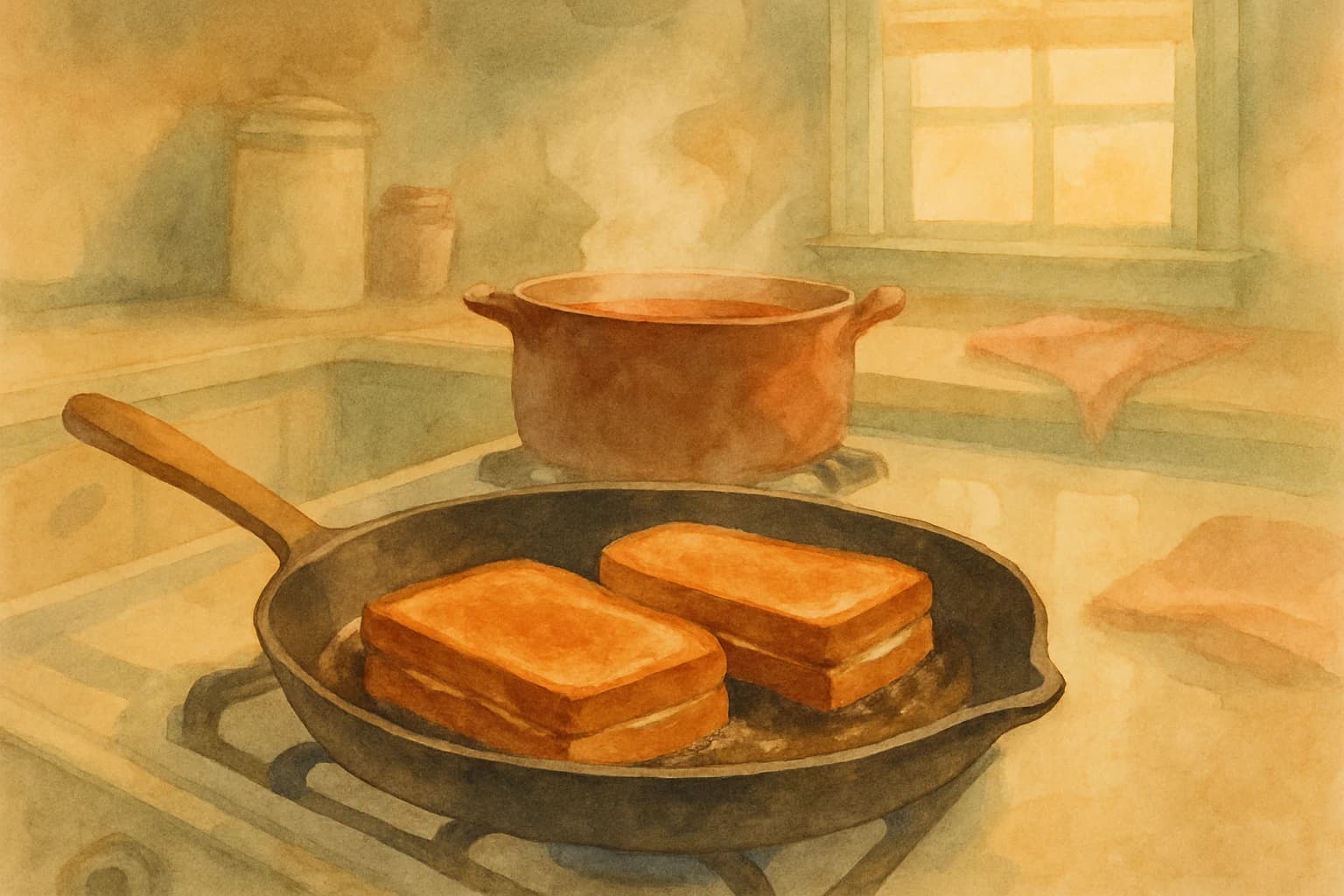
The soup was Campbell's, opened with the church-key opener that lived in the drawer, thinned with one can of milk, stirred on the back burner while the sandwiches cooked in butter in the iron skillet on the front. Two slices of white bread, two slices of American cheese, pressed down with the spatula until the cheese melted completely.
It appeared on Friday with the regularity of a scheduled meal, despite nobody ever scheduling it. The children did not complain. They dunked the sandwich in the soup without asking permission.
3. Breakfast for dinner
Scrambled eggs, bacon, toast. Sometimes pancakes instead of toast. Sometimes both. The rationale was unstated but understood: eggs were cheap, fast, and everyone would eat them. Nobody needed to negotiate.
The word for this meal -- "breakfast for dinner" -- came later, when restaurants put it on menus and called it "brinner" and charged twelve dollars for it. In 1971 it was just supper, and it meant your mother was tired and efficient, which were often the same thing.
4. Hot dogs in the pan
Not grilled. Fried in a dry skillet until the sides blistered. Buns from the bread bag, mustard from the yellow plastic squeeze bottle, chips from the bag that was already open. Done in eight minutes.
Your father made this one when your mother was out. He made it the same way every time. He called it cooking.
5. Tuna noodle casserole from the pantry shelf
A can of tuna, a can of cream of mushroom soup, egg noodles, maybe some frozen peas if the bag wasn't empty, topped with crushed crackers and baked until it bubbled at the edges. The whole dish cost almost nothing and fed the whole table.
This was the meal that appeared when payday was still two days away and the refrigerator was mostly air. It appeared in households across every income level, because every income level had weeks where the timing didn't work out. Nobody said anything about that. You just ate the casserole.
It was also, genuinely, a good meal. The crackers on top softened at the center and stayed crisp at the edges and tasted like something specific that nothing in a restaurant has ever replicated.
6. Spaghetti with jar sauce
By the early 1970s, Ragu was on shelves in most grocery stores, and on Friday nights it was on a lot of stoves. Boil the pasta, heat the jar sauce in a separate pan, grate Parmesan from the green cylinder, put the bread on the table. Forty minutes, start to finish.
The jar sauce had its critics, mostly in other rooms of other houses. In this house, on this Friday, nobody was a critic.
7. Leftovers assembled into something else
The roast chicken from Tuesday became chicken salad on Friday. The rice from Wednesday became fried rice with an egg cracked into it. The mashed potatoes from Sunday were fried in a pan with butter until the outside crisped. Nothing was wasted. Everything became a different thing.
This was a skill with a name once -- "made-over dishes" -- that home economics textbooks taught formally and grandmothers practiced automatically. It is now being rediscovered by food blogs that call it "repurposing leftovers" and treat it as a revelation.
8. Beans and cornbread
In households from the mid-South and inland South especially, a pot of pinto beans cooked most of the day and cornbread came out of a cast-iron skillet an hour before dinner. That was the meal. Sometimes with a sliced onion on the side, or green onions from the garden, or a jar of homemade chow-chow on the table.
This was peasant food, which is to say it was the food that sustained people through generations of not having much. It appeared on Friday in the 1960s and 1970s in the same houses where it had appeared on Friday in the 1930s, because it worked then and it still worked.
9. Fried potatoes and onions with eggs
A skillet meal: sliced potatoes fried until brown at the edges, onions cooked in with them, eggs scrambled in at the end or fried alongside. Salt and pepper. On the table in thirty minutes.
This required three things: potatoes, onions, eggs. The three things were almost always in the house. This is why the meal existed.
10. Fish sticks from the freezer
Mrs. Paul's or the store brand, baked on a cookie sheet, with tartar sauce from the jar and a vegetable that had been opened from a can. Green beans. Or corn. Or peas, gray from the can and seasoned with butter and salt.
The fish sticks were done when the corners were brown and the coating was crisp. The children ate them without incident. This was the correct metric for a Friday supper.
11. Peanut butter sandwiches and chicken noodle soup
Not because anything was wrong. Because it was Friday and your mother wanted five minutes of peace and peanut butter sandwiches and Campbell's chicken noodle were the meal that required her to make the fewest decisions. Cut the sandwiches diagonally. Pour the soup in the bowls. Done.
The children were fine. The children were always fine.
12. Whatever the neighbor brought over
This doesn't fit neatly in the list, but it belongs here. Friday evenings sometimes produced a knock at the back door and a neighbor with a plate or a pot, returning a dish, dropping off something extra from their own cooking. You did not say no. You put it on the table.
The exchanged-meal system ran quietly through American neighborhoods for a long time. It required knowing your neighbors well enough to know they wouldn't take offense if you returned the plate without washing it that night. It required proximity, and schedule overlap, and enough reciprocal trust that food could move between households without accounting for it. That system has thinned in most places. The back-door-neighbor knock is not common anymore, and the meals that arrived through it are gone with it.
A word about what isn't worth saving
Some of these Friday suppers were fine and should stay in memory. Others were the product of real scarcity, and the scarcity isn't worth glorifying. Tuna noodle casserole from an almost-empty pantry was adequate and filling; it was not something a family should have to build a Friday around because money was short. Beans and cornbread sustained people through circumstances that were genuinely hard.
The meals themselves can be cooked with pleasure now. The conditions that made them necessary -- the paycheck that didn't stretch, the pantry that ran out before the week did -- are not conditions anyone should want to restore. There is a difference between cooking pinto beans because you love them and cooking pinto beans because there is nothing else.
The best thing about a lot of these Friday suppers was not what was in the pot. It was that the week was over and the family was at the table and everyone knew it without saying it. That part required no recipe and cost nothing and is still available to anyone who wants it.
Did your family have a regular Friday-night supper that just appeared? What's the one your mother made when she was tired but still fed everyone? Let us know in the comments -- we read them all.
Get a new story every Sunday morning.
One email a week. No spam. Unsubscribe anytime.
If this brought back a memory, you might also like
10 Ways a Screen Door Spoke Without a Single Word
Your mother knew a child was rushing without looking up, hearing the spring bounce twice as it hit the frame.