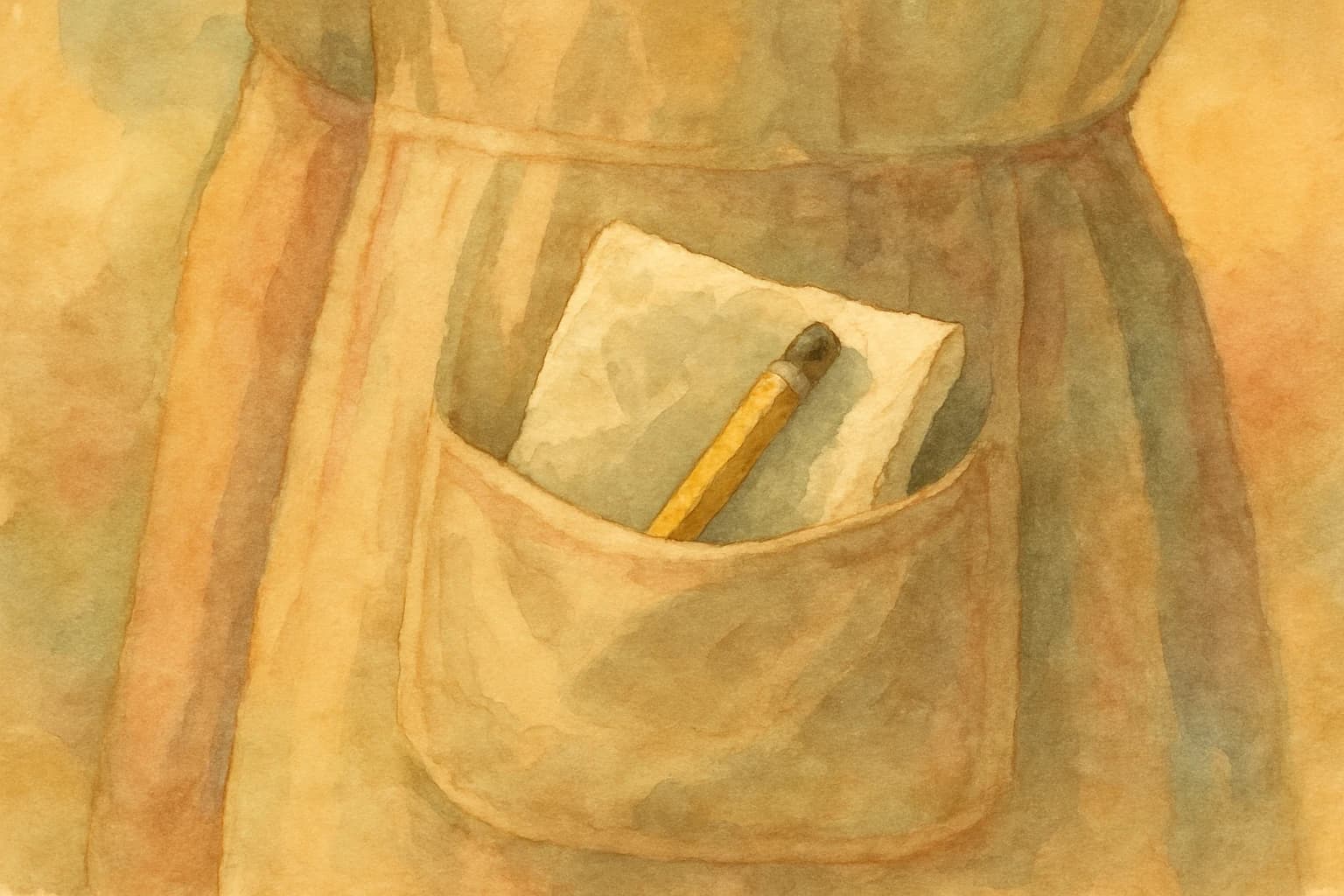
12 Objects That Filled an American Mother's Apron Pocket
The apron was the uniform, and the pockets were the office.
Every American mother of a certain era wore one in the kitchen, and most wore one for the better part of the day. Not just for cooking. For doing the hundred things that fell to the woman of the house between breakfast and supper. The apron pockets held the tools of that work, and the tools said something about what the work actually was.
Here are twelve things you'd have found in those pockets, given the chance.
1. A Folded Paper Towel
Not a fresh one. A used one, folded into quarters and tucked away because it still had something left in it. She had wiped a counter with it, or dried her hands, and it was clean enough to use again. This was the Depression-era calculus that never quite left the generation that grew up in it: the paper towel wasn't finished, so neither was she.
2. A Stubby Pencil
Yellow, or sometimes one of those flat carpenter's pencils if your father's tools had migrated into the kitchen. The eraser was gone or compressed to a hard, useless nub. She used it for the grocery list, for writing a phone number on the back of an envelope, for crossing items off something.
There was almost never a full-length pencil in the apron pocket. Full-length pencils lived in drawers. The pocket pencil was the one that had been there long enough to get used down to its current state, which she had never gotten around to replacing because the stub still worked.
3. The Grocery List
Written on whatever was nearby when the thought occurred to her. The back of an opened envelope. A notepad from the drawer. Sometimes the margin of the newspaper circular from the store. The list was a working document, revised across multiple days, with items added in different handwriting pressures depending on how certain she was about them.
She kept it in her pocket because the pocket was the most reliable place in the house. Not on the counter, where it could get wet. Not on the table, where someone might move it. In the pocket, she knew where it was.
4. A Safety Pin
Or two. One large, one small. They lived in the pocket the way a pocketknife lives in a man's pants -- not for any particular task but for the task that always came up. A hem that had let go. A child's collar that had lost its button. A bag that needed to stay closed until she got around to fixing it properly.
The safety pin in the apron pocket was the first responder of household repair. It held things together until something better could be arranged, and the something better often never happened, because the safety pin worked fine and there were other things to do.
5. Loose Change
Not organized. Not counted. Coins that had arrived from somewhere -- change from the store, the bottom of a purse, coins left on the counter by her husband -- and been pocketed without ceremony.
The change had various possible futures. It might go into the jar on the counter. It might fund a child's school lunch or a candy bar. It might just accumulate in the pocket until she found it during laundry. A certain number of quarters and dimes went through the wash this way and survived fine.
6. A Potholder
The thin kind, not the thick mitts. Folded once and tucked into the pocket for quick use. She could pull it out and grab a hot handle faster than she could reach for a mitt hung by the stove. The potholder in the pocket was about efficiency, the particular efficiency of someone who was managing four things on the stove and didn't have a spare hand to reach anywhere.
It came out of the pocket dark around the edges from months of use, stiff in one corner where it had touched something it shouldn't have. It was never replaced until it started to scorch.
7. A Twist Tie or a Rubber Band
From the bread bag. From the vegetable bundle at the store. From wherever twist ties come from, which is everywhere, once you start noticing them.
She kept it because it would be needed. For the bread bag if it got opened before supper. For the celery in the refrigerator. For the cord on something that kept slipping. The twist tie and the rubber band were the duct tape of the apron pocket economy.
8. A Recipe Clipped From the Newspaper or a Magazine
Folded in half, folded again, soft at the creases from being in and out of the pocket across several days while she decided whether to make it. The clipping was from the food section of the Wednesday paper, or from the back of a magazine, or from a church newsletter that printed recipes in a column next to the meeting announcements.
She might make the recipe. She might not. It might end up in the recipe box, or in the folder of clippings she kept in the kitchen drawer, or it might eventually be lost and the recipe never made. The clipping in the pocket was an aspiration, still in its evaluation period.
9. A Handkerchief
Not a tissue. A handkerchief, cotton, ironed flat, that had been in the pocket since morning. She used it for her own purposes. She also used it, without much hesitation, to wipe the face of a child who needed it.
The mother who produced a handkerchief from her apron pocket and applied it to your face without asking for your opinion about this was performing an act of maternal authority that was universal to the era and has largely been retired. Whether it should come back is discussed below.
10. A Pen From a Business
From the insurance man's office. From the hardware store. From the bank, where pens were available on the counter and were understood by everyone to be a communal resource. The pen in the apron pocket had not been purchased. It had been accumulated.
She had three or four of these, in various states of function, distributed around the house. The one in the apron was usually the most reliable, because she'd tested it recently and the others hadn't proven themselves lately.
11. A Note From One of the Kids
A permission slip not yet signed. A note a child had handed her from school that morning, which she had pocketed to deal with later. Sometimes an actual note, handwritten -- a child's version of communication, crayon or pencil on lined paper, spelling approximate.
The note lived in the pocket until she dealt with it. The permission slip usually got signed before supper. The child's handwritten note sometimes stayed in the pocket a lot longer, folded and refolded, moved from apron to apron, until it ended up in the box on the closet shelf where she kept the things she wasn't ready to throw away.
12. A Spare Button
Matched to nothing anyone could identify. It had come from somewhere -- a shirt, a blouse, a coat -- and been kept because it looked potentially useful. It had been in the pocket long enough that she no longer remembered its origin.
The button drawer or button jar was the more formal home for these, but the pocket caught the overflow. When a button actually came off something and the button jar produced no match, there was always a chance the pocket would. Sometimes it did.
What Shouldn't Come Back
The handkerchief applied to your face without consent, primarily. The era of the apron pocket ran on the assumption that a child's face was her jurisdiction, and that jurisdiction was exercised with a dampened cloth at a moment's notice. The child had no standing to object. This is one of those things remembered with mixed feelings by everyone it happened to, which is everyone who grew up in that era, and the mixed feelings are reasonable.
The broader context is worth naming. The apron itself was the uniform of a life organized, for most women, around the house and the family with limited other options. The pocket full of tools was the pocket of someone doing work that was invisible and unpaid and relentless and not always chosen. The efficiency encoded in those pockets -- the stub pencil, the reused paper towel, the potholder within reach -- was the efficiency of a person who was always working and couldn't afford to waste a step.
The tools were real. The ingenuity was real. The love embedded in the daily maintenance of a household was real. The lack of choice was also real, and that part shouldn't come back.
What was in your mother's apron pocket? Do you still wear an apron yourself? Share yours in the comments -- we love these stories.
Get a new story every Sunday morning.
One email a week. No spam. Unsubscribe anytime.