12 Objects That Never Moved on Your Grandfather's Workbench
Your grandfather's workbench did not have a system. That was the system.
Everything on it had arrived there through use, and nothing had been moved since the last time it was needed, which meant everything was more or less where you expected it to be if you had grown up in that garage. The bench itself was usually a slab door or a sheet of plywood on sawhorses, or something more substantial built from two-by-fours in a Saturday afternoon twenty years earlier. It was dark with oil and marked with rings from coffee cans and scorched in one corner from a soldering iron set down in 1967. It was, by any reasonable standard, a mess. It was also completely functional.
Certain objects lived on that bench the way furniture lives in a room -- permanently, without discussion. They had arrived and they stayed. Here are twelve of them.
1. The Coffee Can of Mixed Fasteners
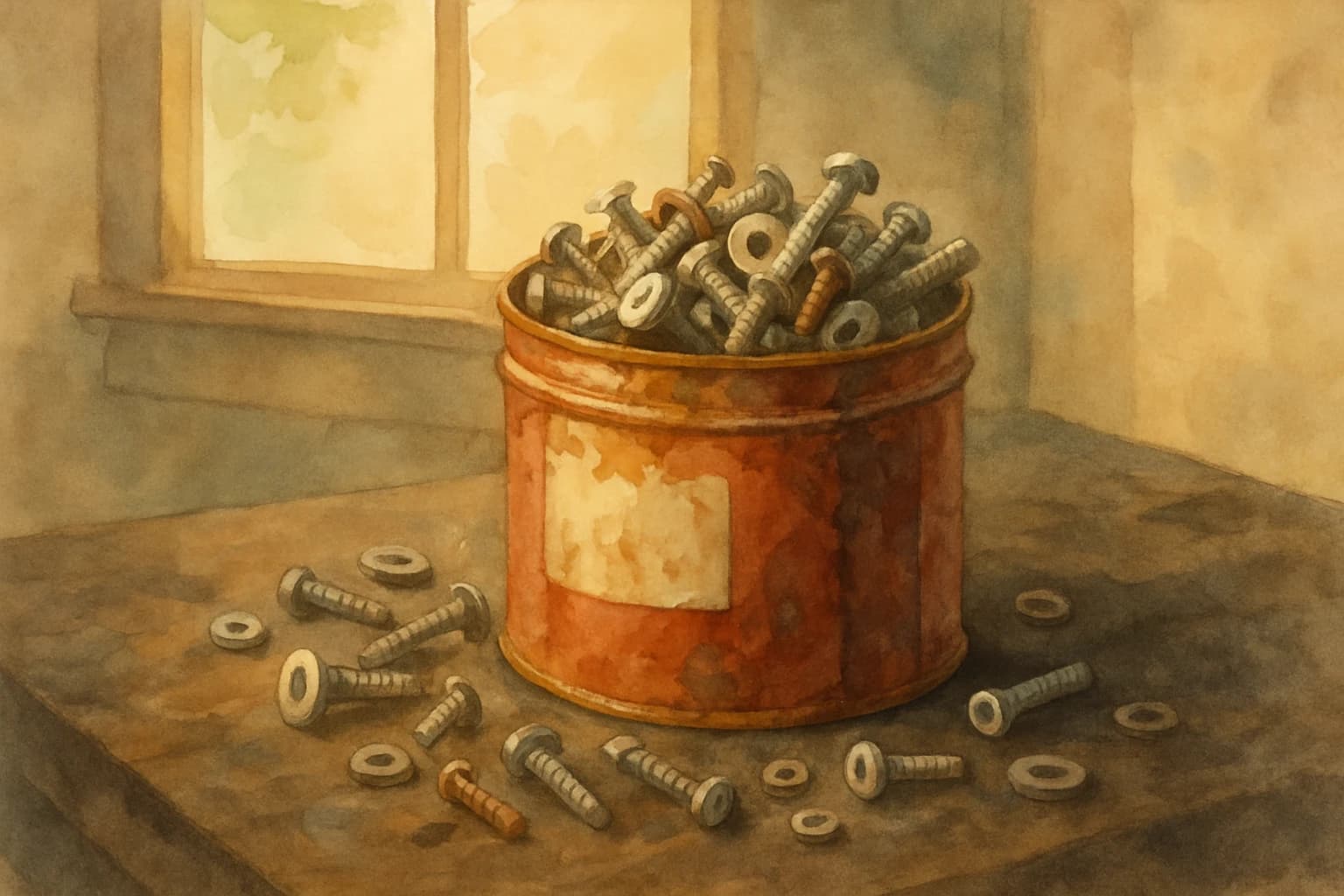
Not organized by size. Not sorted by head type. Just a three-pound Maxwell House can, rust forming on the rim, holding every screw, nail, bolt, nut, and cotter pin that had been removed from something since approximately the Eisenhower administration. The can was too heavy to shake easily. You had to dig.
The digging was the point, in a way. You almost always found what you needed, eventually, because the can had been accumulating hardware since before you were born and contained multitudes. If you needed a 5/16 bolt and two matching washers, you would find them in there. It would take four minutes. You would also find a toggle bolt, a drywall anchor from a wall that no longer exists, three finish nails, and something you couldn't identify but saved anyway.
Nobody threw the can away. Even after the man who had curated it died, the can usually survived him by a decade.
2. The Handsaw Laid Flat on the Back Edge
Every workbench had one handsaw that lived on the bench surface rather than on the pegboard, laid along the back edge with the blade facing toward the wall. Not hung, not stored, just placed. It was there because the last job hadn't required putting it away, and then time passed, and it became where the saw lived.
It still cut fine. The set was off after years of irregular use, and nobody had touched it with a saw file in a long time. But for rough work -- cutting a piece of two-by-four to length, trimming a dowel -- it was exactly sufficient.
3. The Can of WD-40, Without a Straw
The straw was gone. The straw was always gone. The red straw that came taped to the side of every WD-40 can was the most universally missing object in the American garage, and its absence was accepted without comment as a natural condition of the universe.
You used the can without the straw. You pointed the nozzle generally at the hinge or the bolt and sprayed. It worked. You put the can back. This had been going on for years.
4. The Utility Knife With a Dull Blade
A Stanley or similar, with a retractable blade that had not been replaced or broken back since the Carter administration. Still used regularly, because even a utility knife blade that is technically dull is sharper than most people realize, and the work in a home garage rarely requires a surgically sharp edge.
The replacement blades were in a cardboard sleeve in the top drawer. They had been there since the knife was purchased. Some of the blades had developed a light surface rust from decades of drawer humidity. None of them had ever been installed.
5. The Wood Block Used for Everything
This was a scrap of two-by-four, six or eight inches long, kept on the bench not for any particular purpose but as a general auxiliary tool. It was the thing you put under the workpiece to raise it up. It was the thing you tapped with a hammer when you needed to knock something loose without marring it. It was a clamp block. It was a temporary shim. It was a surface to kneel on when the garage floor was cold.
The block had absorbed enough hammer blows over the years that the end grain was slightly compressed and textured like the top of a mushroom. Nobody had ever considered getting rid of it. Replacing a scrap of two-by-four is not a replacement; it is the same thing again.
6. The Tape Measure That Didn't Retract Cleanly
The spring was weak, or the blade had developed a kink, or both. Retracting it required your hand guiding the blade back into the case rather than the case pulling it in on its own. You had grown so accustomed to doing this that you no longer noticed you were doing it.
The hook was still accurate. The blade was still readable. The thing still measured. There was no argument for a new tape measure.
7. The Half-Used Roll of Electrical Tape
Black, vinyl, slightly dried out at the exposed end from years of sitting uncapped. Still useful once you got past the first inch of stiffened tape. You tore that off and threw it on the floor and got to the good stuff underneath.
A workbench without a partial roll of electrical tape is a workbench that has just been cleaned out for a yard sale.
8. The Oil Can
The pointed-spout, pump-action oil can that had been on that bench since it was purchased for a particular job and never removed. Most of them were the all-metal variety -- a tapered body with a pump plunger and a long flexible spout -- and they lasted for decades because there was nothing to break.
The oil inside was 3-in-1, or lightweight machine oil, or automotive gear oil that had migrated from a larger container years ago. It left a smell in the immediate vicinity of the can, and a ring on the bench underneath it, and a stain on your palm if you grabbed it carelessly. It was used for squeaky hinges, drawer slides, bicycle chains, and anything else that moved reluctantly. It handled most of those jobs in about four seconds.
9. The Pencil Behind the Vise Handle
Not in a cup, not on a clip. Behind the vise handle, or tucked into the gap between the bench edge and the pegboard, or laid across the back of the bench where it rolled every time a drawer was opened and somehow never fell. A carpenter's pencil or a standard No. 2 with the eraser worn flat against the metal ferrule. Used to mark cuts, jot measurements on the workpiece, and write phone numbers on the bench itself in moments of haste.
Whole benches were covered in pencil marks. Nobody took inventory of the marks. They accumulated like rings in a tree.
10. The Kerosene Rag or the Shop Rag
A piece of terrycloth or flannel, sometimes the remains of a work shirt, dark gray from accumulated use, stiff in places, kept for wiping tools after a job or cleaning up oil before it spread. Some version of this rag had been on that bench since the house was bought. Whether it was the same rag the whole time was a question nobody had asked.
The rag was never washed. It was used until it stopped serving its purpose and then it was thrown away and a new one appeared, usually another shirt sleeve.
11. The Flashlight With the Weak Batteries
Functional enough to confirm a fuse was blown, not functional enough to actually illuminate the inside of a fuse box. The batteries in it were originals, or close to it. Replacing the batteries on the bench flashlight was the kind of task that required slightly more activation energy than was ever available in the garage context. You kept meaning to.
It stayed on the bench as a permanent reminder that you should replace the batteries. You never did.
12. The Level That Was Off
An older torpedo level or four-foot aluminum level, picked up at an estate sale or borrowed from a neighbor during a particular project and never returned, or just acquired so long ago the origin was forgotten. Most of them were slightly off by the 1990s -- the vials lose their accuracy over time, and a bubble that reads level may be a quarter-degree short of it.
This did not stop anyone from using it. It produced, over a decade of home improvement work, every picture frame, shelf, and fence post being installed at a subtle tilt that matched the error of the level. All the shelves in the garage leaned the same direction, imperceptibly. The whole workshop had a gentle, invisible slant.
The honest part
None of this was particularly efficient. The fastener can wasted time on every project. The dull utility blade made every score worse than it should have been. The weak-battery flashlight was actively useless. The inaccurate level was, strictly speaking, a liability.
Modern shop organization -- labeled bins, calibrated instruments, fresh consumables, digital levels accurate to a tenth of a degree -- produces better work in less time. This is true and it matters.
What the chaotic bench had was a different quality: it was a record. Every stain and ring and pencil mark and saved cotter pin from 1974 was a layer in a human document. The bench told you what the man who worked there had been doing, and roughly in what order, and what he had cared about enough to save and what he had cared about enough to work on for thirty years. A clean, organized workshop is a better workshop. It is not the same document.
The mess was not a system. But it encoded more information than a system would have.
Did your father or grandfather have a bench like this? What was the one object on it you remember most clearly? We'd love to hear your memory of this.
Get a new story every Sunday morning.
One email a week. No spam. Unsubscribe anytime.