12 Unplanned Residents of the Kitchen Sink Windowsill
The windowsill above the kitchen sink was the narrowest real estate in the house, and it was fully occupied.
Not with anything planned. Nobody sat down and decided what would live there. The windowsill was a landing strip for whatever got set down once and never moved again, plus whatever had to stay near the water, plus whatever didn't have anywhere else to go but needed to be somewhere. Over the years, it accumulated into a kind of self-portrait of the household, arranged in a strip about four inches deep and however wide the window was. Every family had its own version. The objects were different. The logic was the same.
Here are twelve things that were almost always in it.
1. The Dish Soap
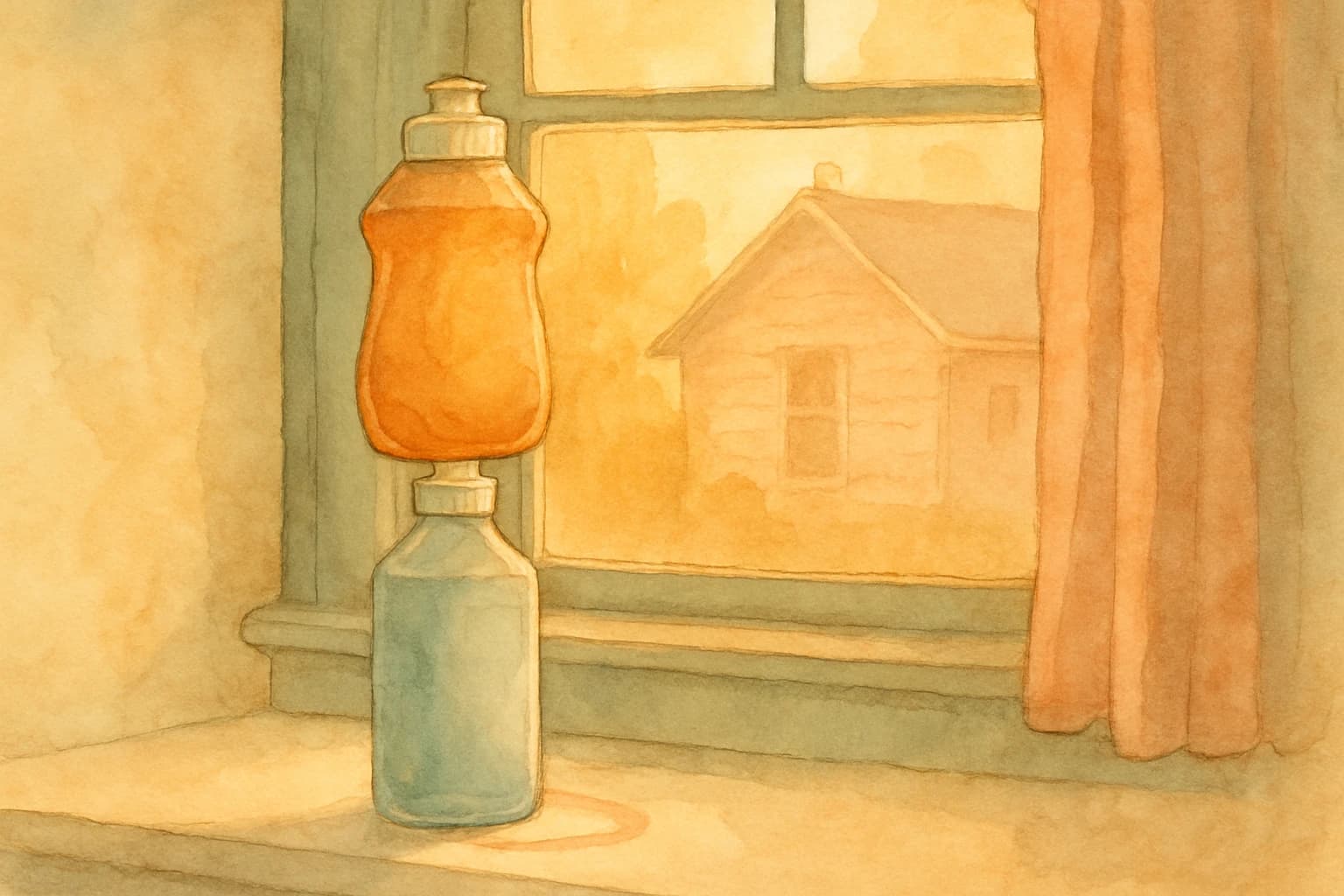
The dish soap stood at one end, usually the right end if you were right-handed, because that was where you reached for it without thinking. Ivory, mostly. Or Ajax. Or Dawn, once Dawn arrived in force. The bottle was never full and never quite empty. When it got low enough, somebody would refill it from the jug under the sink, or a new bottle would appear and the old one would be stood upside-down over the new one to drain the last inch, because nothing was wasted. The ring the bottle left on the sill was permanent after the first month.
2. A Bar of Soap in a Dish
The dish soap handled pots. The bar of soap handled hands. Both were present, because these were understood as separate tasks requiring separate tools.
The soap dish was usually ceramic, usually white, with drainage ribs across the bottom that rarely drained properly. A wet bar of soap in a non-draining dish turns into a particular kind of gel at the base, and the base of the bar always went soft before the top. You worked the soap down from the top and refused to touch the bottom. When the bar got too thin to use, somebody put a new one on top and the whole cycle started again.
3. The Plant
Some households kept an African violet. Some had a pothos cutting in a glass of water, rooting from a single node somebody had snipped off a larger plant months ago. Some had a cactus that had been a gift and couldn't be thrown away.
The windowsill plant existed because the window above the sink had the best light in the kitchen. It was the only south-facing glass in many older houses, or the only window that wasn't shaded by the porch overhang. The plant went there because the plant needed light, and the light was there, and the arrangement was efficient.
Some of those pothos cuttings, in households that kept topping up the water and moving the glass aside when the dishes piled up, stayed in the same glass for years. A cutting that went into water in 1968 could still be alive in 1985, roots a foot long, in the same jelly glass, on the same sill.
4. A Rubber Band
One rubber band, always. Sometimes two. Originating from the newspaper, or from the broccoli at the grocery store, or from a box that came in the mail. Placed on the windowsill because someone intended to use it later. Never used later. Never thrown away because it might be needed. The rubber band dried out in the window light and eventually broke when you picked it up, and was replaced by another one from the next bunch of broccoli, and the cycle resumed.
5. Pill Bottles
Not all of them. The daily ones -- the ones somebody took every morning with breakfast and needed to remember.
The windowsill was the reminder system. Setting the bottle there, where it would be seen while standing at the sink doing the breakfast dishes, meant you wouldn't forget. The system worked. It worked well enough that the bottles stayed there for years, with new bottles appearing as the prescriptions were refilled, until the windowsill above the sink became the household's informal medicine counter.
6. A Sponge
The sponge had its place, usually at the lip of the sink, but it migrated. When the dish drainer was full and someone needed to set something down, the sponge ended up on the sill. It sat there getting dry and stiff in the window light, and then somebody ran water on it and it came back to life, and it sat on the sill again.
The sponge smell is its own subject. A sponge that had been used for a week in a busy kitchen developed a smell that announced itself from across the room. Everyone knew the smell. Most people tolerated it longer than was reasonable, for the same reason the rubber band never got thrown away.
7. A Candle
Usually a votive. Usually burned down to within a half inch of the bottom, still functional, not quite worth replacing. There was a book of matches nearby, or a lighter that mostly worked.
The candle got lit on evenings when something was cooking that smelled like something was burning, which was often, or when the kitchen needed a different atmosphere for no particular reason someone would have named out loud. Nobody talked about the candle as a ritual. It was just there, and sometimes it got lit, and that was the extent of it.
8. A Seashell
Or a smooth stone from a trip somewhere. Or a piece of sea glass, green or white, found on a beach years ago by a child who handed it to her mother and said keep this.
The windowsill accumulated talismans. Objects that had no function but that had been given or found under circumstances that made throwing them away feel wrong. The seashell was not decorating the windowsill. It was surviving. The distinction is real.
9. Steel Wool
A pad of Brillo or SOS, or the off-brand equivalent from the grocery store, in a bowl or on a folded piece of aluminum foil to keep it from rusting the sill. The steel wool was for the specific problems dish soap couldn't fix: the casserole dish with the burned cheese ring, the cast iron that had gone wrong, the pot that had been left on the burner too long.
It was not used every day. But it lived on the windowsill because it was used regularly enough that putting it away under the sink was more trouble than it was worth, and because under the sink was already full.
10. The Window Stick
Older houses with older windows often couldn't stay open on their own. The latch was broken, or the weight-and-pulley system inside the frame had failed, or there was no screen and the window needed to be cracked only a few inches.
A stick lived on the sill for this purpose. Cut to exactly the right length to hold the window open the right amount. Not labeled. Not explained to guests. Everyone in the household knew what it was for and used it without thinking. Guests occasionally tried to remove it and the window fell on their hands.
11. A Calendar, Sometimes Wedged Against the Frame
The promotional kind -- from the insurance agent, or the feed store, or the savings and loan. A picture at the top, the month's grid at the bottom, a narrow strip of space to write in appointments.
It went on the windowsill because the window had the light to read it by, and the phone was nearby, and the kitchen was where the scheduling happened. The calendar on the windowsill was the household's appointment book, medical record, birthday reminder, and meeting log, all in one palm-sized grid. The months filled up with penciled notes in different people's handwriting, and the calendar got full before it got finished.
12. A View
Not an object. But it was what the windowsill was arranged in front of, and it was what you looked at while standing at the sink.
The backyard, usually. The garden, or what was trying to be a garden. The driveway. The alley behind the house. The neighbor's garage. A single tree in a good house with good light.
You spent more time looking out that window than any other window in the house, because you spent more time at the sink than anywhere else. Whatever was out there -- the clothesline, the kids playing, the first snow -- you saw it from here. The windowsill objects became familiar the way a commute becomes familiar. You stopped seeing them and started seeing through them, to whatever was happening in the yard.
Most of what lived on that windowsill was, if you're honest, clutter. There were better systems for all of it. The pills could have lived in a medicine cabinet. The soap could have had a proper caddy. The plant could have been on a proper stand with drainage and a saucer.
But the windowsill collected what it collected because function mattered more than tidiness, and proximity to water and light and the telephone mattered more than aesthetics. The kitchen worked because of this logic, not in spite of it. The windowsill above the sink was not decorating the kitchen. It was holding the kitchen together from a four-inch strip of painted wood, one rubber band and one dried-out sponge at a time.
What lived on the windowsill above your kitchen sink? Was there something specific you remember that didn't make this list? Share your story in the comments -- we're listening.
Get a new story every Sunday morning.
One email a week. No spam. Unsubscribe anytime.