13 Things a Swimming Pool Did to Your Senses Before You Ever Hit the Water
You knew the pool was there before you saw it.
That's the fact the memory skips over, because the memory usually starts at the water -- the blue of it, the cold of it, the cannonball. But the pool worked on you earlier than that. It started in the car, or in the parking lot, or at the chain-link gate. By the time you actually jumped in, your body had already been through something.
Here are thirteen of those somethings.
1. The chemical smell that hit you in the parking lot
Chlorine carries. On a hot day, with the wind right, you could smell a public pool from a hundred yards out. The smell was sharp and slightly wrong -- not a natural smell, not a food smell, not anything your nose had prior vocabulary for. It was industrial and outdoor at the same time, and your brain learned, through the repetition of childhood summers, to translate it directly into anticipation.
That translation stuck. Adults who haven't been to a public pool in twenty years still report the smell triggering something physical: a loosening, a readiness. The nose remembered the deal. Chlorine meant summer meant water meant hours of unstructured time. The smell was the announcement.
2. The heat of the concrete through the soles of your feet
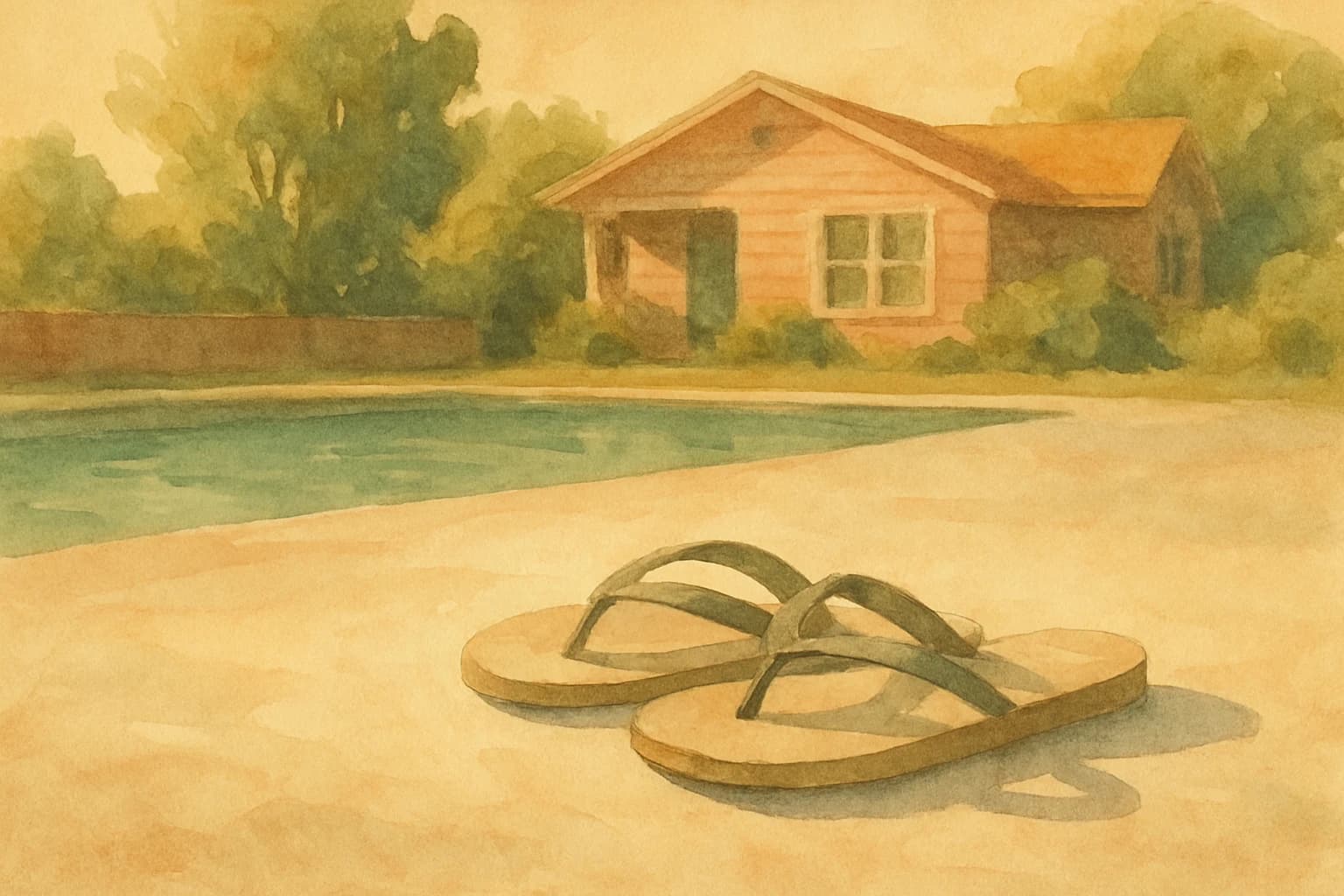
The pool deck was not just warm. It was a surface that had been absorbing direct sunlight since early morning, and by two in the afternoon it was radiating that heat upward through the thin rubber of your sandals, and through your bare feet when the sandals came off.
You walked fast across it. Everybody walked fast across pool concrete, on their toes, with an urgency that had nothing to do with hurry and everything to do with the physics of heat transfer. The concrete left an impression on the bottoms of your feet -- a temporary waffle of the aggregate that faded in the cool water within minutes.
3. The noise before you found your spot
Public pools were loud in a specific way. The sound bounced off the water surface and the concrete surroundings and the corrugated metal of the equipment shed and the chain-link of the fence, and it came at you from multiple directions at once. Screaming. Splashing. The lifeguard's whistle. The low warble of a radio somewhere near the shallow end. The slap of wet feet.
It was not peaceful. It was not quiet. If you were the kind of child who needed to ease into crowds and noise, a public pool on a July afternoon was a sensory event you had to brace for and then get through. Once you were in the water, it changed. The noise went muffled and distant. But before that, it was a lot.
4. The cold of the metal gate latch
Somehow, in the middle of all that heat, the gate latch was always cold. It was a heavy, institutional latch -- the kind you lifted with your thumb -- and the metal had not caught the sun the way the concrete had. Your hand registered the cold before your brain quite caught up.
A small thing. But the gate latch was the last object between you and the pool, and the cold of it was the first physical confirmation that something different was about to happen.
5. The visual shock of the water color
A full outdoor pool is a particular shade of blue that doesn't appear much in nature. It's the color of the paint on the pool floor, modified by the depth of water above it and the angle of the sunlight hitting the surface. It's a little too blue. A little saturated.
You could see it from the gate, and from the parking lot on clear days. Your eyes had to adjust. The brightness of it, especially when the sun was high, was a separate sensory event -- you squinted before you'd done anything at all.
6. The smell of sunscreen on everyone around you
The chlorine was the dominant smell, but it shared the air with zinc oxide and coconut and whatever SPF 8 oil your mother had bought at the drugstore. Other people's sunscreen was all over the pool deck. It was on the handles of the locker room doors. It was in the air in a general, unplaceable way.
This smell carried its own information. It meant warm weather. It meant exposed skin and outdoor hours. It meant the season had arrived. You could smell summer on people.
7. The locker room floor
Cold tile on bare feet, with standing water in the grout lines, and a smell that was different from the pool smell -- older, more enclosed, slightly mildewy, with overtones of the industrial soap in the dispensers bolted to the wall.
The locker room floor demanded careful walking. There were things growing in the grout that you didn't look at directly. Your mother had said things about the locker room floor that stayed with you, involving fungi and flip-flops. You tried to keep your feet on the wooden slat benches and failed, and got the cold tile anyway, and moved through the space quickly.
8. The sound of the diving board
The diving board had its own acoustic signature: the thunk of someone's feet on the end of the board, then the vibrating sprong as the board flexed, then the pause at the top of the arc, then the splash. This cycle repeated continuously through the afternoon from the deep end, and you heard it wherever you were in the pool.
The sound was a minor landmark in the auditory landscape of the afternoon. When the diving board was quiet, the pool felt quieter overall. When someone was doing repeated dives, the rhythm of it organized the background noise into something almost predictable.
9. The taste of the water before you meant to drink any
You were not going to drink the pool water. Everyone understood this. But the pool water was going to get in your mouth anyway -- during a dive, during a dunk, during the ordinary physics of being a child underwater. The taste was chemical and flat and faintly wrong, and you spat it out when you came up.
Within about fifteen minutes of being in the pool, you had tasted the pool. This was simply true, and everyone knew it was true, and the pretense that you were not going to drink the water was maintained by all parties anyway.
10. The pressure of the water when you went under
The first time you went fully underwater in a pool, the pressure change was a distinct physical event. Your ears registered it. The noise of the pool compressed and distorted. The world went a kind of blue-green and muffled, and the sounds from above came through thick and distant, and you were briefly in a different medium altogether.
Children who grew up around pools often describe the underwater pressure as something they sought out deliberately -- the silence, the difference, the way it cut off the noise of the surface. The pool was loud until you went under. Then it was its own thing.
11. The rough scratch of the pool wall
The plaster interior of an older pool was not smooth. It had a grit to it from years of chemical exposure and use, and the edges of the wall where you grabbed to rest were rougher still. The drain grates were textured metal, cold under your feet when you stood on them.
Newer pools were smoother. But the old municipal pools, the ones that had been there since the 1950s, had walls that would scratch the inside of your forearm if you weren't careful. You learned where the rough patches were and avoided them.
12. The sudden cold of the water on your feet at the first step
The pool steps were the moment before the decision. You sat on the edge and put your feet in, or you walked down the shallow-end steps, and the water temperature -- which was nothing like the air temperature, which was nothing like the concrete temperature -- registered immediately as a different kind of physical reality.
Cold. Almost always colder than you expected, even though you'd been to this pool before and knew how cold it was. The expectation adjusted every time, and the water beat it every time. Your feet went in, and your body paused, and then you went the rest of the way because you were already there and the afternoon was long.
13. The light on the surface
The pool on a clear afternoon was a moving light source. The water surface caught the sun and redirected it -- onto the ceiling of the bathhouse awning, onto the undersides of people's chins, in shifting ripple patterns across the concrete deck. The light was alive in a way that overhead light indoors never was.
If you were already in the pool, the light on the surface was something you looked up at from underneath. From above, looking down, the pool floor showed the same ripple patterns in reverse. The whole place was organized around that moving light. Even before you were wet, you were standing inside it.
One honest note: the public pool of 1975 was not always what it should have been. Facilities that served certain neighborhoods got better maintenance than facilities that served others. The diving boards came down in the 1980s partly for liability reasons and partly because the pools they were attached to had been systematically underfunded for years. The "public" part of the public pool was never quite evenly distributed. The sensory experience described above was real -- and not everyone had equal access to it.
The better pools being built now are often more equitable in where they're placed and who they serve. That's worth more than the diving board.
Did your pool have a diving board? What was the first thing you noticed when you got to your pool as a kid? We want to hear your version in the comments.
Get a new story every Sunday morning.
One email a week. No spam. Unsubscribe anytime.