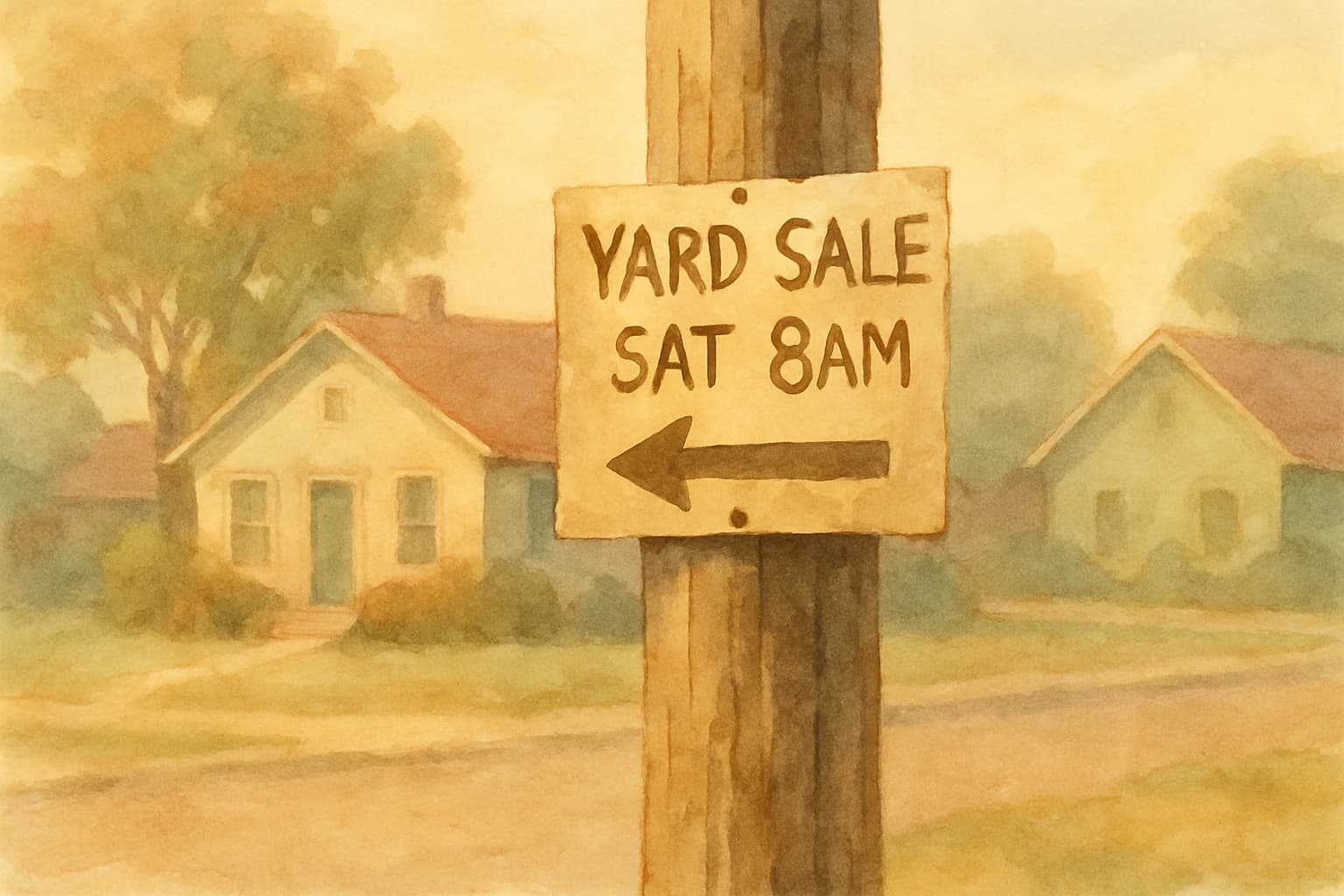
The Saturday Morning Map Drawn in Thick Marker on Telephone Poles
Your neighbor had a folding table set up on the driveway by seven-thirty, and you knew it was coming because you'd seen the cardboard signs on the telephone poles the night before.
The signs were handwritten, usually in thick marker, sometimes with arrows drawn in a second color. YARD SALE. SAT. 8AM. They appeared Thursday evenings on the corner pole, maybe two more at key intersections, and if you drove the neighborhood before dark you'd see four or five of them, each pointing toward a different driveway, and you'd start making a mental map for Saturday morning.
This was the yard sale economy, and it ran on its own quiet logic for about thirty years in the American suburb. It wasn't formal. Nobody regulated it. The prices were made up. The hours were approximate. It worked anyway.
What the driveway actually held
The standard yard sale, circa 1975 to 1995, was a cross-section of a household's accumulated miscalculations. Appliances purchased with good intentions. Clothes that fit during a different decade. Books finished once and not likely to be finished again. A bread maker. Ice skates in the wrong size. A fondue set, used twice, with the forks.
The stuff had been in boxes in the basement or pushed to the back of the garage, not quite junk but not quite useful either, in that middle category that's hard to throw away because it still works. The yard sale was the mechanism that moved it along. It let the seller recover a fraction of the original cost while telling themselves the thing was going to someone who wanted it. It let the buyer acquire something functional at a price that made the risk feel low.
A blender for two dollars. A full set of encyclopedias for five. A child's bicycle in reasonable condition for eight. A lamp that just needed a new shade. A winter coat, good wool, that someone had stopped wearing.
The prices had no relation to retail. That was the point. A yard sale price was a negotiation-opening position, not a firm number, and the negotiation was part of the transaction. You picked up the item. You looked at the price written in masking tape on the bottom. You said four dollars instead of six. The seller said five. You said five, and it was done, and both of you felt like you'd done something reasonable.
The Saturday morning circuit
Serious yard-salers ran a circuit. They had the signs mapped by Friday night and left the house early, before eight, because the good stuff went fast and everyone knew it. A transistor radio in working order, a cast iron skillet, a box of National Geographic issues from the 1960s -- these were gone by eight-fifteen.
The circuit ran on neighborhood knowledge. You knew which houses had been there since the fifties and had basements full of things worth finding. You knew which estates were being cleared out following a death in the family, because those were the sales with the real objects -- the wool blankets, the hand tools, the furniture built to last more than a decade. You knew which young couples were selling off duplicate wedding gifts and which retirees were starting to shed fifty years of accumulated life.
The circuit was also a form of low-stakes social life. You ran into the same people at every sale. You learned their names, or not, but you recognized them. There was a woman who was always looking for Depression glass. There was a man who bought every functional hand tool regardless of whether he needed it. You developed a nod, a shorthand. You were briefly part of the same loose community, organized entirely around other people's driveways on Saturday mornings.
The seller's side of it
Selling was a different kind of morning. You were up before six, hauling boxes out of the garage, finding extension cords so you could demonstrate that the lamp worked, arranging things on the folding tables in a way that looked deliberately organized but really just reflected which box you'd opened first.
You priced everything with masking tape and a Sharpie the night before, trying to guess what someone would actually pay. You consistently guessed too high for furniture and too low for children's things, though it took a few sales to learn this.
The first hour was the professionals. They came with cash and moved fast, picking up anything worth reselling at flea markets or antique stores, not unkindly, just efficiently. Then came the neighbors, the circuit-runners, the casual browsers who stopped because they saw the signs. By eleven the pace slowed. By noon you were starting to consolidate the tables. By one you were loading whatever was left into the car for Goodwill.
You made sixty, maybe ninety dollars. Sometimes more. The number almost didn't matter. What mattered was that the basement was lighter than it had been, and some useful object you'd stopped using was going somewhere it would be used again.
What didn't work about it
The yard sale ran on the assumption that Saturday was a shared free day, which it mostly was for white-collar households in American suburbs during a particular window of time. Two working parents, a weekend schedule, a neighborhood where most families lived on roughly the same rhythm.
It was not built for anyone who worked Saturday. It was not accessible if you didn't have a car and the sales were spread across a wide suburban grid. The casual economy that looked so democratic had real edges around it. The woman working a retail shift Saturday morning wasn't running the circuit. The elderly neighbor who couldn't drive wasn't getting to the sale four blocks over. The whole system worked because of a kind of leisure that a kind of life produced, and not every life produced it.
There was also the question of what people brought to the table. Not everything at a yard sale was worth having. A fair amount of it was worth throwing away, and the yard sale was sometimes just a way of making someone else responsible for eventually throwing it away. The fondue set went from your basement to the buyer's basement to, eventually, a landfill. Some of the transactions were just delay.
And the haggling, which felt pleasantly transactional to some, felt uncomfortable to others. Plenty of people priced things to sell and then found the negotiation hard to manage, either giving things away or holding firm when they should have let it go, because they hadn't quite worked out how they felt about the object they were selling.
What replaced it
Craigslist changed things first. You could post the blender without the whole Saturday production. The buyer came to the door on Tuesday. The transaction was private, direct, done on your schedule. No setup. No folding tables in the rain.
Facebook Marketplace and the apps that followed changed things further. You photograph the object, post it, field offers, arrange a pickup. The friction is minimal. The reach is wider. If you have something worth selling, you're more likely to find the person who actually wants it, rather than whoever happened to drive past your address on Saturday.
This is, by most measures, better. The seller gets a better price. The buyer doesn't have to drive a circuit. The exchange of objects that still have use continues, more efficiently.
What's gone is the morning itself. The social, accidental quality of running into the woman who only buys Depression glass, of watching your neighbor haggle over a socket set, of finding the cast iron skillet you didn't know you were looking for. Marketplace connects buyer and seller, but it doesn't produce an experience. The yard sale produced an experience out of commerce, and the experience was most of the point.
The apps also can't reproduce the moment of finding something you didn't search for. The algorithm shows you what you've indicated you want. The driveway table showed you what this particular family had accumulated over thirty years, which was a different kind of information entirely.
The signs on the poles
They've mostly gone quiet now. You still see them occasionally, in older neighborhoods, written in the same thick marker. YARD SALE. SAT. 8AM. Arrow pointing left.
When you see one now, you might pull over. Old habits. You walk the driveway, pick up a few things, put them back down. Maybe you find something, maybe you don't. But the pole sign and the folding table and the masking-tape price on the bottom of the thing are still part of the same language, and some part of you still knows how to read it.
Did you run the Saturday circuit, or were you the one setting up the folding tables? What's the best thing you ever found at a yard sale? Share your story in the comments -- we're listening.
Get a new story every Sunday morning.
One email a week. No spam. Unsubscribe anytime.
If this brought back a memory, you might also like
The Brass Bell That Knew You Were the Gallaghers
He knew you took sliced rye, not round, and that buying motor oil meant your husband had sent you to get it right.