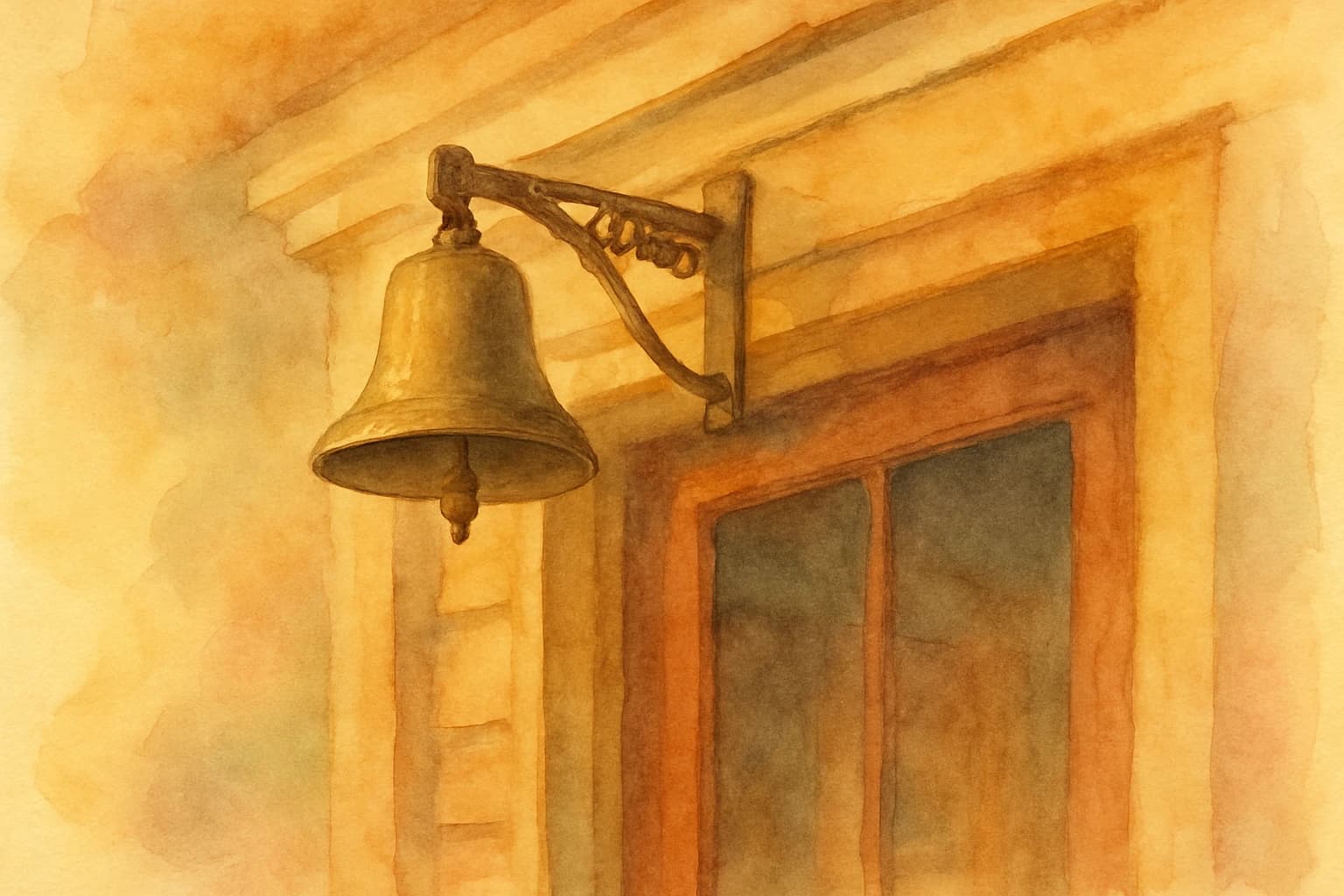
The Brass Bell That Knew You Were the Gallaghers
The bell was there because the owner couldn't see the door from the back of the store.
That's the whole engineering story. A spring-loaded bracket, a brass bell, and a door frame. Fifty cents of hardware that solved a real problem: somebody needed to know when a customer walked in, and nobody could be standing at the door all day. The bell was a practical object. But it also announced you, which turned out to matter in ways the owner probably never considered when he nailed the bracket up.
Walking into a store that knew your name was a particular experience, and it's worth being precise about what made it what it was, because the word "community" gets thrown around as a summary and it doesn't quite cover the specifics.
What it actually felt like
You pushed the door open and the bell rang and the owner looked up from wherever he was. If he knew you, he said your name or your family's name -- "Hey, the Gallaghers" or just "Mrs. Patterson" or sometimes just a nod that carried the same information. He already knew roughly what you were there for, because you were a creature of habit and so was he, and the overlap between those two habits was the relationship.
He knew you took the sliced rye, not the round. He knew your husband was particular about the brand of motor oil and that you weren't, and that if you were buying motor oil it was because your husband had sent you and you'd want to get it right. He knew your daughter had started high school because he'd seen her walk by the window every morning since September.
None of this was intimate, exactly. He didn't know your fears or your finances or anything you'd told him in confidence. What he knew was the surface of your daily life as it passed through his store, accumulated over years, converted into a kind of rough practical knowledge. He knew your habits. Habits are not the whole person, but they're not nothing.
You got the thing you came for. Sometimes he had already pulled it before you asked. Sometimes he told you he was out and offered a substitute and mentioned that the regular order was coming Thursday. He told you this not because he'd looked you up in a database but because he'd been thinking about his inventory, and his inventory was shaped by the habits of the people who walked through his door, and you were one of those people.
The transaction was efficient, in a way that looked inefficient. It looked like chitchat. What it was, was the fast communication of two people who had established enough context over years that they didn't need to start from scratch every time.
Who this worked for, and who it didn't
The small-shop economy of mid-century American towns was good for the people the store considered its regulars. It was often actively bad for everyone else.
The shopkeeper who knew your name knew it because you were the kind of person he'd decided to learn. In a great many shops across a great many decades, the people whose names he didn't learn, and didn't try to learn, were not random. They were people he'd made a judgment about -- by race, by class, by whether they seemed like the kind of person he was in business to serve.
The warmth of the known customer was the other side of a coin whose reverse was indifference or worse toward the unknown one. The bell above the door announced you. Whether you were welcomed in depended on who you were, and the answer was not always the same for everyone. Any honest accounting of this era has to say that plainly, without softening it into something easier.
The other thing that shouldn't come back is the monopoly. A small town with one hardware store and one grocery and one pharmacy was also a town where those owners could be complacent, could be rude, could be dishonest, and you had nowhere else to go. The charm of the known relationship depended on the owner being worth knowing. Some of them weren't, and there was no recourse except to drive twenty miles.
Why it faded
The chain stores came in offering lower prices, which mattered to households where money was tight, which was most households. The supermarket had sixteen varieties of the thing the corner grocer stocked in one. The big-box store had parking, which the old downtown didn't. These were not tricks or illusions. They were real advantages that real people needed, and choosing them was not a failure of community feeling. It was economic sense.
What the chain couldn't replicate was the accumulated knowledge. The cashier at the supermarket didn't know your name because she'd been working the register for three weeks, not fifteen years, and she was covering three stores this month, and there was no structure in the business model that created the conditions for her to learn. This wasn't her failure. It was arithmetic. A store that serves thousands of customers a day, with rotating staff, produces different relationships than a store that serves two hundred customers a week with the same owner behind the counter.
The internet finished the job the chain stores started. You can order what you need without speaking to anyone, which some people experience as convenience and some people experience as loneliness, and both experiences are real.
What was actually lost
Not charm. Not warmth. Those are the wrong categories.
What was lost was a particular kind of low-level social infrastructure. The shopkeeper who knew you was a node in a network. He knew you, and he knew your neighbor, and he knew the family on the corner, and when he mentioned offhand that he hadn't seen the Hendersons in a couple of weeks, that information traveled in a way that mattered to a community paying loose attention to its own members. The store was a place where the neighborhood bumped up against itself and exchanged information without planning to.
This infrastructure was unreliable, partial, and subject to all the prejudices of whoever ran the store. It was not a substitute for anything formal. But it was real, and it ran on the daily commercial life of the town rather than requiring anyone to organize it or fund it or show up for it deliberately. It happened because people needed bread and motor oil and aspirin, and they got those things in a place where they also happened to see each other.
The errand was the occasion. The occasion doesn't exist in the same way when the errand is a UPS box on your porch.
What can be recovered, in pieces
Some of it is still out there. The butcher counter at a good independent market, staffed by the same three people for ten years, will learn your preferences if you show up regularly and talk to the person holding the knife. The independent hardware store that survived -- and some did -- still has someone who'll ask you what you're trying to fix before they hand you a part. The local pharmacy where the pharmacist has been filling prescriptions for the same families for twenty years is a different institution than the chain pharmacy, not because it's charming, but because the knowledge is there.
You have to be a regular. Regulars are made by showing up, repeatedly, and by talking to the person across the counter as though they are a person across the counter rather than a point of transaction. This sounds obvious. It is apparently not, because a great many people have stopped doing it.
The bell above the door is mostly gone. Some stores still have one, usually a boutique or a bakery, usually for the same reason the original hardware store put one up -- somebody needs to hear when you come in. The bell doesn't know your name either. But the person who looks up when it rings might, eventually, if you keep coming back.
Did you have a store in your town where they knew your name when you walked in? What did they call you, and what did they know about you without asking? Drop yours in the comments -- we'd love to hear it.
Get a new story every Sunday morning.
One email a week. No spam. Unsubscribe anytime.
If this brought back a memory, you might also like
The Map Folded Wrong in the Glove Compartment
Creases ran in four directions, erasing small county roads into white space where you guessed or found another way before the engine even turned over.