15 Things That Lived in the Glove Compartment and Solved Every Emergency
The glove compartment wasn't named for gloves, except that for a while it was actually used for them, back in the motoring era when they were required. By the time your parents were driving, it had become something else entirely: a compact archive of preparedness, organized by no system anyone could name but understood by everyone in the car. The latch clicked open the same way every time. Everything inside was slightly too warm from the sun and slightly grayish from road dust. And when something went wrong -- a flat, a nosebleed, a fight about whether you'd missed the turn -- the first thing anyone did was open it.
Here are fifteen things that lived in there, and what they were actually for.
1. The Owner's Manual
It came with the car, in a clear plastic pouch, and your father put it in the glove compartment the day he drove off the lot. He never read it. Nobody read it until something happened -- a dashboard light came on, or a neighbor asked what the tow capacity was -- and then someone dug it out and flipped through it with the car idling on the shoulder of the highway.
The manual was proof that someone, somewhere, had anticipated your particular problem and had written it down. That it was usually insufficient didn't reduce its authority.
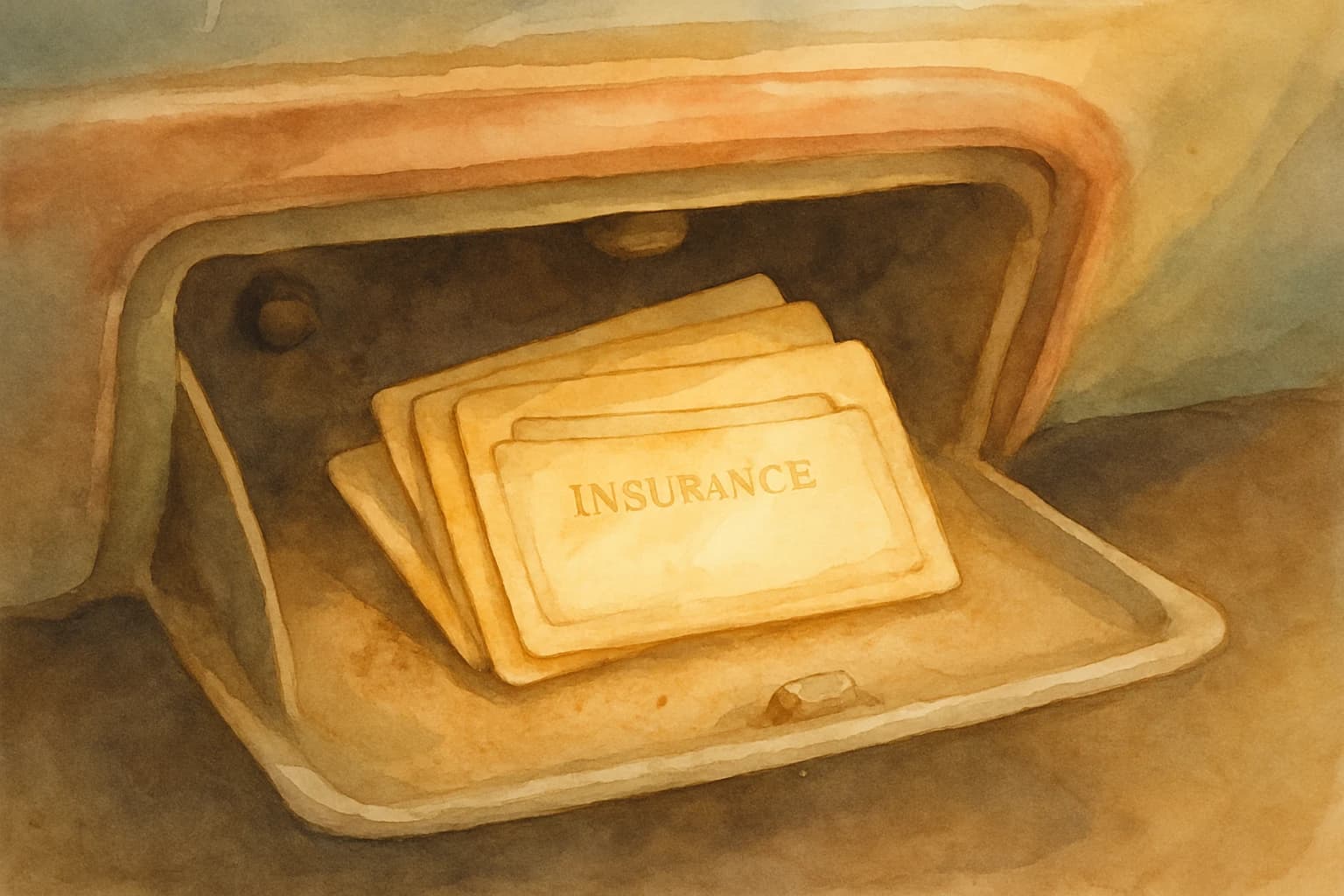
2. The Insurance Card
A paper card, re-issued every six months, and the old one stayed in the glove box for the first year or two before someone finally cleaned it out. You had three of them in there, usually, the valid one somewhere under the others.
A police officer asking to see your insurance card was a situation with a very clear procedure: open the compartment, hand over the card, wait. The card was the ticket that proved you were part of a system larger than yourself -- that there was a company somewhere with your name on a policy. It mattered in proportion to how rarely you needed it.
3. The Road Atlas
A full-size road atlas, folded or not depending on how much your family cared about such things, typically an older one with the current interstates and the ones that no longer existed both represented in faded green and orange. The Rand McNally held up longer than most paperbacks because it was printed on thicker stock. Some families had the same one for fifteen years.
Your mother navigated with it. This meant she traced the route ahead with one finger while your father drove, and she reported turns with enough lead time for him to do something about them. When she lost her place, the car got quiet. When she found it again, everyone relaxed.
The atlas is the item on this list that has been most completely replaced by something better, and the replacement is genuinely better in every functional way. This is worth saying plainly.
4. A Pen
Not a good pen. A ballpoint pen that worked half the time, found under the insurance cards. It was in the glove compartment because someone had needed to write something in the car once -- a phone number, directions, the mileage reading -- and it had stayed.
5. Registration
The registration was usually in an envelope from the DMV, or later in a printed card, and it lived behind the insurance cards in the same stack. It told any interested authority that the car belonged to someone who had paid the fees to use the road. The stack of registration documents from prior years served no purpose except to take up room. Nobody threw them away.
6. A Flashlight
Usually a D-cell or a two-AA flashlight with a push button on the end, bought at a hardware store or a gas station, with batteries in varying states of charge depending on how long ago anyone had used it. When you needed it -- when the car stopped in the dark, when the tire iron slid under the spare -- you shook it once to see if it worked before trusting it.
Some families had a good flashlight in there and kept fresh batteries in it. These were families that had needed one at a bad moment and had decided it wouldn't happen again.
7. A Folded Paper Napkin (or Several)
Not put there intentionally. Accumulated from fast food stops over several months, each one slightly translucent from proximity to french fries. You used them for spills, for a nosebleed, for wiping steam off the inside of the windshield when the defroster was slow.
The napkin collection was the most honest artifact in the glove compartment because it documented actual life in the car without any preparation. The road atlas was aspirational. The napkins were true.
8. Aspirin or Tylenol
A bottle, usually 100 count, bought at a drugstore and put into the glove compartment because someone had a headache at exactly the wrong moment and decided it would not happen again without recourse. The childproof cap was difficult to open if you were also trying to keep the car on the road. The bottle had aspirin in it long after the expiration date, because throwing away medicine felt wasteful to people who had grown up when medicine was expensive.
This was one of the better ideas in the glove compartment. It was used.
9. A Tire Gauge
A pen-shaped pressure gauge, metal, with a printed scale on the side. You pushed the end onto the valve stem of the tire and a white ruler slid out with the reading. Your father checked the tire pressure in the driveway before long trips. The gauge was the instrument of that ritual. It cost about two dollars and lasted twenty years.
The digital gauges now are more accurate and easier to read. But the old metal one had a heft and a directness that the digital version has replaced without quite matching.
10. Sunglasses
A backup pair, usually cheap ones from a gas station or a drugstore rack, scratched on both lenses, kept for the moment when someone left the good pair at home. They worked. They were ugly. Nobody in the car complimented them.
11. A Notepad
Spiral-bound at the top, with pages mostly used. The remaining pages had been used for directions, for a list of things to pick up at the hardware store, for a child's game of tic-tac-toe. The notepad was the glove compartment's record of everything the car's occupants had needed to write down and had no other place to put.
Some notepads had a phone number on the front page that was years old, and nobody knew whose it was anymore, but nobody tore the page out either.
12. The Spare Key
Not always. But sometimes. A spare key in an envelope or a key clip, kept there either because someone had been locked out once and was not going to be locked out again, or because a family member had suggested it with enough authority that it stuck.
The logic was reasonable until someone locked the keys in the car along with their spare key, which happened enough times to be a running American joke.
13. A Roll of Quarters
For toll roads, for parking meters, for the laundromat that was never actually used but theoretically could have been. The quarters were the glove compartment's acknowledgment that certain transactions required particular currency and that you should have it on hand.
By the mid-1980s, quarters had mostly given way to exact change and then to transponders and then to nothing at all. The roll sat in there longer than it was useful, because it was still quarters, and you don't throw away quarters.
14. A Box of Tissues
The flat Kleenex box, kept under the notepad. For colds, for allergies, for a child crying in the back seat at a rest stop outside Amarillo. The box was sometimes replaced when it ran out. Sometimes the cardboard sleeve stayed in the compartment for two more years with two tissues left in it.
15. A Folded Twenty
Flat in the bottom of the compartment, under everything, or tucked into the cover of the owner's manual. Put there by a parent who had a theory about emergencies: that there was one kind of emergency where what you needed was twenty dollars in cash, right now, with no argument. A gas station in a town with no ATM. A toll booth you hadn't expected. A situation where you needed to buy your way clear.
Nobody touched the twenty unless things had genuinely gone wrong. It was a reserve, held back from normal spending by an act of deliberate restraint. A lot of families had one. Most of them needed it at least once.
The glove compartment did real work. It wasn't organized and it wasn't clean, but it addressed a plain truth about car travel before the smartphone made most of its contents redundant: you were frequently out of your normal context, without your usual resources, and you had to have solved the most likely problems in advance.
The atlas is gone, replaced by something better. The quarters are gone, replaced by a tap on the phone. The insurance card and registration are still there in most cars, still a little crumpled, still in the same stack.
The twenty dollar bill at the bottom -- it would not be the worst thing to put one of those back.
What did your family's glove compartment always have in it? Was there something in there you never understood but never took out? Tell us about yours in the comments below.
Get a new story every Sunday morning.
One email a week. No spam. Unsubscribe anytime.