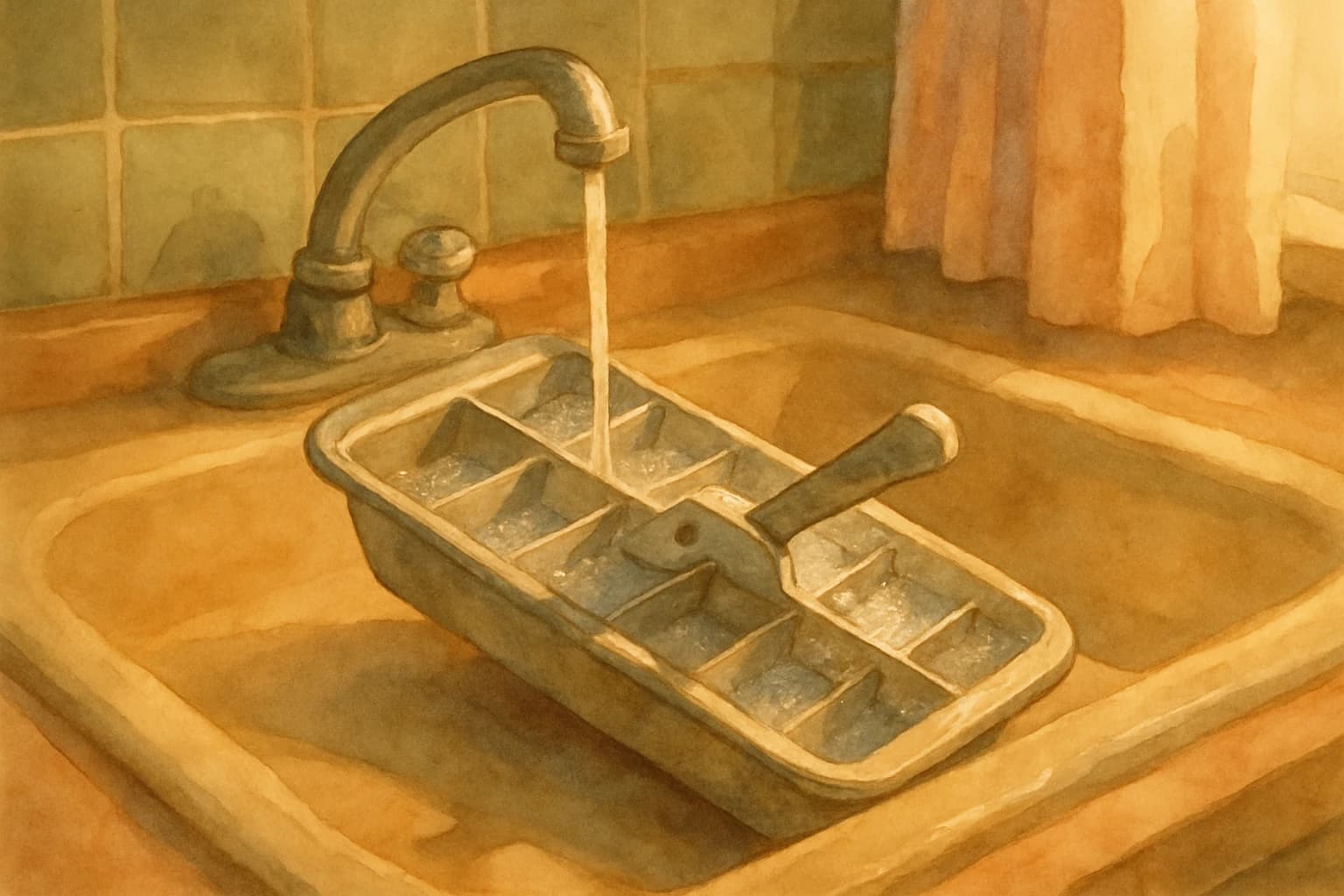
The Aluminum Lever That Fought You for Every Ice Cube
The metal ice cube tray had a lever, and the lever fought you.
You pulled it up, and the aluminum grid inside twisted against the ice, cracking the cubes loose from the tray one row at a time. Sometimes it worked on the first pull. More often it stuck, the lever frozen solid to the frame, and you'd run hot water over the bottom for a few seconds before trying again. If you pulled too hard, water sprayed across the counter. If you didn't pull hard enough, half the cubes stayed welded to the tray and you had to go back at them with a butter knife, which your mother had told you a hundred times not to do because it scratched the aluminum and once, memorably, it slipped and left a mark on somebody's hand.
This was the ice cube tray of the 1950s and 1960s, before the plastic flex trays arrived, before the icemaker got built into the door of the refrigerator. It required your attention. That was the whole design.
The tray was a daily test of patience
The aluminum tray with the lever, most commonly sold under names like Kelvinator or Servel or whatever the refrigerator manufacturer happened to be, worked on a simple mechanical principle. A divided grid sat inside a metal frame. A handle attached to a bar that ran the length of the tray. Pull the handle, and the bar twisted, breaking the ice apart along the divider lines and popping the cubes loose from the sides.
The principle was sound. The execution depended entirely on timing. Ice fresh from the freezer, still at its coldest, might not release. Ice left too long developed a layer of frost that fused it to the tray in a different way. There was a window, and you learned the window by feel, through trial and error and the occasional flooded counter.
Nobody explained this to you. You figured it out the way you figured out most household mechanics as a kid, by watching an adult do it first and then doing it wrong several times yourself. Your grandmother ran the tray under the faucet for exactly as long as it took to loosen the bottom layer without melting the cubes into slush. She never timed it. She just knew.
Refilling it was its own small ritual
Once the cubes were out, the tray went back under the tap, and you filled it to a line that wasn't marked but that everyone in the house understood by sight. Too full, and the water sloshed over the sides on the walk back to the freezer. Too shallow, and you'd shorted yourself by dinner.
The full tray then had to be carried, level, back to the freezer, which in most 1950s kitchens meant a compact box above the refrigerator door rather than a separate drawer. You slid the tray in flat, careful not to bump the shelf below it, and you closed the door with the particular attentiveness that avoiding a spill requires.
This happened multiple times a day in an active household. Somebody was always refilling the tray, because somebody had always just emptied it. The chore wasn't assigned so much as absorbed. Whoever took the last cubes refilled the tray. It was one of the few household tasks that operated on pure cause and effect rather than a schedule.
The tray taught you where things came from
There was no mystery to the ice. You could see the whole process: water in, cold time passing, cubes out. A refrigerator with an automatic icemaker hides this. Ice simply exists in the bin, replenished by machinery you never see and don't think about. The old tray put the entire mechanism in your hands, four times a day, whether you wanted to think about it or not.
Kids learned basic physics from the tray without anyone calling it that. Water expands when it freezes, which is why an overfilled tray sometimes cracked at the corners over the years, the ice pushing outward against metal that had nowhere to give. Cold makes metal contract, which is why a tray fresh from the freezer felt different in your hand than one that had been sitting on the counter for ten minutes. None of this was taught. It was absorbed through daily contact with an object that behaved consistently enough to notice.
What replaced it, and why the replacement won
The flexible plastic tray showed up in the late 1960s and became standard through the 1970s. You twisted the whole tray instead of pulling a lever, and the flex of the plastic popped the cubes loose without the fight. It required less force and less technique. A child could do it without adult supervision and without a butter knife anywhere near the operation.
The automatic icemaker followed, built into refrigerator freezer compartments starting in the late 1960s and becoming common in middle-class kitchens by the 1980s. It made ice on its own schedule, dropped the cubes into a bin, and refilled itself from a water line. Nobody had to remember to refill anything. Nobody had to time the tap water. The mechanism disappeared into the appliance and the task disappeared along with it.
This was, by any honest measure, an improvement. The automatic icemaker doesn't run out at the worst possible moment, the way the old tray always seemed to when company was coming. It doesn't require someone in the house to notice the tray is empty and act on it. It doesn't scratch, and it doesn't need a butter knife, and nobody has ever cut themselves prying a stuck cube loose from an icemaker bin. If you're the kind of person who wants ice and doesn't want to think about ice, the icemaker is a categorically better piece of engineering, and pretending otherwise would be dishonest.
The metal tray was not a superior technology. It was simply a technology that asked something of you, and the asking is the part some people miss.
What the modest task did that the machine doesn't
The tray put a chore inside a kitchen that otherwise ran on larger rhythms, the meal schedule, the laundry schedule, the school schedule. Refilling ice was a task with no deadline and no assignment, which meant it belonged to whoever happened to notice. That kind of task, minor and undramatic and shared by nobody in particular, used to make up a good portion of how a household actually functioned day to day. Somebody always just does it. Nobody remembers being told to.
The automatic icemaker removed one more of these tasks from circulation. It's a small removal. Nobody is arguing that ice trays should come back, or that families were closer because they fought with aluminum levers over the sink. But a house used to be full of these tiny mechanical negotiations, the kind that taught a kid patience and cause and effect without either being the stated goal, and a house today has fewer of them than it used to. The ice is just there when you open the freezer. It always has been, if you're young enough. It always will be.
Did your family have the metal tray with the lever, or did you skip straight to plastic? Do you remember who in your house was in charge of refilling it?
Share yours in the comments -- we read every one.
Get a new story every Sunday morning.
One email a week. No spam. Unsubscribe anytime.