The Attendant Who Checked Your Oil
The attendant came to your window.
That was the whole thing, really. You pulled in, you stopped, and a person walked toward your car with a purpose. You didn't have to get out. You didn't have to touch anything. You sat there while someone else handled it.
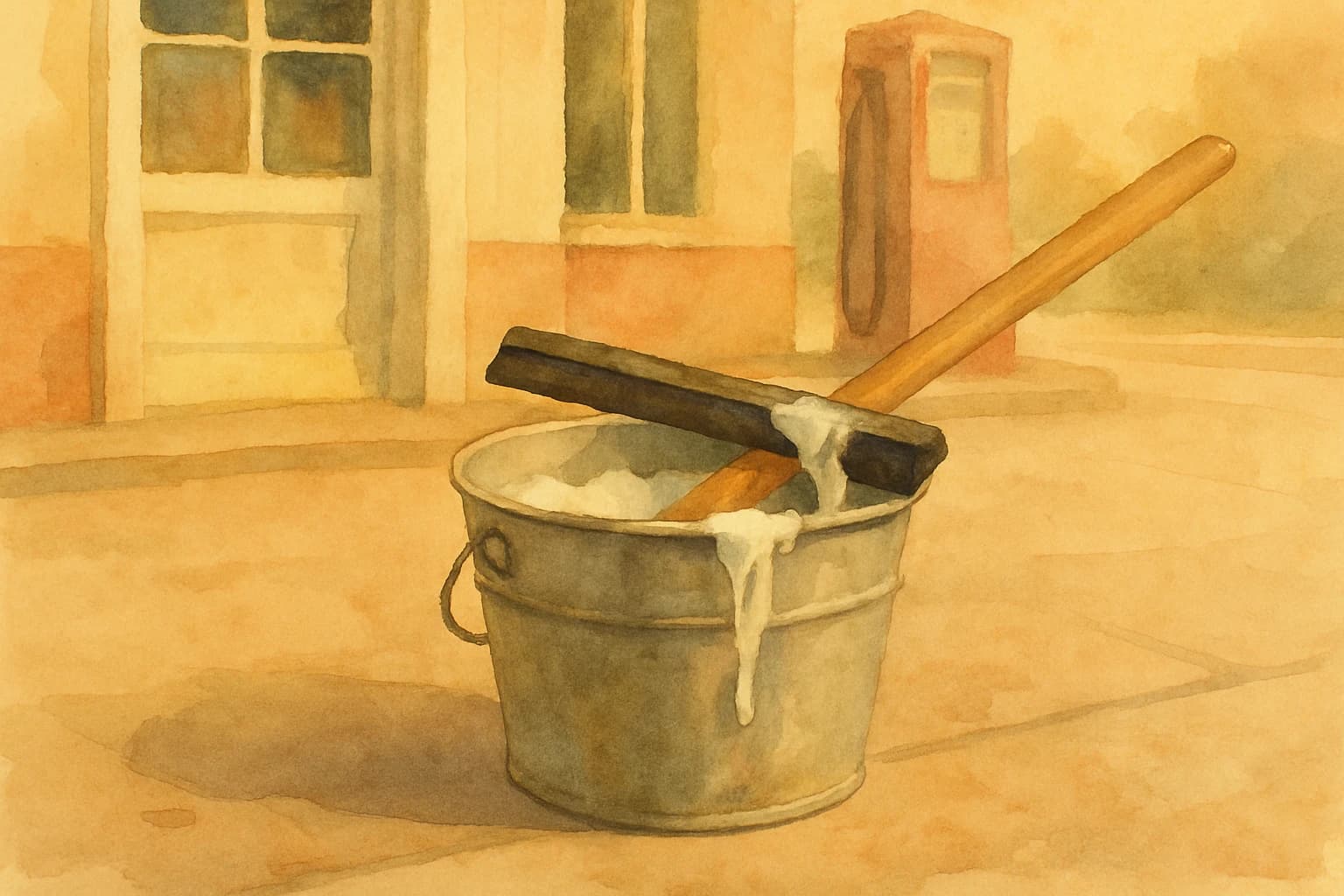
He asked how much. You said fill it up. He unscrewed the gas cap, put the nozzle in, and then he kept moving. He didn't stand there watching the pump. He went around to the front of the car and lifted the hood. He checked the oil with a rag in his back pocket. He checked the battery terminals if he was thorough. He came around to the windshield with a squeegee on a long handle and went across the whole glass in two or three strokes, methodically, the way you'd do a job you've done a thousand times. If the tires looked low he told you.
When the pump clicked off he replaced the cap, took your money, made change from a dispenser on his belt, and you drove away. The whole transaction took four or five minutes. You never left the car.
This was the full-service gas station, and it was the default mode of buying gasoline in America from roughly the 1920s through the 1970s. Not the exception. The default.
The men who ran it
The full-service station was a specific kind of American business, and it produced a specific kind of man. He was usually the owner or a senior employee who had worked his way up to full comprehension of the operation. He could change your oil and rotate your tires and tell by the sound of your engine whether the problem was worth worrying about this week or next month. He probably had a first name that half the neighborhood knew.
Some of them wore uniforms with the oil company's colors -- Texaco's star, Gulf's orange, Esso's oval. Some of them wore whatever they'd been wearing that morning with a rag in the back pocket to signal the trade. The uniform or its absence didn't tell you much about the quality of the man. The quality was in whether he actually looked at the car or just went through the motions of looking.
The good ones had regulars. The regulars had the same conversation with the attendant every few weeks, reliably, for years. He knew what kind of oil your car took. He remembered that your left rear tire had been running soft since October. He waved you through the first two questions because he already knew the answers.
This was not extraordinary customer service by any formal standard. It was just competence repeated long enough to become familiarity.
What self-service did to the economics
Self-service gas started showing up in California in the late 1940s and early 1950s, and consumers noticed that it was measurably cheaper. By the late 1970s, most states had legalized it, and the economics were straightforward: you eliminate the attendant, you lower the price, you get more customers. New Jersey and Oregon resisted and kept mandatory full-service laws on the books -- Oregon finally allowed self-service in 2023, after decades of being the last holdout.
The price differential was real and it mattered. Gas wasn't cheap in the post-1973-embargo years. A few cents per gallon was a few cents per gallon, and multiplied across a family with two cars it added up. People made a rational choice, and they made it in large numbers, and the full-service station mostly disappeared within a decade.
The stations that survived either went full self-serve or converted to the convenience store model. The little brick station with two bays and a grease pit became the building behind a seven-pump canopy with a lottery machine and a fountain drink station inside. The economics demanded it. A small station surviving on full-service margins in 1985 was not surviving for long.
The car culture that surrounded it
The full-service station made a certain kind of car ownership possible. If you were not a mechanically inclined person -- and most people were not -- the attendant was a resource. You could ask him whether that sound was serious. You could ask him why the temperature gauge was running high. He might look at it for five minutes and tell you for free, or he might tell you to bring it around back tomorrow morning, and either way you had information you didn't have before.
This was especially valuable to women driving alone, to older people who had driven for forty years without ever learning what the inside of an engine looked like, to anyone who had bought a car without inheriting the knowledge of how to maintain one. The attendant was a standing resource at the point where you already had to stop anyway.
The self-serve model removed that resource and replaced it with nothing. You now pump your own gas and check your own oil and notice your own low tire, or you don't, and if you have a question you look it up on your phone. Which works. It just works differently -- on your initiative, at your own pace, without the standing resource that was already there.
The honest counterpoint
The romantic version of this story stops before the inconvenient parts. The full-service station was not uniformly good.
The attendant who knew his stuff and treated every customer with the same competence was real and common. The attendant who talked a nervous driver into a new air filter she didn't need was also real and common. The up-sell was baked into the model. You were a captive audience in your car, the attendant had a few minutes with your hood up, and the station made money on the services not the gas. Some stations were honest about what they found. Others were not, and there was no easy way for the customer to know the difference without already knowing what to look for.
Women driving alone reported, with some regularity, that the experience could be uncomfortable. A stopped car is a stopped car, and not every attendant was the neighborhood fixture with twenty years of familiarity. Some were teenagers with no particular investment in the customer's comfort.
And the labor itself was hard. Standing outside in January pumping gas and checking oil in subzero temperatures was not a job anyone romanticized from the inside of it. The wages were modest. The hours were long. The work was physical and the conditions were whatever the weather decided to be that day.
So the self-service pump, for all that it removed, removed some things worth removing.
What's actually gone
What's gone is the checkpoint.
When you stopped at a full-service station, a knowledgeable person walked around your car. Not a mechanic doing a formal inspection, not a dealership service advisor running a checklist -- just a person who had looked at a lot of cars and knew what looked right and what looked wrong. He checked the oil because that's what you did. He checked the windshield because that's what you did. He noticed the tire that was going soft.
The modern equivalent is the annual inspection sticker and the dashboard warning light. Both of which come after the problem has been established long enough to be formal. The attendant caught things early, informally, as a side effect of doing his actual job.
The other thing that's gone is the standing relationship with someone who knew your car. Not a technician who pulls up your vehicle history on a screen, but a person who remembered your car from the last time it came through, three weeks ago, because it was a 1968 Ford with a distinctive miss in the idle. That kind of knowledge accumulates differently than digital records do. It lives in a person rather than in a file.
The two holdouts
For a long time, New Jersey was the useful test case. Full-service remained mandatory by state law, which meant that driving into New Jersey and pulling up to a pump was a brief window into what 1972 felt like. The attendant appeared. He took the nozzle. You sat there.
New Jersey drivers who had never known anything else sometimes spoke about it with mild defensiveness, because the rest of the country had been laughing about it for years. What they knew, without necessarily saying it directly, was that it was just easier. You didn't get out in the rain. You didn't get gas on your hands. You didn't have to learn which way the nozzle locked on unfamiliar pumps.
The arguments for keeping it were partly economic -- station jobs, tips, employment -- and partly about something harder to articulate. The experience of buying gas in New Jersey was a transaction that included a human being. The human being did not change the economics of the fuel. He changed the quality of the stop.
Oregon finally folded in 2023. New Jersey is the last one standing, and even there the law now permits self-service at some stations.
Do you remember a full-service station from your town? Was there an attendant whose name you knew? Drop yours in the comments -- we'd love to hear it.
Get a new story every Sunday morning.
One email a week. No spam. Unsubscribe anytime.