The Wednesday Ritual That Saved the American Week
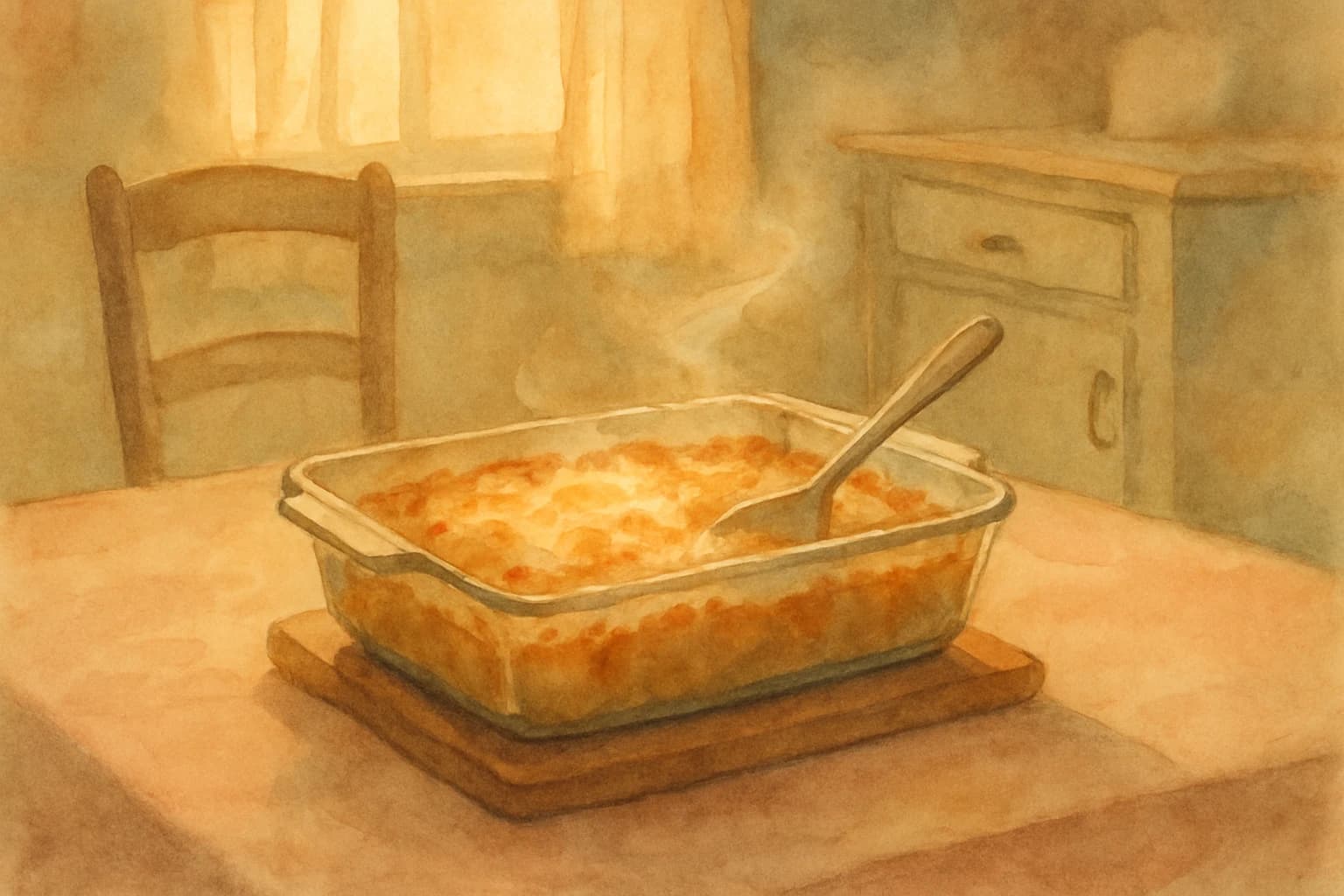
The casserole did not announce itself. It was already on the table when you sat down.
No plating, no presentation, no moment of reveal. The dish came out of the oven in the same pan it had been built in, set on a trivet in the center of the table, and that was dinner. You served yourself from the same vessel it had baked in. The serving spoon was already in it. The whole transaction took thirty seconds and zero ceremony, which was precisely the point.
This was the American casserole at its peak, roughly 1955 to 1985, and in that window it was the most efficient, most communal, and most quietly important meal in the weekly rotation. Not the most glamorous. Not the most delicious. The most important.
What made it the anchor of the week
The casserole was a Wednesday meal, usually. Sometimes Thursday. It landed in the middle of the week when the fresh groceries from Sunday's shopping had been used, when everyone was tired, when nobody wanted to be in the kitchen longer than necessary. The casserole answered all of this. It went in the oven at 350 degrees. You set the timer. You went and did other things. When the timer went off, dinner was ready.
The whole structure of the meal compressed the cooking labor into a single hour in the afternoon and asked nothing of the evening except the act of eating. This mattered enormously in a household where the person cooking was also managing children, a house, and often a part-time job or a volunteer commitment or both. The casserole was not a shortcut. It was an engineering solution.
It also fed an indefinite number of people. You couldn't easily add two guests to a roast. You could always add two people to a casserole by setting two more plates and scooping smaller portions. The dish expanded to meet the situation, which was a property the family needed from a mid-week meal.
The recipes were not really recipes
Most American casseroles of this era were not made from written recipes. They were made from a process -- a framework -- that the cook had internalized over years. A starch. A protein. A vegetable. A binding element, usually a cream of mushroom soup or its equivalent. A topping.
The specific contents varied by what was in the refrigerator and what was on sale. Tuna one week, ground beef the next. Egg noodles this time, rice the time after. Green beans from the garden in August, canned corn in February. The casserole absorbed whatever the pantry had and turned it into something hot and complete.
This is why there are so few truly canonical American casserole recipes. The green bean casserole is the famous exception -- standardized in 1955 by a home economist at Campbell Soup named Dorcas Reilly, who was trying to create a recipe that used two Campbell's products and could be made fast. It worked so well that it became a national dish, at least on Thanksgiving. But most casseroles were not like this. Most casseroles had no fixed recipe, no official name, no printed card in a box. They had a method that the cook knew by heart and adapted weekly.
The knowledge lived in the cook. When the cook was gone, the recipe was gone.
What the dish did for the household
It fed people reliably, which was the main thing. But it also did something subtler. The casserole was one of the last meal forms in American domestic life where the leftovers were expected and welcomed. You made a casserole big enough to have some left over. The next day's lunch, the next night's dinner -- the casserole kept providing after the original meal was over. It yielded more than it cost in effort, and the household built its food economy partly around this yield.
The dish also traveled. You could make a casserole and take it somewhere. To a neighbor who had just had a baby. To a family where someone was sick. To the church potluck on Wednesday night. To the bereaved family down the street, whose front porch you left it on with a note. The casserole was portable grief support and portable celebration and portable we-are-thinking-of-you, all in the same aluminum pan.
The aluminum pan is worth pausing on. Disposable aluminum pans -- the ones you could buy in bulk at the grocery store -- made the casserole into a gift that didn't require the return of the dish. Before disposable pans, taking food to a neighbor meant waiting for your baking dish to come back. With disposable pans, you left the food, left the pan, and asked nothing in return. The whole transaction was complete.
What shouldn't come back
Some of the recipes were not good. This is worth saying plainly.
The mid-century casserole had a texture problem. When you combine a starchy base with a cream-soup binder and bake it covered until everything softens together, you get a specific texture across all the components. Uniform. Soft throughout. The individual ingredients lose their edges. The green beans become as soft as the noodles. The noodles become as soft as the sauce. Everything yields to everything else and the result is a dish that is satisfying and filling and substantially lacking in contrast.
Some people love this. Many people ate it without thinking about it. But as a set of eating experiences, the mid-century casserole repertoire was narrow in a way that nobody needed to defend. A world with better vegetables, better technique, better understanding of what heat does to different ingredients -- this is not a world that needs to go backward.
The sodium levels in a cream-of-something casserole made with canned soup were also significant, and not in a good way. One cup of condensed cream of mushroom soup has 870 milligrams of sodium, undiluted, and it went straight into the dish. A serving of a typical tuna noodle casserole in 1970 contained more sodium than any nutritionist would now recommend for an entire meal. The food was inexpensive partly because it was engineered for shelf stability rather than nutritional quality.
And the uniformity of the recipes reflected the uniformity of what was available. Canned vegetables, condensed soups, processed cheese, and iceberg lettuce for the salad on the side. This was not cuisine built around abundance of choice.
None of this erases the efficiency, the community function, the portability, the reliability. But the version of the casserole worth preserving is the structure and the social logic, not the sodium content.
What's worth keeping
The casserole as a form is as useful now as it ever was. A baked dish, made ahead, that feeds a table of people out of a single pan, with leftovers -- this is not an outdated technology. It is a sensible answer to a permanent problem.
The form has migrated. The enchilada casserole. The shakshuka made in a cast-iron pan and finished in the oven. The sheet pan dinner that's not technically a casserole but operates on the same one-dish logic. The slow cooker meal and the Instant Pot meal are the casserole's direct descendants, built for the same harried Wednesday night.
What's harder to reconstruct is the casserole's community function. The dish you brought to the bereaved neighbor. The pan left on the porch. The potluck slot where you were expected to show up with something that fed twelve people and didn't need reheating. These still exist, but the automatic social script around them has faded. You have to think about whether to bring food now, and whether it will be welcome, and whether it crosses some boundary of presumption. In 1968 you didn't think about it. You made an extra casserole and you took it down the street.
There's something in that thoughtlessness that was actually a virtue. The casserole was humble enough that it could be given without ceremony and received without obligation. It didn't say here is my finest cooking. It said here is a hot dinner. And a hot dinner, at the right moment, is exactly enough.
Did your mother have a casserole she made every week? Do you still make it? Let us know in the comments -- we read them all.
Get a new story every Sunday morning.
One email a week. No spam. Unsubscribe anytime.