The Last Generation That Built Forts From Scrap
You gave your kid a hammer at around age eight, and something started that didn't stop for most of a summer.
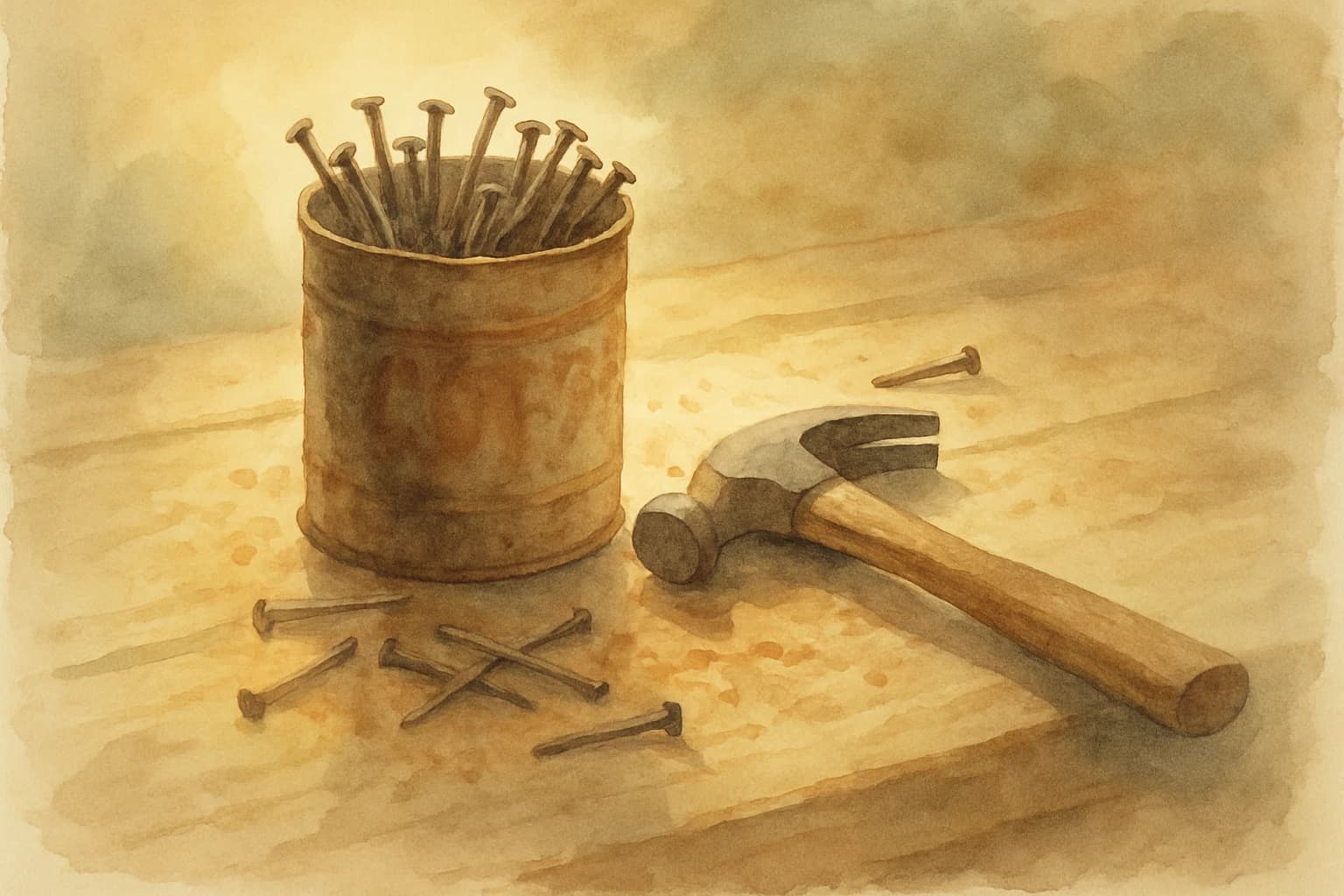
There was no kit for it. No instructions. No adult standing over the lumber pile with a safety briefing. There was scrap wood from the garage, a coffee can of bent nails that had been straightened by hand and bent again, and however many hours until dinner. The resulting structure usually leaned. It often collapsed. It got rebuilt the following Saturday, with modifications.
This was a particular kind of childhood education that nobody called education. Here are ten things kids built from scratch in the backyard, with whatever was on hand.
1. The Fort
Not a playhouse. Not a kit. A fort, which is a different thing entirely.
A fort was a project that started with two pieces of wood nailed at right angles and grew, over weeks, into something that had a door, or the intention of a door, and walls that were approximately plumb if you didn't look too hard. It was built with found materials: scrap two-by-fours from the side of the house, plywood someone's father had stacked against the fence after a home project, flattened cardboard boxes wedged into the gaps.
The fort got added to constantly. A roof section went up, then came partly down in a storm, then went back up again with more nails this time. A window got cut with a handsaw by someone's older brother. The floor was bare dirt, then someone dragged in a piece of outdoor carpet, then the carpet got wet and had to go. The thing was never finished. Finishing wasn't the goal. The goal was the next modification.
2. The Tire Swing
The rope came from the garage, or from the hardware store if someone's father was cooperating. The tire came from behind the filling station, where they sometimes stacked them on the side of the building and didn't seem to mind when they went missing. The branch had to be tested first, which meant jumping on it, which told you very little but felt scientific.
One end of the rope through the tire, tied with whatever knot a ten-year-old could manage, and the other end over the branch and tied to itself. The whole operation took forty minutes. The swing lasted two summers before the rope frayed enough that someone's mother cut it down.
3. The Go-Kart
This was the most ambitious project most backyard builders ever attempted, and it worked only occasionally.
The chassis was a two-by-four, long, with a shorter two-by-four nailed across the front. Four wheels came from somewhere -- old wagon wheels, lawnmower wheels, skate wheels if the builder was lucky. The front axle pivoted on a bolt so you could steer with your feet. There were no brakes, which was a design choice arrived at not by decision but by forgetting.
The hill down the side of the yard, or the driveway slope, was the testing ground. Most first runs ended in a crash into the fence or a controlled bail-out onto the lawn. The second run was better. The third run was when someone broke something.
The go-kart had no engine. That's important to note. The engine version was for older kids, teenagers, and it was a different project. The backyard go-kart ran on gravity and nerve, and it was rebuilt every summer by kids who were convinced this time they had the steering figured out.
4. The Dam
Any backyard with a drainage ditch, a low spot that collected rain, or a decent slope had the potential for a dam. The materials were mud, rocks, sticks, and more mud. The project started as soon as the ground was wet enough.
The goal was to stop water. The water never fully stopped. The dam got higher, got patched, got reinforced with larger rocks, developed a leak on one side, got patched again. The most ambitious dams grew into canal systems, with channels dug by hand across the yard connecting one pool to another. These took an entire afternoon and were mostly washed away by the next good rain, which meant they could be rebuilt next week.
5. The Zip Line
A rope between two trees, strung as high as both parties could manage, with a pulley or a looped piece of garden hose for the handle. The mathematics of sag meant the rider always slowed to a stop about two-thirds of the way down and had to push off with their feet. This was considered acceptable.
6. The Soapbox Racer
Different from the go-kart in one essential way: it was built for a specific occasion. The neighborhood had a hill. Every summer, someone organized a race. You had two weeks and whatever your father didn't need right now.
Serious builders spent those two weeks doing real engineering, in their way. The seat needed to be low enough to keep the center of gravity down. The wheels needed to be aligned, which meant spending an hour crawling around on the driveway with your face six inches from the axle. The steering rope needed to be exactly the right length so you didn't overcorrect. Weight mattered, and the kid who figured out that a lighter frame was faster had an advantage.
Most racers lost. The winner was usually the kid whose older brother had actually done this before.
7. The Treehouse
Different from the fort in that it was up in something, which meant the first challenge was structural and couldn't be faked. A treehouse with a bad platform fell.
Fathers got involved more often here, or got pulled in against their will when the kid had already nailed something to the oak tree and the nail had gone all the way through. The collaboration was sometimes tense. The father wanted to do it right; the kid wanted to do it now. The resulting structure usually reflected the negotiation: solid platform and joists, supervised by the father, and then increasingly improvised upper works built when he wasn't watching.
The best treehouses had a pulley system for hauling up supplies. This took another full afternoon to rig and worked about half the time.
8. The Skateboard Ramp
This one appeared later than most of the others on this list, mostly in the late 1970s and through the 1980s. The materials were plywood, two-by-fours, and an increasingly sophisticated understanding of the geometry of a curved surface.
The first attempt was usually flat with a curled-up end, which worked but produced a sharp lip that ended rides abruptly. The second attempt bent the plywood more gradually, which required steaming it or kerfing it, which required looking up what kerfing meant, which required talking to someone's father who worked in construction. The ramp that actually worked took three weekends and two sheets of plywood, and it occupied a significant portion of the backyard until someone's mother made them move it to the side yard.
9. The Slingshot
A forked branch, a strip of inner tube, a leather tongue cut from a worn-out shoe. Twenty minutes of work. The thing fired. The ammunition was whatever rocks were the right size and roundness, which took another ten minutes to collect from the driveway edge.
The targets were usually cans set up on a fence rail, and the hit rate was low enough to keep the exercise interesting for an entire afternoon.
10. The Lean-To
When there was no wood, or not enough, a lean-to was the fallback. You took the longest branches you could find and propped them against the fence, or against the side of the garage, at an angle. You layered more branches across them sideways. You piled leaves on top until the structure shed rain, or you told yourself it did.
The lean-to was the most primitive structure on this list and possibly the one that produced the deepest satisfaction. Nothing was purchased. Nothing was cut or nailed. The shelter came entirely from what was on the ground, arranged by a kid with time on their hands and no particular plan.
What you should probably not try to bring back
The bent-nail coffee can from the garage, yes. The afternoons with no agenda, absolutely. But some of what surrounded this particular childhood deserves to stay in the past.
There were kids who got hurt, seriously, on homemade go-karts and zip lines that were not built with any real knowledge of load limits or friction or the mechanics of what happens when a rope breaks at speed. Some of those injuries were minor and instructive. Some were not minor. The absence of adult supervision that made the fort-building possible was the same absence that let a genuinely dangerous project proceed without anyone noticing until too late.
The "kids build everything unsupervised and figure it out" era wasn't uniformly good. It produced resourcefulness and independence in children who came through it fine. It produced broken arms and concussions in children who didn't. The nostalgia is for the resourcefulness. It shouldn't be for the part where nobody checked on you for six hours while you nailed scrap lumber over your head.
The kids who built things did learn something real. The medium was the lesson. But the learning didn't require that the adults be entirely absent -- it required that they be present enough to let the kid lead, which is a different thing and a harder thing to get right.
Did you build any of these? What was the biggest structure you ever put up in your backyard? Share yours in the comments -- we love these stories.
Get a new story every Sunday morning.
One email a week. No spam. Unsubscribe anytime.
If this brought back a memory, you might also like
12 Objects That Filled an American Mother's Apron Pocket
A folded, used paper towel tucked away because it still had something left, and a stubby pencil with an eraser worn down to a hard, useless nub.