The Clothesline Neighbor and the Friendship That Never Entered the House
She knew your laundry before she knew your last name.
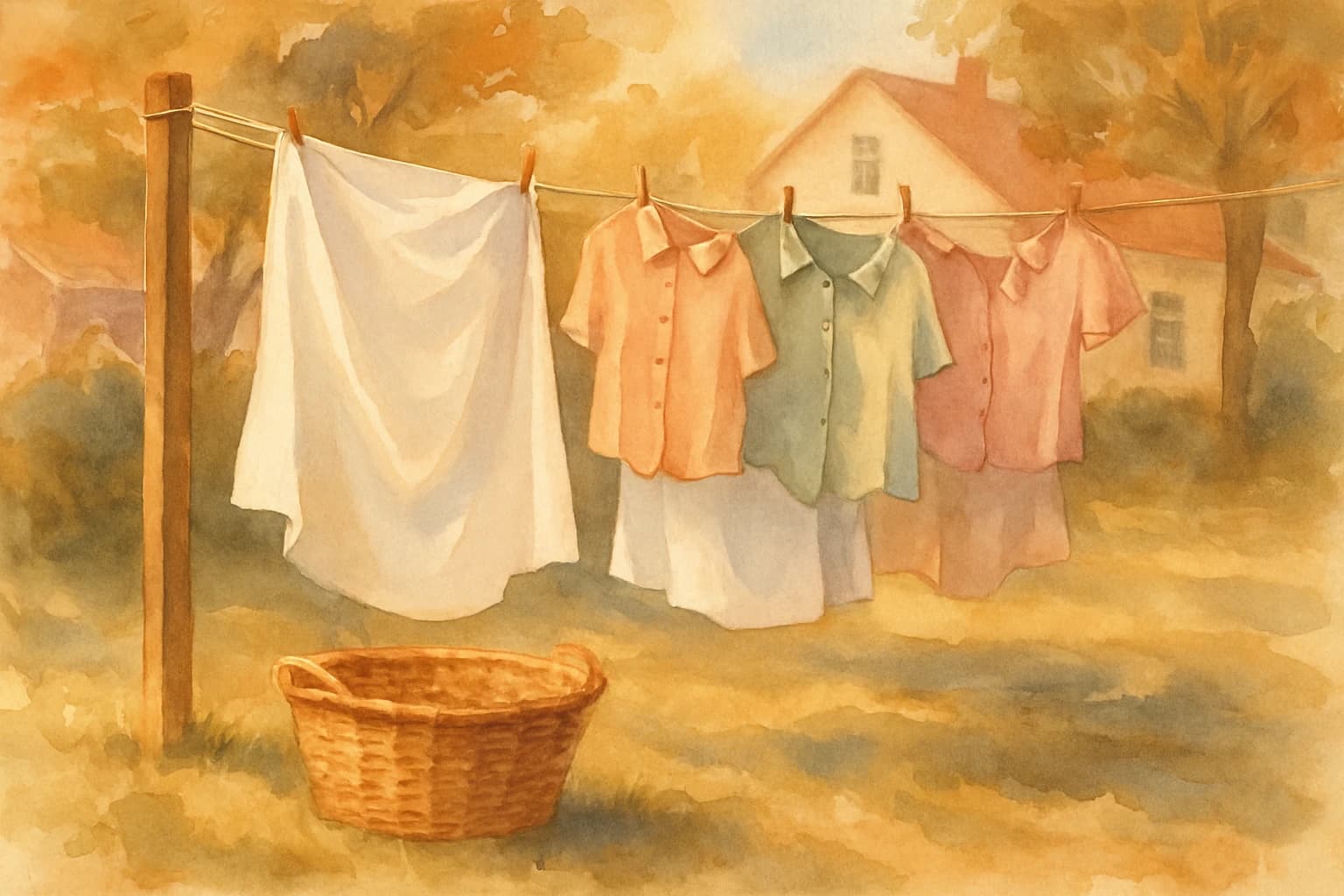
That's how it worked with the clothesline neighbor. The relationship had its own sequence, and the sequence ran backward from what you might expect. You learned, first, that she used bleach on her whites. Then that she had a husband who wore undershirts in two sizes, which suggested a significant weight change in recent years. Then that she kept a handkerchief in her apron pocket while she hung things, pulling it out to wipe her hands before touching the good blouses. You knew all of this before you ever sat in her kitchen.
If you sat in her kitchen at all.
The friendship that lived entirely outdoors
Most clothesline neighbors never got past the yard. The relationship was bounded by the act. You came out with your basket. She was already out there, or she came out ten minutes later when she heard your screen door. You said something. She said something back. One of you made a mild observation about the weather, not to fill space but because the weather was genuinely relevant to the task at hand -- a stiff wind was a good thing, a humid morning was a problem. The conversation went two or three minutes, sometimes five. Then you both went back inside.
This happened two or three times a week, and it happened for years.
The friendship never had a dramatic moment. There was no dinner party, no long evening on the porch, no crisis that revealed what the other person was made of. It was built entirely from these accumulated contacts, each one unremarkable, all of them continuous. The structure was what kept it together. Take away the clothesline and the two of you had no real mechanism for contact, and you both knew it without saying so.
What got said and what didn't
The clothesline conversation had a particular register. It was neither small talk nor serious conversation. It lived somewhere between those two, in a zone that doesn't have a good name.
You said things you wouldn't say at a dinner party because there was no audience and no sustained eye contact -- you were both busy with pins and wet fabric and the business of the line. You mentioned, almost offhand, that your daughter hadn't called in two weeks. She said that her husband's hours had been cut and they were working out whether to move the phone to a less expensive plan. These were real pieces of information about real circumstances. They were not confessions. They were just things that were easier to say while your hands were occupied.
The physical activity gave the conversation cover. You didn't have to hold the weight of what you said because neither of you was holding still for it. The basket and the pins and the reaching up gave your hands something to do and released your mouth from the usual social obligation to manage the other person's reaction. You said your piece. She received it. You both moved on to the next item on the line and the next subject, or to no subject at all.
This is one of the things that disappeared when the outdoor laundry ritual disappeared. Not the information exchanged -- people find other ways to share news -- but the particular quality of confidence that's possible when you're both doing something else at the same time.
The competition you were supposed to pretend wasn't happening
Let's be honest about what else went on out there.
You noticed her sheets. She noticed yours. There was a standard operating in those yards, never stated, that had to do with whiteness and hang time and the absence of stains and the care with which items were folded onto the line rather than just heaved up. It was not aggressive, the way competition can be aggressive. It was quieter and more persistent than that. It ran underneath the friendly conversation like a separate channel.
Some women took genuine pride in a line hung well. The sheets evenly spaced, the shirts pinned by the tails so they'd come down unwrinkled, the towels doubled over the line in thirds. The visible line was a statement about the running of the household, and it was a statement made to the one audience most likely to be paying attention, which was the clothesline neighbor.
None of this was acknowledged directly. It operated through observation and implication. "Your cottons always come out so bright" was a statement that contained a question. "I do a second rinse" was an answer that closed the conversation politely while conveying the relevant information.
This was competitive in the way that a lot of mid-century women's domestic life was competitive -- constant, precise, and entirely underground. That part of clothesline culture you do not need to miss.
What the line told a neighborhood
A clothesline was legible to anyone who knew how to read it.
You could see when a family had a new baby by the change in what went up. You could see when someone was sick by the absence of laundry for too long. You could see the economic circumstances of the household, roughly, by the quality of the fabric. You could see the season changing by what came off the line -- the flannels coming out in October, the cotton nightgowns going back up in May.
The neighborhood, in this way, was not a private collection of sealed houses. It was a place where ordinary life was legible from the yard. People knew things about each other because daily life had a visible dimension. The clothesline neighbor friendship existed in that visible dimension. It was built from being seen, and from seeing, in the most literal sense.
The sealed modern house -- the climate-controlled interior, the electric dryer, the closed garage, the backyard privacy fence -- reversed this. It made ordinary life invisible to the neighbors. This is not entirely a loss. Privacy has value. But the visibility of ordinary life was also the mechanism that produced casual neighborly contact, and when you removed the visibility, you removed the contact with it.
What replaced it, more or less
Nothing replaced it exactly, but a few things landed in the general vicinity.
The dog walk comes closest. Two people walking dogs in the same neighborhood at the same time of morning will eventually stop and talk while the dogs investigate each other. The conversation is bounded by the activity. It runs two to five minutes. It happens regularly. It accumulates over years. You learn things about each other that you would not learn at a dinner party.
The school drop-off circle operates on similar mechanics, though it's bounded by a shorter season and depends on children aging out of it.
The clothesline neighbor friendship was different in one way worth naming: it was domestic. It happened from within the household, in the yard attached to the house, during a task that belonged to the household. The friendship emerged from the dailiness of the domestic life itself. The dog walk is chosen -- you go out for the dog. The laundry happened whether you wanted it to or not, and the neighbor appeared as part of the same necessity. There was something about that involuntary quality that made the contact easier. Neither of you was putting effort into the relationship. The relationship just formed around the unavoidable.
What's worth keeping
The mechanics, more than the laundry.
Hang a clothesline in your yard, if your neighborhood allows it, and you'll probably use it. The laundry does come out better in some ways -- flat-dried sheets have a feel that a dryer doesn't quite reproduce, and you'll save on the electric bill. Whether you'll recreate the clothesline neighbor relationship depends entirely on whether your neighbor is also out there regularly, which is no longer a sure thing.
But the broader lesson the clothesline encodes is still usable. Regular, low-stakes, face-to-face contact, conducted while doing something ordinary -- this is how the looser friendships that hold a neighborhood together actually form. You don't build those friendships by scheduling them. You build them by being outside, or visible, or in some regular place at some regular time, often enough that the other person eventually says something.
The clothesline was one mechanism for that. There are others. The front stoop. The garden in the front yard rather than the back. The mailbox check at the same time every afternoon. The porch where you actually sit.
None of these is the thing. All of them can produce the thing, which is the two-minute conversation, repeated often enough over a long enough span of time, that eventually becomes something you'd miss if it stopped.
She knew your laundry before she knew your last name. And by the time she knew your last name, she already knew quite a lot more than that.
Did you have a clothesline neighbor growing up -- someone your family talked to in the yard in passing, year after year? What do you remember about those conversations? Share your story in the comments -- we're listening.
Get a new story every Sunday morning.
One email a week. No spam. Unsubscribe anytime.
If this brought back a memory, you might also like
10 Midway Traditions Vanished Along With the Ferris Wheel Skeleton
The skeleton of the Ferris wheel rose in sections by the highway, and a rubber mallet struck steel to ring a bell that rarely sounded.