The Cool Air and Bare Bulb That Waited at the Bottom of the Cellar Stairs
Every house that had a cellar had a door that led to it, and the door was always in a specific place.
Not the basement. The cellar. The distinction matters. A basement was finished space, with drywall and a television and maybe a ping pong table. The cellar was the other thing: raw block, the water heater in the corner, a bare bulb on a string. The cellar is what houses had before basements were something you decorated.
The door was usually in the kitchen, or off a back hallway. It was a regular-sized door that looked like any other door in the house except that it was slightly heavier, and when you opened it, the air that came out was different. Cooler. Not cold, exactly. Cooler, and with a smell that was particular to that house, to that soil, to whatever had been stored down there long enough to leave a trace.
And then the stairs went down, and the light was at the bottom, not the top.
What was down there
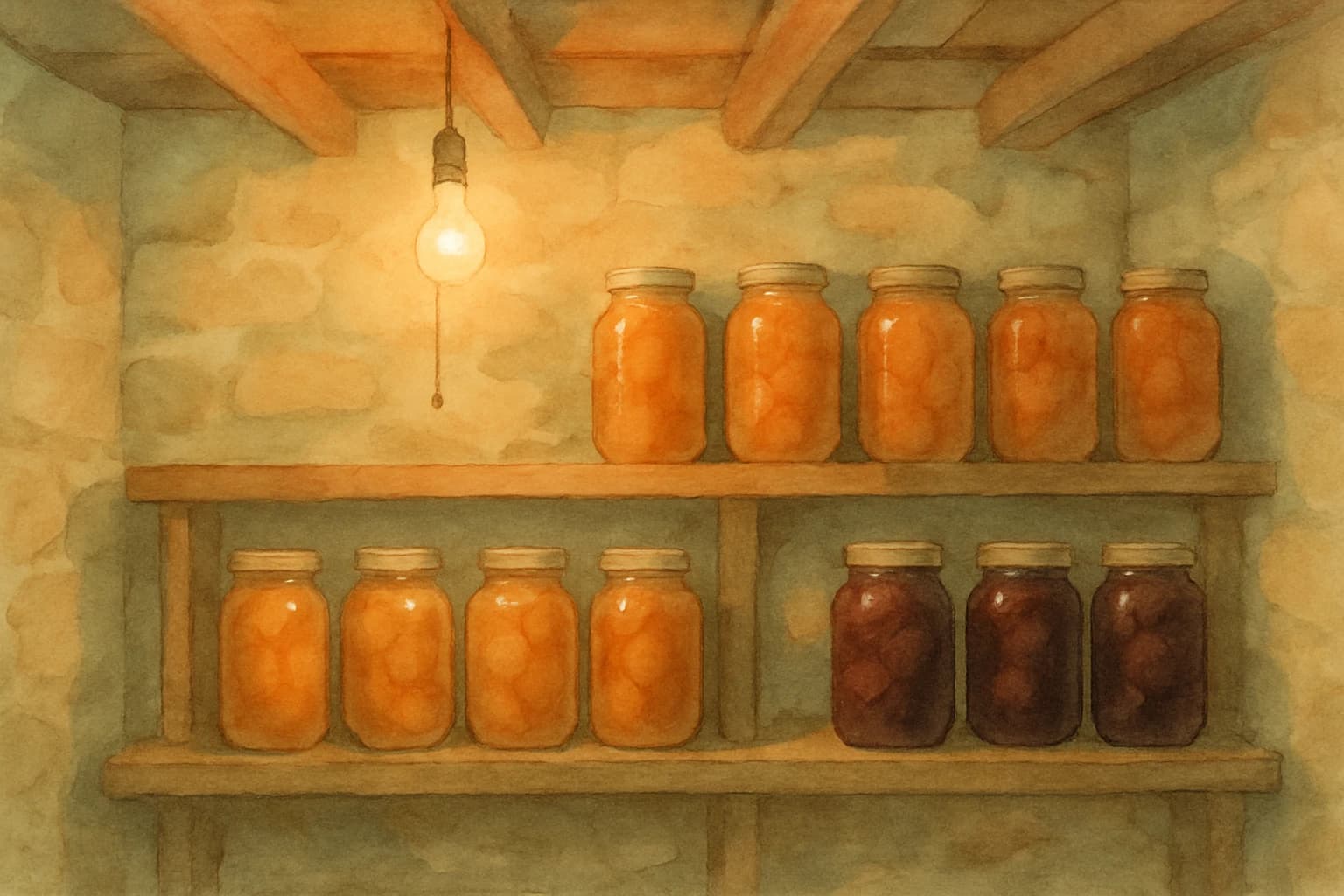
The cellar was a working room. The preserves were down there, on wood shelving along one wall -- the canned tomatoes your grandmother put up in August, the pickled beets in their dark jars, the green beans she and your mother had done together on the back porch one long Saturday in July. The shelves had been built by someone with a handsaw and no particular precision. They held.
The root vegetables were down there in bins: potatoes, turnips, onions. A coal bin in the older houses. The freezer chest your father bought in 1968 that held the beef from the half-cow he'd purchased from a man in the next county. The oil tank. The workbench, if there wasn't one in the garage. The Christmas boxes, labeled in marker on the outside. The fishing gear in November.
The cellar held the parts of the household that the household needed but didn't want to look at every day. It was a memory system, a storage system, a pantry, and a utility corridor all in one undivided space. It was the stomach of the house.
And at the top of the stairs leading to it, every child who grew up with one understood a certain calculation: I need to go down there, and I need to do it fast, and I need to go alone.
The particular dark
The switch was at the top, most of the time. You flipped it and a single bulb came on somewhere below, and the bottom of the stairs became visible, and everything between you and the bottom was still in partial shadow because one bare bulb doesn't reach the corners.
The dark at the bottom of cellar stairs was not like other dark. It was a visible dark, which sounds like a contradiction but wasn't. You could see the light. The light was on. And there were still places the light didn't reach, and those places moved slightly when the bulb swung on its cord, which it did if the furnace kicked on and moved the air.
Children understood this dark the way they understood almost nothing else: completely, and without being able to explain it. You went down fast. You got what you were sent for. You came back up fast. You didn't look at the corners. Everybody had their own version of what lived in the corners, and nobody talked about it, because talking about it gave it more weight.
The cellar dark is one of the things that every generation of American children who grew up with one carries forward into adulthood as a memory that is fully intact in a way that most memories are not. The smell. The particular temperature on the way down. The rough feel of the wooden railing. The sound of your own feet on the stairs. The pull to hurry.
You still know it. You don't need a photograph.
What was good about it
The cellar was evidence that the household had planned ahead. The shelves of preserves meant your grandmother had spent one full season anticipating the next one. The half-cow in the chest freezer meant your father had made a calculation about the family's needs, negotiated with a farmer, and carried through. The root bins were stocked in the fall because someone understood that fall came before winter.
Modern households can plan ahead with a list and a car and a supermarket open until midnight. The planning doesn't leave the same visible evidence. There's no shelf in the kitchen showing you how many winters your household has managed. The cellar shelves did that. They were a record of provision, in glass jars, labeled in hand.
And there's something else. The cellar was a room children were sent to alone. "Go down and get me a jar of tomatoes." Not, "let's go together." Alone. You were expected to manage yourself, to feel whatever you felt on the way down, and to come back with the tomatoes. The errand trained something. Self-command is a neutral description. Grit is an overused one. Something in between: the understanding that you could be uncomfortable and still complete the task.
What was bad about it
Some of them flooded. Every spring thaw or heavy rain, the water came in through the block walls or up through the floor drain, and whatever was stored at the bottom of the shelves was at risk. Families lost preserved food. They lost boxes. They ran wet-vacs down the stairs for two days. The cellar was also where the radon came from, in many houses, silently and for decades, before anyone understood what radon was or thought to test for a gas you couldn't see or smell.
The preservation jars, done wrong, could make you sick. Not sometimes -- reliably, if the seal was bad and you didn't catch it. Botulism is not a historical curiosity. It was a real and present risk in home canning, and families who canned heavily and didn't know the proper temperatures were playing a game with odds they didn't fully understand.
The coal bin was a specific kind of grim. The oil tank leaked into the soil, sometimes. The electrical in many old cellars was wired by the original owners at a time before code meant much, and it stayed that way for sixty years.
The cellar had a romantic character that should not be separated from the actual conditions. It was cold, and damp, and in many houses it was a genuine health risk. Radon mitigation exists now. Frost-free refrigerators and modern grocery supply chains mean a household doesn't need a root bin or a chest freezer full of half a cow. The supermarket being open at midnight is not a sign of American moral decline. It is a sign that food storage has been professionalized out of the individual household, and that the individual household is better off for it.
What disappeared with it
The planning calendar disappeared. When you could see the preserves on the shelves, you could see where you were in the year. Twenty jars of tomatoes in October meant you were set. Seven jars in February meant you'd used them faster than expected and needed to be careful. The shelf was a running count of where the household stood.
Modern households keep that count in the abstract. You know roughly whether you need to shop. You don't have a physical shelf that shows you the number.
The tolerance for productive discomfort also thinned a little. The cellar trip was not a big thing, in retrospect. It was thirty seconds of mild unease and a task completed. But it was a daily or weekly occasion where a child was required to be uncomfortable without anyone managing the discomfort for them. The cellar trip, the long walk to school, the unstructured afternoon in the vacant lot -- these were unremarkable small experiences that added up, over a childhood, into a person who understood that discomfort was temporary and tasks had to be completed anyway.
The cellar stairs are gone from most houses now. The new construction has slab foundations, or finished basements, or nothing below grade at all. The particular dark at the bottom of the stairs has nowhere to live.
There are people in their fifties and sixties who can still feel the railing on the way down, still hear the furnace, still recall the exact quality of light from that single bulb. The memory is completely preserved, which is one of the stranger ironies: the cellar was built to preserve things, and it turns out it preserved something no one expected.
Did your house have a cellar? What was at the bottom of those stairs for you? Drop yours in the comments -- we'd love to hear it.
Get a new story every Sunday morning.
One email a week. No spam. Unsubscribe anytime.