The Dial Turned by Hand: Three Channels and the Static in Between
Three channels, and you watched all of them, because that was the whole selection.
CBS, NBC, ABC. Maybe a fourth if you lived near a big enough city to pick up an independent UHF station through the static, the picture rolling every few minutes until somebody got up and adjusted the antenna. Saturday afternoon television in most American households in the 1960s and into the 1970s meant choosing among a wildlife documentary, a bowling tournament, and a black-and-white movie from 1948, and then watching whichever one you'd landed on for the full ninety minutes, because getting up to change the channel required walking across the room and turning a dial by hand.
This was not a golden age of programming. Nobody thought that at the time. What it was, instead, was a shared experience with almost no alternative, and the absence of alternative did something to the afternoon that's worth looking at plainly, without pretending the limitation was secretly a gift.
The dial itself was the whole apparatus
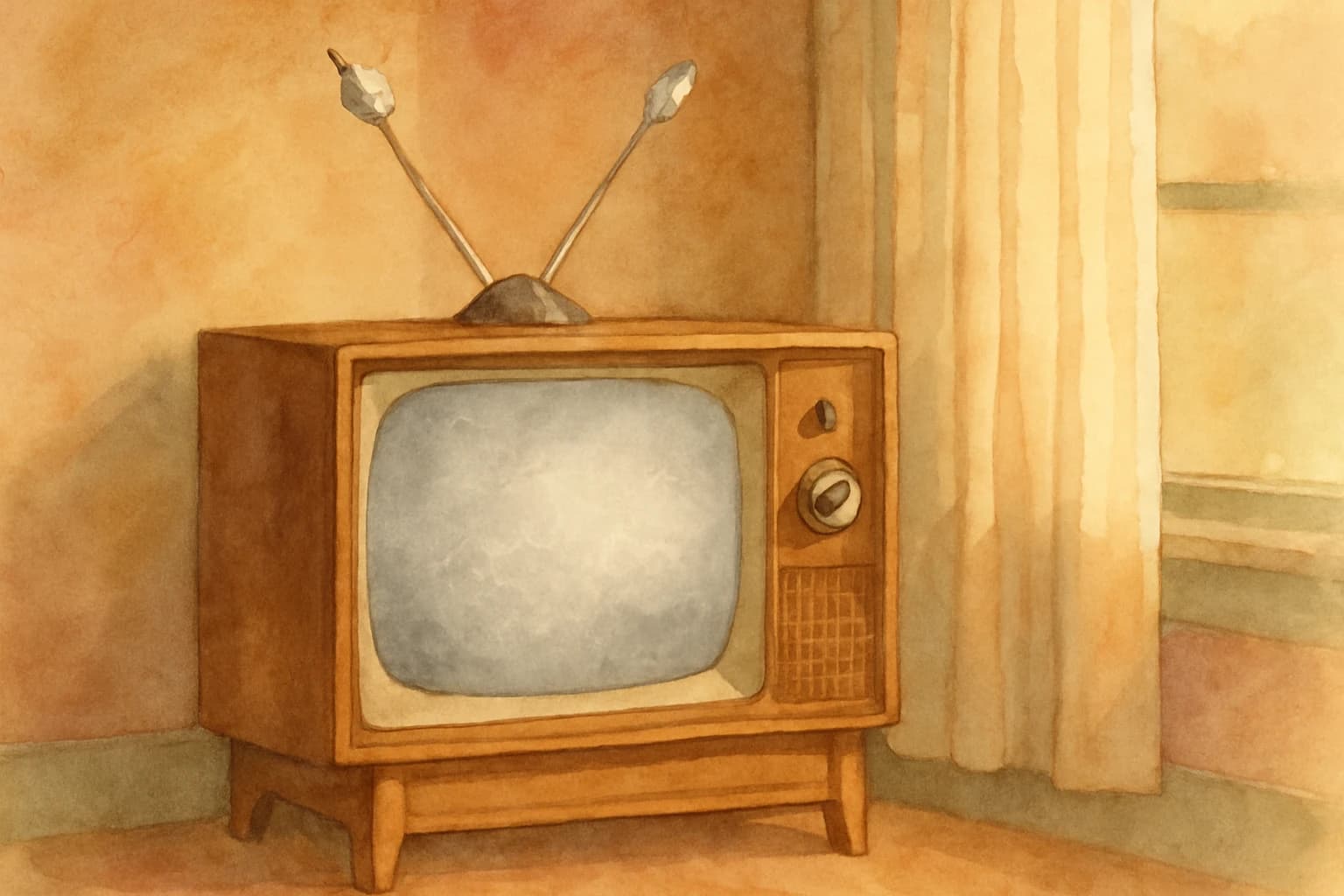
The television sat in a wooden cabinet, often with doors that closed over the screen when it wasn't in use. The dial had numbers up to 13, though most households only ever used three or four of them. Turning it produced a mechanical click, and between stations there was a stretch of static, a shape shifting between snow and picture as you rotated past the dead channels.
Getting reception at all depended on a rabbit-ear antenna balanced on top of the set, sometimes with a piece of aluminum foil wrapped around one prong because somebody had discovered years earlier that it helped the picture hold. Adjusting it was a household skill. Somebody in the family, usually a father or an older brother, knew exactly where to stand and how to angle the antenna to get channel 5 to come in clean, and that knowledge was passed down the way other household skills were passed down, without instruction, just by watching him do it enough times.
The remote control existed by the mid-1950s but hadn't reached most households by 1965. Changing the channel meant getting up. This single fact shaped the entire experience of Saturday afternoon television more than anything else about it.
Nobody watched what they wanted. Everyone watched what was on
If channel 4 had a bowling tournament from two to four in the afternoon, and you were in the living room, you watched bowling. Not because you liked bowling. Because the alternative was getting up, walking to the set, turning the dial to a station showing something you also hadn't chosen, and sitting back down to watch that instead.
Wide World of Sports ran on ABC starting in 1961 and covered whatever was available that week: cliff diving from Acapulco, log rolling, a track meet from somewhere in Europe. You didn't tune in because you cared about log rolling. You tuned in because it was two o'clock on Saturday and that was what was on, and by the third commercial break you had somehow developed opinions about the log rollers.
This produced a strange kind of fluency. Kids who grew up in this era can often still describe the format of shows they never would have chosen, because they'd absorbed them by sheer repetition. You knew the rhythm of a Saturday afternoon movie, the studio logos, the specific way local stations broke in for weather. You knew this the way you know a song you never bought, just from having heard it enough times in a room you couldn't leave.
The whole house watched together, whether or not they agreed
A single television meant a single audience. If the set was on, the family was, to some degree, watching the same thing, even if half of them were reading the paper or doing a crossword with one eye on the screen. There wasn't a bedroom television for the kids and a kitchen television for mom and a den television for dad. There was one screen, and whoever was in the room shared it.
This created its own low-grade friction. Somebody always wanted to watch something else. The negotiation over what stayed on the dial was a real, ongoing domestic argument, conducted in short bursts. "Just let me see the score" was a common phrase. So was "we're not watching this the whole time, are we."
But the friction had a byproduct. Families ended up watching things together that none of them would have chosen alone, and some of what stuck with people later, the shared references, the lines from old movies that became family jokes, came directly out of that forced togetherness. You didn't choose the show. You chose to be in the room, and the show came along with it.
What this actually cost people
It would be dishonest to pretend the three-channel era was simply a warmer, more communal time that we traded away for something worse. The limitation was real and it was often just a limitation, not a virtue.
If you didn't like sports, and it was a sports Saturday, you sat through sports, or you left the room and found something else to do, which many people did. If you were a girl in a household that mostly watched what the father wanted to watch, your preferences didn't factor into the decision much at all. The idea that everyone happily consented to whatever was on is mostly retrospective softening. A lot of people were simply outvoted by whoever controlled the dial, and the person who controlled the dial was usually the same person every week.
The programming itself was thin by later standards. A lot of Saturday afternoon television was filler, purchased cheaply by local affiliates to occupy hours nobody at the network cared much about. Old movies ran because they were inexpensive to license, not because anyone had curated them thoughtfully. Bowling and wrestling filled hours because they were cheap to produce, not because audiences were clamoring for them. Choice, when it eventually arrived with cable and later with streaming, gave people access to things they actually wanted to watch, and that access is a genuine improvement, not a loss dressed up as one.
Nobody who lived through a Saturday of watching a badly dubbed foreign film because it was the only thing on channel 9 wants that particular Saturday back. The abundance we have now, whatever its problems, solved a real and common frustration.
What went with it anyway
Still, something thinned out along with the limitation. The shared cultural reference points, built from everyone watching the same handful of things because there was nothing else to watch, don't get rebuilt the same way with a thousand channels and infinite scroll. A popular show on a Saturday afternoon in 1968 could reach an audience that dwarfed anything a single program draws today, and that scale gave a country a common vocabulary it didn't have to work for. Nobody has to negotiate over the remote in a house full of individual screens, because there usually isn't a remote to negotiate over anymore. Everyone has their own show, on their own device, in their own room.
The three channels didn't make people happier. They made people share more, sometimes against their will, and the sharing left a residue that the current abundance doesn't produce, because abundance doesn't require anyone to sit through anything they didn't choose.
Did your family fight over the dial? What was the show you ended up loving even though nobody would have picked it? We'd love to hear your memory of this.
Get a new story every Sunday morning.
One email a week. No spam. Unsubscribe anytime.