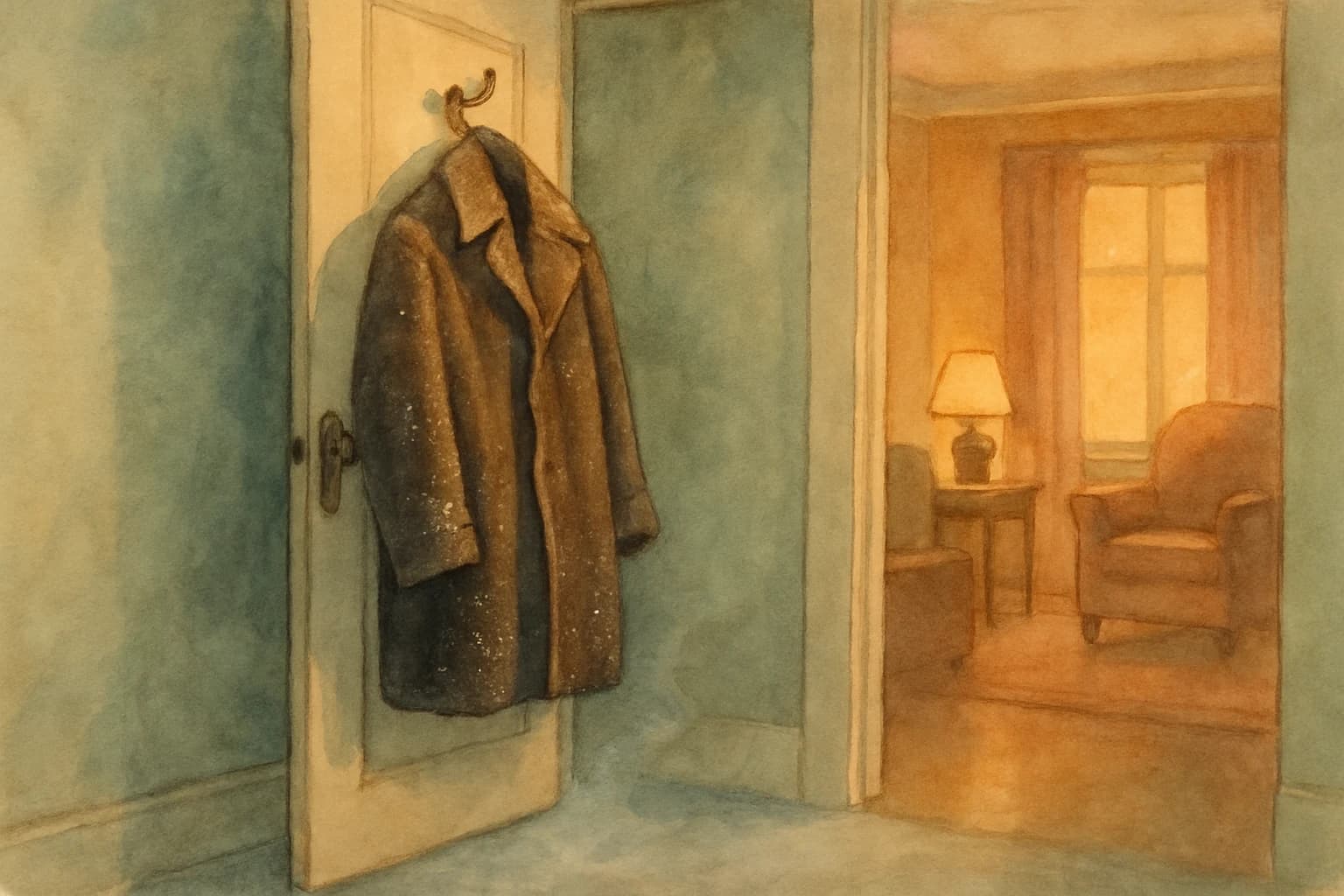
The Front Hall Closet That Held the Winter at Bay
The door had a rule, and everyone in the house knew it without being told.
You went out, you came back in fast, and you shut the door behind you before the cold got any further than the mat. This wasn't about heating bills, or it wasn't only about heating bills. It was a physical fact of winter life in a house with a furnace that worked hard and windows that didn't quite seal: the cold was a guest that would walk right into the kitchen if you let it, and your job, every time you opened that door, was to keep it in the entryway and then push it back out.
You felt it on your legs first if you were a kid in corduroys. You felt it on your face if you'd just come in from shoveling. And you felt it as a kind of weather that briefly occupied the house itself, a cold pocket that moved through the front hall and dissipated by the time it reached the living room, assuming somebody had done their job and closed the door in under three seconds.
The architecture of coming inside
Houses built before central heating became universal, and even a lot of houses built after, had a real relationship with outdoor temperature that modern construction has mostly engineered away. Storm windows went up in November and came down in April. Plastic sheeting sometimes got stapled over the worst offenders. There was a particular chair, usually near a heating vent or a radiator, that was understood to be the warm chair, and there was a hierarchy about who got to sit in it.
The front hall closet existed partly to solve the coat problem, but it also solved a temperature problem. You didn't walk your outdoor coat through the house. You took it off in the entry, hung it up, and by doing that you left most of the cold behind you in that first six feet of hallway. Boots came off there too, on a rubber mat or a folded towel, because wet boots tracked snow and snow melted and melted snow was its own kind of cold that lingered on the floor.
The storm door was the first line of defense, a second door outside the real door, and its whole purpose was to create a buffer of trapped air between you and the outside. You'd hear it slap shut behind whoever went through it, a particular sound, thinner and tinnier than the main door's sound, and that slap told everyone in the house that the real door was still closed and the cold hadn't gotten through yet.
The cold of particular rooms
Not every room got cold the same way. The kitchen usually stayed warmest because the stove ran most of the day and heat radiated out from it into the surrounding air. The bathroom, especially if it had a window near the tub, could feel like an outdoor room in January, and a lot of houses solved this with an electric heater plugged in just for morning use.
Upstairs bedrooms in older houses were frequently colder than downstairs rooms, because heat rises past them on its way to the attic and because upstairs windows had usually been the second priority when storm windows went up. Kids slept under enough blankets that getting out of bed in the morning required a kind of preparation. Feet hit a cold floor. You dressed fast, or you dressed under the covers, a skill involving getting a shirt on while horizontal that most people over fifty still remember how to do.
The mudroom, where houses had one, was the coldest room by design. It wasn't meant to be comfortable. It was meant to be a transitional space where the outside handed you off to the inside gradually, where your boots and coat and the cold clinging to both of them could be dealt with before you were allowed into the rooms that mattered.
What the cold taught you
There was a discipline in it worth naming honestly, without dressing it up. You learned to close doors behind you because an open door in January was a minor betrayal of everyone else in the house. You learned that heat was a shared resource, generated by a furnace that ran on oil or gas your parents paid for, and that wasting it by standing in an open doorway deciding whether to go out was a real offense with real consequences on the bill.
You also learned patience with your own body. Getting warm again after being cold wasn't instant. It took twenty minutes by the vent, or a mug of something hot held in both hands, or wool socks and a few minutes under a blanket on the couch. The house didn't respond to a thermostat the way houses do now. The furnace had a lag to it. You waited out the cold the way you waited out most things then, which is to say you didn't have another option, so you just did it.
The honest part
None of this should come back, not really. The old houses were drafty in ways that were genuinely uncomfortable and sometimes dangerous for older people or infants. A lot of that cold wasn't character-building. It was just poor insulation, and it cost families real money every winter in fuel that better-built houses don't require. The kid dressing under the covers because the floor was too cold to stand on wasn't living some superior, hardier life. He was cold, and being cold in your own bedroom in December isn't a thing to romanticize.
Modern houses hold heat evenly. A house built to current code doesn't have a cold pocket by the front door because the door itself, and the wall around it, are built to a standard that simply didn't exist in 1962. This is better. Nobody should want their grandchildren dressing under blankets because the floor is too cold to touch.
What's gone, though, along with the drafts, is that ritual of coming inside. The stomp of boots on the mat. The particular slap of a storm door. The shared understanding that closing the door fast was an act of consideration for everyone else in the house. Those things depended on the cold being real and present, a visitor you had to manage, and a house that can keep itself warm without effort doesn't need that vigilance anymore. The thermostat handles it. Nobody yells "shut the door" because the door barely matters now.
That's a fair trade. It's just not a free one.
Did your house have a warm chair, or a cold bedroom everyone complained about? What sound did your storm door make when it closed?
Drop your memory in the comments -- we'd love to hear.
Get a new story every Sunday morning.
One email a week. No spam. Unsubscribe anytime.