The Heavy Aluminum Pot That Compressed Time in a Rushed Kitchen
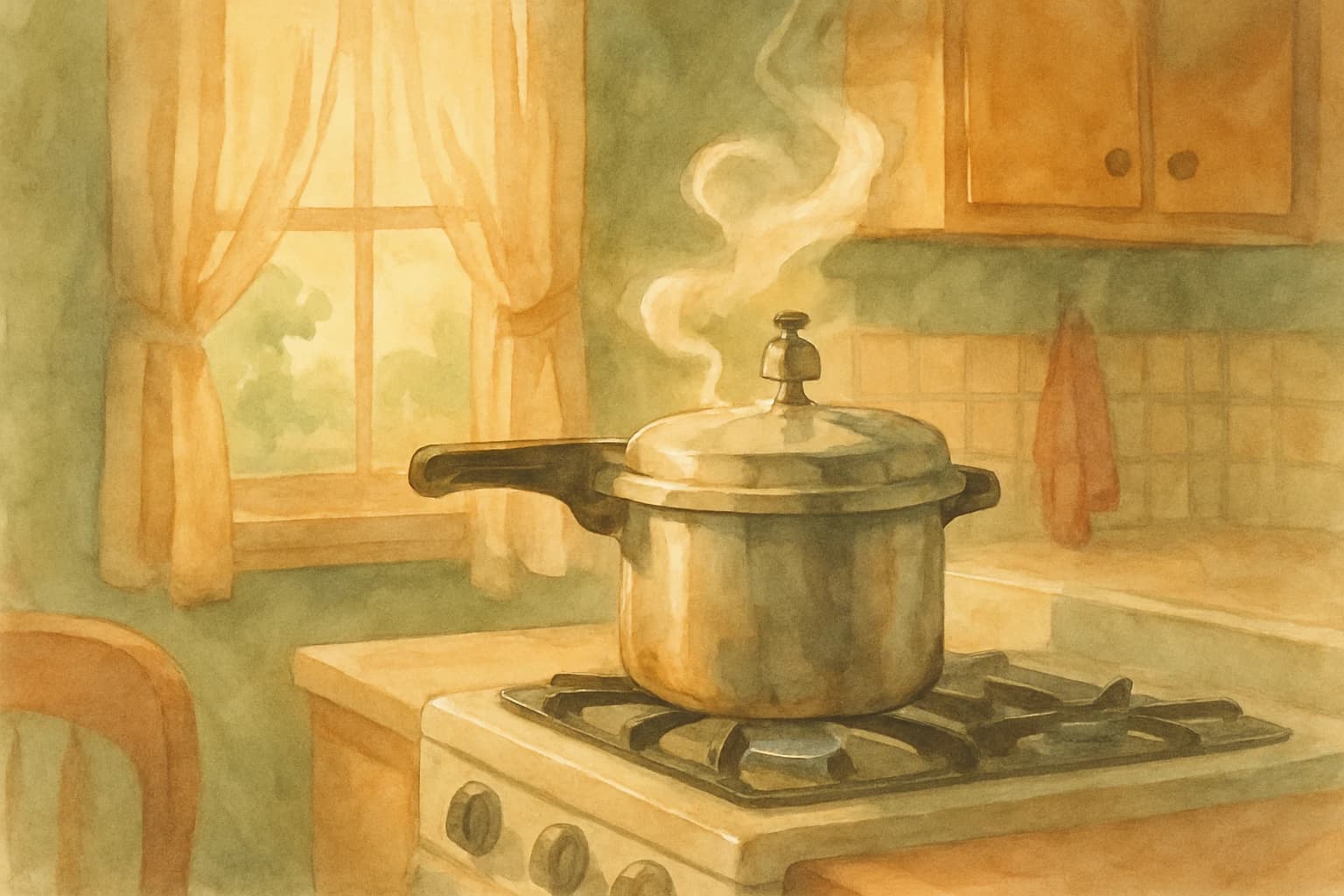
The pressure cooker sat on the back burner and made itself known.
It was not a subtle appliance. It was a heavy aluminum pot with a locking lid and a rubber gasket and a weighted valve on top that rocked when the steam built up underneath it. The rocking made a sound. The sound was a low, rhythmic jiggling, like a coin being shaken in a cup, and when you heard it from the other room it meant dinner was underway in a serious way, and that there was nothing to do about it for at least forty-five minutes.
Your mother bought it from a hardware store, or from a door-to-door salesman, or from a catalog. It might have been a wedding gift. It might have been her mother's. In either case, she had been using it for fifteen years before you were old enough to understand what it was, and she used it without consulting a recipe, because she had made this particular dish in this particular pot often enough that the recipe was in her hands.
What the pot actually did
The pressure cooker cooked food under high-pressure steam, which raised the internal temperature above the boiling point of water and cut cooking time dramatically. A pot roast that would take three hours in a Dutch oven was done in fifty minutes. A chicken that needed an hour and a half in the oven was tender in thirty. Dried beans went from hard and dry to soft and cooked without the overnight soak, if you were running behind.
This was the point. The pressure cooker existed to compress time in a kitchen that had a lot of tasks and not a lot of hours. It was an efficiency tool, in the way that most serious mid-century kitchen equipment was an efficiency tool. The woman who owned a pressure cooker was not using it for novelty. She was using it because it made hard things faster, and hard things needed to get done.
The cuts of meat that went into it were the cheap ones. Chuck roast, pork shoulder, chicken thighs, beef short ribs. The cuts that needed long heat to soften the connective tissue. These were weeknight cuts, budget cuts, the cuts you bought when you were feeding a family of five on a working income and needed every dollar to go as far as it could. The pressure cooker took the cheapest available protein and turned it into something that fell apart on a fork. That was its core competency.
The sound did real work
The jiggling valve was more than a mechanical byproduct. It was the kitchen's communication system.
If the valve was rocking steadily, the pressure was right and the dinner was on schedule. If it wasn't rocking at all, the temperature was too low and something needed adjustment. If it was rocking hard and fast and releasing too much steam, the heat was too high and you needed to turn it down before the thing blew its gasket. The sound was the pot telling you what was happening inside it, because there was no other way to know.
Children learned early that the rocking valve meant the stove was occupied and you did not remove anything from or place anything on that burner. You didn't run in the kitchen when the pressure cooker was going. You didn't jostle the stove. The valve communicated status to everyone in earshot, for its entire duration.
This is a different relationship to cooking than most households have now. Modern appliances -- the instant pot, the slow cooker, the oven timer -- are sealed and self-contained. They announce completion, not process. The pressure cooker announced process continuously, the whole time it ran. You could hear dinner happening.
What kind of household owned one
The pressure cooker was especially common in households where the cook had immigrant roots, or rural roots, or had learned to cook during the Depression. These were all households that had learned to work with cheaper cuts, to extend what they had, to make something good from something modest.
It was common in Black American kitchens, where it was used heavily for beans, greens, and the braised meats that are foundational to the Southern tradition. It was common in Italian American households for Sunday gravy with tougher cuts, for bean soups, for the long braises that normally needed most of a Sunday afternoon. It was common in households where the main cook had been raised by someone who had lived through genuine food scarcity, and who cooked accordingly even when scarcity was no longer the immediate condition.
The pressure cooker was not a showcase piece. It didn't go on the open shelf. It lived in the cabinet under the stove, or on a low shelf in the pantry, and it came out when there was real work to do.
What could go wrong
Here is the honest part.
The pressure cooker of 1965 was not perfectly safe. The gaskets wore out. The valves stuck. If you had a worn gasket and the valve stuck and you didn't notice, you had a sealed pot at high pressure with no release, and that could end badly. There were burned hands from steam when the lid was opened wrong. There were pots that released their pressure in a single loud explosion when a component failed at the wrong moment.
Most households that used these pots for decades never had a serious accident. But the accidents that did happen were memorable, and they spread. The pressure cooker had a reputation for being dangerous, and the reputation had some basis. The rubber gasket needed to be replaced every year or two, and a lot of people didn't replace it. The release valve needed to be checked before every use to make sure the opening wasn't clogged, and a lot of people didn't check it.
The new generation of electric pressure cookers -- the instant pots and their competitors -- are safer in all the ways that matter. The pressure-release mechanisms are more reliable. The lids won't open under pressure; they physically cannot. The sensors monitor the internal state continuously and regulate automatically. The engineering is genuinely better.
If you're cooking dried beans on a Tuesday night, the modern appliance is the right choice. This is not sentimentality. The old pot was good. The new tools are safer.
What replaced it, and what disappeared
The slow cooker came first, starting in the early 1970s, and it took the low end of the pressure cooker's work: the long braises, the soups, the pot roasts. It was silent. You could leave the house while it was running. It did not require monitoring. It cost less than the pressure cooker and had fewer parts to fail.
The trade-off was time. The slow cooker needed eight to ten hours where the pressure cooker needed forty-five minutes. For households where someone was home all day, this was acceptable. For households where the cook got home at five-thirty and needed to feed people at six-thirty, it was not.
The instant pot arrived much later and claimed both advantages: fast like the pressure cooker, sealed and mostly safe like the slow cooker, with digital controls and preset programs. It sold in enormous quantities, because it solved a real problem.
What it doesn't do is make that sound.
The jiggling valve is gone. The kitchen no longer announces its own work in progress. The instant pot sits on the counter with a digital display and a low hum, and when it finishes it beeps. The beep is informative and accurate. The old valve was something else -- present in a different way, for its whole duration. The dinner was audible. The household could hear that something was being made.
There's a version of this that tips into pure nostalgia and doesn't mean much. The sound was not magic. The pot was not magic. The dinner that came out of it was good because the person cooking it was skilled and practiced and willing to work with the right ingredients, not because of the appliance.
But the sound was an honest report from a working kitchen, transmitted to everyone within earshot, the whole time it ran. You knew when your mother was cooking something serious because you could hear her cooking it. Most households now don't have a sound like that. The kitchen has gone still, and the food appears on schedule, and this is fine. It's just different.
What you can still do
If you find a vintage pressure cooker at an estate sale, in good condition, with a fresh gasket and a clear valve -- it still works. It does exactly what it did in 1970. The technique hasn't changed and the results haven't changed. You can still make a Tuesday-night pot roast in forty-five minutes from cheap beef and root vegetables, and it will still fall apart in the right way.
You can also buy a stovetop pressure cooker new, because they never stopped making them. They are better engineered now than they were. They are faster and safer. They still jiggle.
The instant pot is also fine. The food is just as good.
But if you ever find yourself in a house where one of the old aluminum pots is going on the back burner, and you hear that particular low jiggling from the next room -- you'll know exactly what it means. Dinner is serious. It will be ready when it's ready. There's nothing to do about it until then.
Did your family have a pressure cooker? Do you remember what your mother made in it? Let us know in the comments -- we read them all.
Get a new story every Sunday morning.
One email a week. No spam. Unsubscribe anytime.
If this brought back a memory, you might also like
10 Heavy Objects That Lived in the American Laundry Room
Concrete floors worn thin by decades of mopping and wringer rollers that could take a finger off defined a space built for work, not comfort.