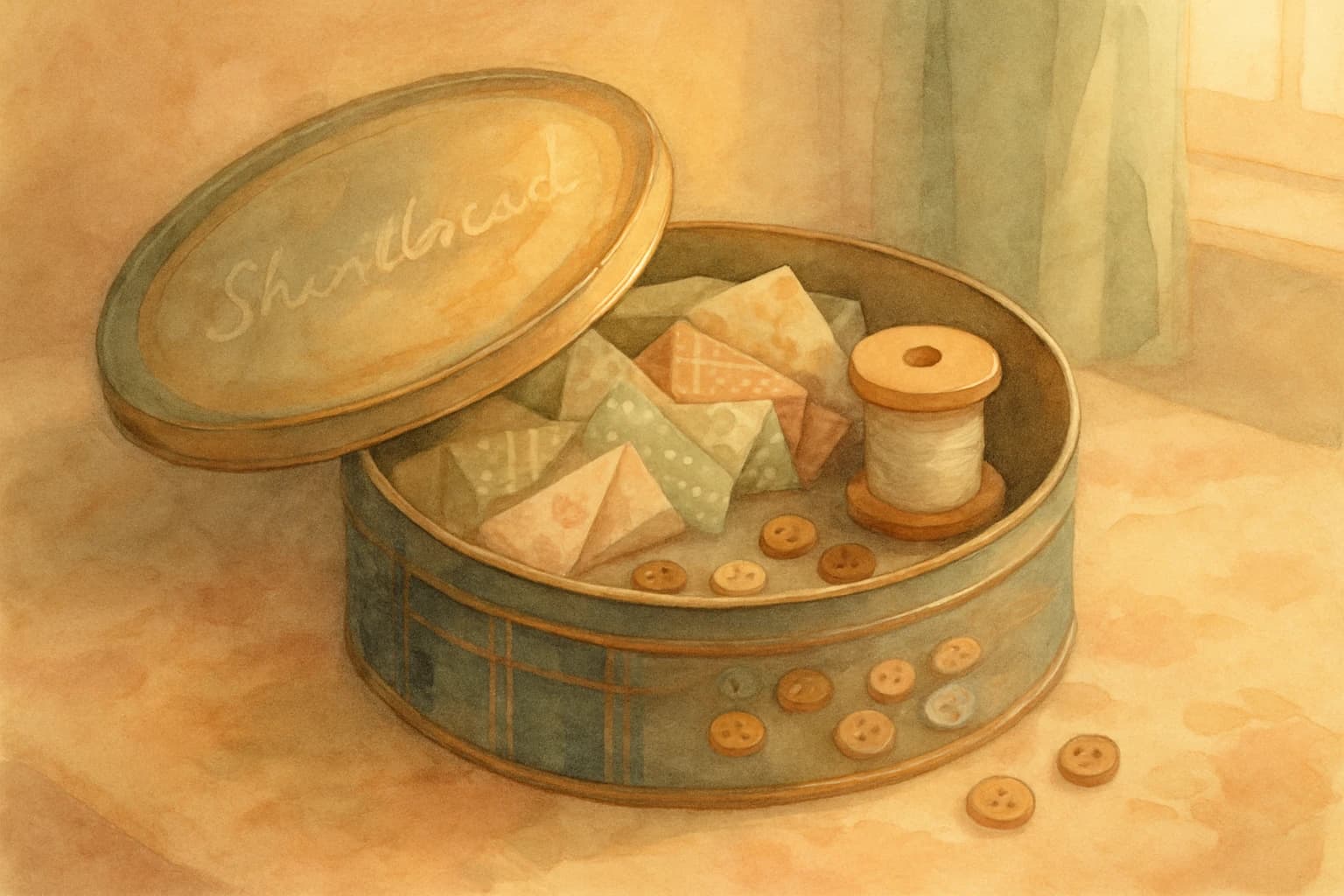
The Shortbread Tin That Became a Sewing Box
The tin said shortbread on the lid. It had a tartan pattern, or sometimes a Scottish castle, or a scene of snow falling on a village that did not exist in any particular country. Inside, there were no cookies. Inside there were buttons, or bobby pins, or a spool of thread and a few loose needles, or folded fabric scraps saved from a dress made in 1974. The tin had held cookies exactly once, the year it was purchased or given as a gift, and had held sewing notions for every year since.
This was standard equipment in American households for most of the twentieth century. The Royal Dansk butter cookie tin, blue with gold lettering, was probably the most common version, though there were others: Danish butter cookies in a similar tin, Scottish shortbread in a tin with a plaid design, sometimes a popcorn tin repurposed the same way. The cookies inside, when there were cookies, came in paper cups arranged in tidy rows. The tin outlasted the cookies by decades. Almost nobody threw the tin away.
The transformation happened fast
The cookies were eaten within a week, usually during the holidays, since these tins were disproportionately a Christmas gift item. Once they were gone, the tin sat empty on a counter or a shelf for a few days, and then something needed a container, and the tin was there.
The first thing that usually went in was sewing supplies. A woman doing mending needed a place for buttons that had come off shirts, and the tin was the right size and already sitting empty. Buttons of different colors and shapes accumulated for years, saved from shirts long since discarded, on the logic that a matching button might be needed someday. The button never was needed, in most cases, but the accumulation continued anyway.
Some tins went a different direction. Loose change collected in one instead. A father emptied his pockets onto the dresser at night and the tin caught the coins. Some tins held tools: a screwdriver, a few nails, a tube of glue gone hard at the cap. Some tins held photographs that had not made it into an album, stacked loose, corners bent.
The tin did not care what it held. It had been built to hold cookies for a season and then to hold whatever the household needed held for the next thirty years.
The design worked because of the lid
The lid fit tightly, tighter than most modern plastic containers manage. It sealed with a pop when you pressed it closed, and it took real effort to pry back open, usually with a fingernail worked under the rim on one side.
This mattered because a tin of loose buttons or bobby pins needed to survive being knocked off a shelf, dropped in a move, or stored in a closet for years without spilling. The tightness of the lid was not decorative. It was functional, in the same way the tin itself was functional: thin metal, stamped and painted, cheap enough to give away as a gift but sturdy enough to survive daily handling for a generation.
The size was also right. Large enough to hold a real quantity of loose objects, compact enough to fit in a drawer or on a shelf without taking up much room. Somebody at a cookie company, decades ago, arrived at a container size that turned out to be the correct size for a hundred different second lives, and never advertised that fact, because it wasn't the point of the product.
What the tin actually stored, beyond the objects
A woman's sewing tin, opened decades later by a daughter cleaning out a house, told a particular story. The buttons matched shirts and dresses that no longer existed. A certain color of thread matched a coat the daughter remembered her mother wearing to church. A rusted thimble had a dent in one place from being dropped on a hard floor once, years before the daughter was born.
None of this was written down anywhere. It was just there, in the tin, in the arrangement of objects that had been added to and subtracted from for thirty years without any system beyond convenience. The tin was an unintentional archive. Nobody curated it. Nobody meant for it to mean anything. It just accumulated, the way a life accumulates, and by the time anyone looked at it closely, it had become a record of a household's ordinary needs across a long stretch of time.
This is different from a scrapbook or a photo album, which are curated on purpose, with the awareness that someone will look at them later. The tin was never meant to be looked at by anyone. It was meant to hold buttons. The fact that it also held a record of a life was incidental, and that incidental quality is part of why finding one, later, feels different from finding a deliberate keepsake.
What shouldn't come back
The tin's usefulness depended partly on a household economy where you saved a mismatched button because buying a replacement, or a whole new shirt, cost real money and took a trip to a store that might not have what you needed anyway. Mending was routine because mending was cheaper than replacing. A lot of what filled these tins reflects a thrift that was not always a virtue so much as a necessity, and a fair amount of it reflects labor that fell disproportionately on women, who were expected to do the mending as a matter of course, without much choice in the matter or credit for the work.
There is also nothing to romanticize about a rusted needle in a communal button pile, waiting to be found by a child's hand reaching in blind. A few tins caused real injuries over the years, minor ones, the kind nobody wrote down.
The tin, in other words, is a good object. The conditions that made it necessary were not automatically good, and it is worth being honest about that rather than treating every object from that era as evidence of some superior way of living. Sometimes a tin was just a tin, holding onto things because throwing them away felt wasteful in a household where waste was harder to afford.
What happened to them
Plastic containers replaced tins for most household storage by the 1980s and 1990s. They were cheaper to produce, came in a wider range of sizes, and did not rust. The ritual of receiving a shortbread tin as a Christmas gift, eating the cookies, and repurposing the tin faded as the cookies themselves became less commonly given, and as households accumulated enough purpose-built storage that they no longer needed to improvise.
A fair number of the tins still exist, in attics and basements and the back corners of closets, holding buttons nobody will ever use, in houses belonging to people who inherited them without quite deciding to keep them. They get found during moves and during the clearing-out that follows a death in the family, and they get opened, usually with some curiosity, since the box says cookies and everyone somewhere in the back of their mind still expects, for half a second, to find cookies.
If you have one of these somewhere in your house, open it this week. Don't sort it. Just look at what's actually in there, and try to remember when the last item went in.
What was in your family's version? Do you remember whose sewing box it became, or what else it ended up holding? Tell us in the comments -- every story matters.
Get a new story every Sunday morning.
One email a week. No spam. Unsubscribe anytime.