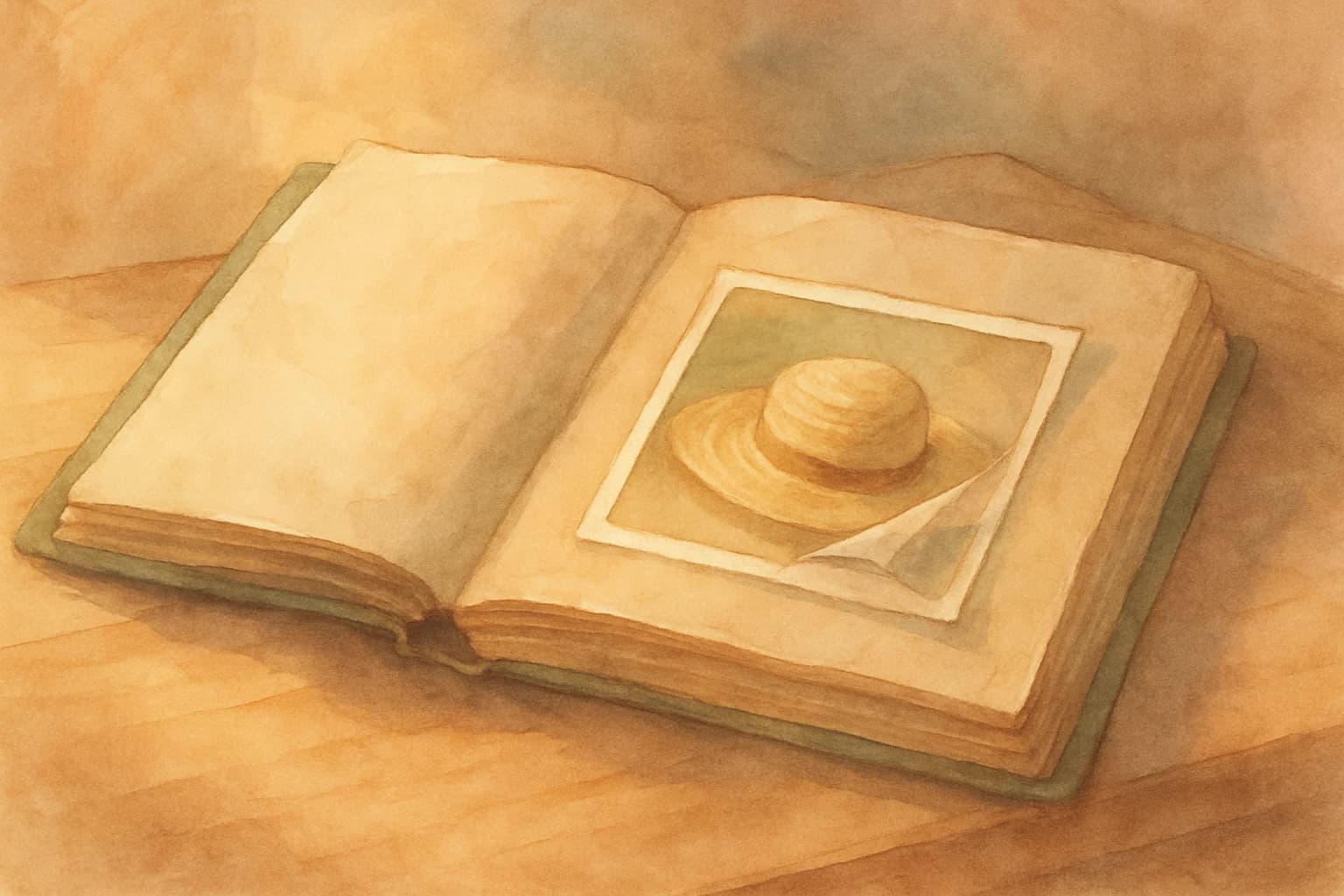
The Stiff Pages and Chemical Smell of the Family Album
There was a shelf in the living room with two rows of albums on it, and you were in them.
Not curated. Not filtered. In them the way you actually were: the bad haircut from 1977, the Christmas morning where you were mid-yawn, the family vacation where your father got sunburned on his shoulders and your mother wore the big straw hat she bought at a gas station in South Carolina. The photos were four inches by four inches and printed on paper that yellowed at the edges over time. Some of them were blurry. Some of them were duplicates because the drugstore included two prints and your mother wasn't sure which was better, so she kept both.
The album itself was heavy. Stiff cardboard pages with a sticky surface covered by a clear plastic sheet. The photos went on and stayed put, and then the pages turned stiff from the adhesive curing, and the album smelled like a specific thing -- old paper and something chemical underneath -- that you cannot describe but would recognize immediately.
That shelf held about fifteen years of your life, in approximate order, misfiled in places. That was where the record lived.
What the album was actually doing
It was a physical argument that the family existed, and had existed, and had been somewhere together.
You had documentation. Not documentation in the legal sense, but the informal kind -- the kind a family makes for itself, without fully knowing it's doing so. The album was the family's idea of what was worth remembering. Birthday parties, yes. But also Sunday afternoons that didn't mean anything at the time. The backyard. The dog who died in 1983. The car before the car you remember. The grandmother at an age you never got to see her in life.
The selection process was limited by cost, which turned out to be a reasonable filter. You took a roll of 24 exposures over the course of six weeks, then drove the canister to the drugstore, then waited three days for the prints. You paid for each print whether it came out or not. This meant you thought about what you were photographing, at least a little, and you couldn't take 400 photos of a Sunday lunch and sort through them later.
Twenty-four frames per roll. The discipline was built into the economics.
The ritual of the new roll coming back
The envelope came from the drugstore, sometimes with a coupon for the next roll attached. You opened it at the kitchen table. The whole family gathered, or whoever was home gathered, and you went through the prints one at a time.
Some were ruined. Too dark, or someone blinked, or a thumb came across the lens. Those got thrown away or dropped back in the envelope. The rest you spread out on the table and decided: album, or the drawer.
The drawer was the alternative to the album. A shoebox, often, or a kitchen drawer dedicated to loose prints. The drawer was where photos went when they didn't quite fit the album yet, or when you ran out of space on the page, or when the photo was too interesting to throw away but not quite official enough to laminate. The drawer was less organized than the album and more honest.
People still find these drawers, in the houses of parents who died, and spend days going through them.
The act of looking at the album together
You got the album down from the shelf for guests. Grandparents who hadn't seen the kids in a year. A cousin visiting from out of state. You sat on the couch together and turned pages and the conversation that happened over those pages was of a particular type -- corrective, contextual, slightly argumentative.
"That's not 1974, that's 1975, we hadn't bought the new car yet."
"She looks exactly like you did at that age."
"I don't remember that at all."
"You were there. You're in the next picture."
This was a specific kind of conversation that does not happen anywhere else. It was a conversation organized by physical sequence, by proximity on the page, by the logic of a particular roll of film used during a particular month. It had a shape that a phone's photo gallery does not quite produce, because the phone gallery is sorted by algorithm and adjusted by preference and never quite stops presenting you with more.
The album stopped. You reached the last filled page and the remaining pages were empty, and you closed it and put it back.
What was lost when it became a cloud folder
The organization, for one thing. A cloud folder is as disorganized as you are, and most people are quite disorganized. The 12,000 photos in the phone's camera roll are not sorted. They have not been selected. They include seventeen near-identical shots taken in sequence to catch the right expression, and nobody has gone through to delete the sixteen that weren't it.
Printing is the act that has been skipped, and printing was the act that created the physical object. Without printing, the photos stay in the device. The device gets replaced every two or three years. The transfer to the new device is imperfect. The photos from 2014, if you are honest with yourself, are in worse shape than the photos from 1974, because the 1974 prints are in an album on a shelf and you know exactly where they are.
The photo from 1974 doesn't need a charger. It doesn't need a subscription to a backup service. It doesn't become inaccessible when the platform decides to restructure its free storage tier.
The permanence of the print was accidental, in a way. Nobody was thinking about archival longevity when they dropped the roll off at the drugstore. But the print lasted, and the file is less certain to last, and most families haven't done anything about this.
The honest counterpoint
The family photo album preserved what the family wanted to preserve, and the family usually wanted to preserve the occasions. Birthdays, holidays, vacations. The ordinary days are underrepresented in most albums because most rolls of film were loaded for an occasion.
The camera phone has partly fixed this. The lunch that nobody photographed in 1975 because it wasn't a birthday gets photographed now. The ordinary Tuesday afternoon. The kid doing homework at the kitchen table. The dog sleeping in a sunbeam. These images exist now in a way they didn't exist before, and some of them are worth having.
The camera phone also fixed the hierarchy of who got photographed. The person taking the pictures was usually the mother, and the mother was not usually in the pictures. This was the structural flaw of the film era -- the family archivist was systematically excluded from the family archive. The front-facing camera solved this, imperfectly, but with real improvement.
And the sheer accessibility of the digital photo is real. You can pull out your phone and show someone a photo immediately, without getting the album down from the shelf. You can share photos with family across a distance in ways that once required making a copy at the drugstore and mailing it.
These are genuine improvements, and they should be named as such.
What you can still do
The gap is not between film and digital. The gap is between printed and not printed.
A photo on a phone is a photo nobody has looked at yet, most likely. A photo in a printed album is a photo somebody held in their hands and decided was worth keeping in a form that could be passed down. The decision to print is the decision that makes the photo real, in the sense that the album was real.
Services exist to do the printing and binding. They are cheap enough. The effort is approximately one afternoon per year, which is less effort than your mother spent making the album she made, and she made the album anyway.
The alternative is the 12,000 photos on the phone, unreviewed, taking up space in a cloud server somewhere, potentially lost when the phone is lost, certainly not sitting on any shelf that your grandchildren will find in forty years.
Do you still have your parents' photo albums? What's in them that you wouldn't have thought to photograph yourself? We want to hear your version in the comments.
Get a new story every Sunday morning.
One email a week. No spam. Unsubscribe anytime.