The Tin Can That Held the Bacon Grease and the Silent Logic Behind It
There was a can next to the stove that nobody talked about and everybody had.
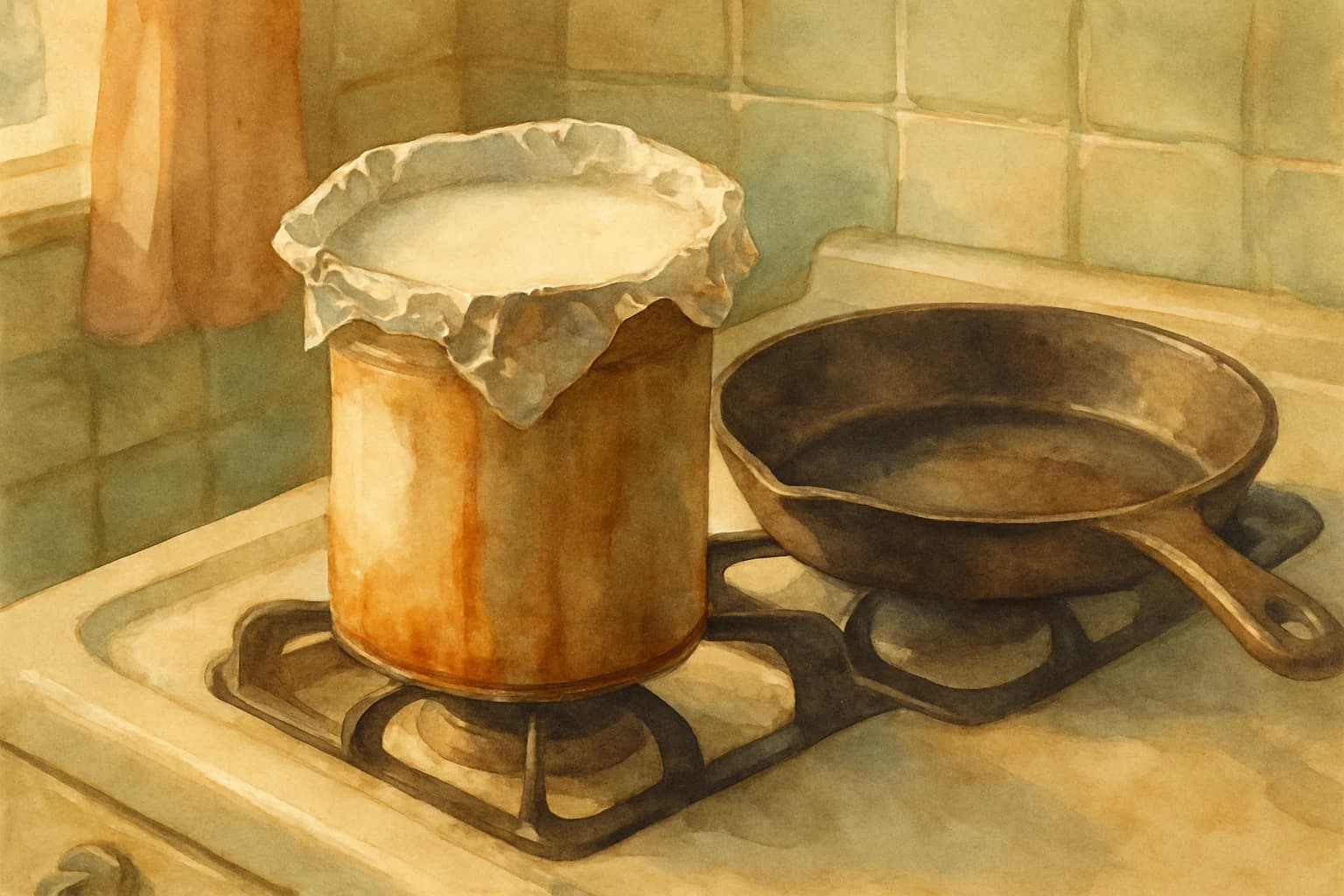
It was usually a coffee can, or sometimes a shortening can, or occasionally a recycled can from canned tomatoes with a new lid fashioned from a square of aluminum foil. It sat on the back corner of the counter, or directly on the stovetop edge where things got set without much thought, and it held bacon grease. That was its one job. Every time you cooked bacon, you poured the fat off the pan into the can while it was still hot and liquid, and the can sat there and the grease solidified back into white or off-white or faintly yellowish opacity, and the next time you needed to cook something, you spooned some out.
This was not a recipe. It was a system.
The logic behind the can
Nobody told most women of that generation to keep bacon grease. They kept it because their mothers had kept it, and their mothers had kept it because throwing away rendered fat was a form of waste that serious households did not commit. The Depression had formalized this into household doctrine. You rendered fat from what you cooked and you used it to cook more things. The cycle was efficient, and the efficiency had a name, and the name was not a philosophy but a practice that showed up in the food.
The grease did real work. It went into the pan before you fried eggs on a weekday morning. It went into the cast iron skillet before cornbread batter. It went into green beans with a spoonful of water and a lid and thirty minutes on the back burner, which is what made those green beans taste the way they tasted rather than the way green beans taste now. It went into the roux for gravy. It seasoned cast iron that had been seasoned the same way since the pan was new, building up a layer of polymerized fat that would outlast everyone in the household.
The can was a bank. You made deposits after bacon. You made withdrawals when cooking required fat, which was constantly. The account was always open.
What else the can meant
It meant the kitchen was being run. This is harder to articulate but easy to recognize in the houses of people who had it. A kitchen being run was a kitchen where the tools served multiple purposes, where nothing useful was thrown away, where the modest economies compounded. A can of bacon grease was evidence that somebody was paying attention at the level of detail that competent domestic management required.
It also meant the food tasted different. There is a particular flavor that comes from cooking in a fat that has been through the process of frying bacon -- the salt, the smoke, the slight sweetness -- and it spreads through whatever you cook next in a way that neutral vegetable oil does not do. Cast iron cornbread made in bacon fat has a crust. Fried eggs made in bacon grease have a laciness at the edge where the fat foams. These are real differences, not nostalgic ones. They come from the chemistry of the fat, and the chemistry does not care whether you remember your grandmother.
The can was also a kind of calendar. The color and opacity of the grease changed depending on how long it had been since the last batch of bacon, how hot the stove had been, how many other things had been fried in the pan. A practiced cook could look at the can and know something about the recent history of the kitchen.
Where it lived
The location of the can was not arbitrary. It lived near the stove because you poured into it with the pan still in your hand, and you did not want to walk across the kitchen with hot fat. It lived somewhere accessible but out of the way, which is why the back of the stove or the corner of the counter directly adjacent to the stove was the standard location.
Some kitchens had a dedicated grease container, a ceramic crock with a strainer lid that strained the browned bits out and kept only the clean fat. These were sold for exactly this purpose. Hardware stores stocked them. People received them as gifts. They were, compared to the repurposed coffee can, formal. The households that had the ceramic crock were the same households that also had a proper bread box and a labeled canister set. Both systems worked.
The coffee can was the more common solution because coffee cans were free, the lid fit well enough, and the volume was approximately right. You did not need to buy anything to have a grease can. You needed only to finish the coffee.
The honest counterpoint
The grease can reflected a dietary reality that we should not romanticize without being accurate about it. The people who cooked in bacon fat daily cooked in bacon fat daily. Saturated fat at this volume, in this frequency, across a lifetime of eating this way, contributed to outcomes that were visible by the time those same cooks were in their sixties and seventies. Heart disease ran through mid-century American households at rates that were not coincidental.
The shift to vegetable oils, the dietary guidance that began to emerge in the 1960s and 1970s, the declining use of rendered animal fats in everyday cooking -- these changes were not simply cultural drift. They were a response to mortality data that was real and particular. Families buried people at 58, at 63, at 67, and the food that was inseparable from love in those households was inseparable from arterial disease in those same households. That is not a comfortable sentence to sit with, but it is the accurate one.
Cooking occasionally in bacon grease is not a meaningful health risk. Cooking everything in bacon grease for sixty years, the way the grease can system was designed to support, was something different. The can is worth appreciating. It should not necessarily come back in its full, original form.
What replaced it, and what was lost
Vegetable oil replaced the grease can functionally, and vegetable oil is adequate at most things. It is not the same. It has no flavor of its own to contribute, which is what made it dietetically safer and what made it culinarily neutral. When you fry eggs in vegetable oil, you get fried eggs. When you fry eggs in bacon grease, you get eggs that have absorbed something from the fat. The difference is not dramatic but it is consistent and it accumulates across thousands of breakfasts.
What was also lost was the habit of thinking about cooking fat as a resource. The modern kitchen treats cooking oil as a consumable that you pour from a bottle and throw the remnants of away. The grease can kitchen treated cooking fat as something you kept and cycled back in. This is a plain shift in orientation toward the kitchen and the food, but plain shifts in orientation accumulate too.
Some cooks still do this. Bacon grease in a jar in the refrigerator is common enough that most people know someone who keeps it. The practice never entirely went away; it just stopped being universal. What was once the default is now a choice, and choices require a reason, and not every cook has been given a reason.
Using what you have
The grease can was one expression of a principle that ran through kitchens of that era: use what you have, fully, before you go looking for something else. The bread end slices went into stuffing. The vegetable cooking water went into soup. The fat from the bacon went back into the pan. Nothing left the kitchen before it had done its full work.
This was not frugality as a personal virtue. It was a reasonable relationship with food that recognized each ingredient as having more to give than one use.
If you cook bacon at all, the practice is worth considering. Pour the fat into a jar while it is still liquid. Keep the jar in the refrigerator, where it will stay stable for weeks. Use it by the spoonful where a neutral fat would do the job adequately but not especially well. Notice what it does to cornbread. Notice what it does to greens. These are not complicated instructions, and the equipment is whatever jar you have.
The can on the back of the stove is mostly gone. The cooking knowledge it stored is still available, if you want it.
Did your family keep a grease can? What did they cook in it? Let us know in the comments -- we read them all.
Get a new story every Sunday morning.
One email a week. No spam. Unsubscribe anytime.